
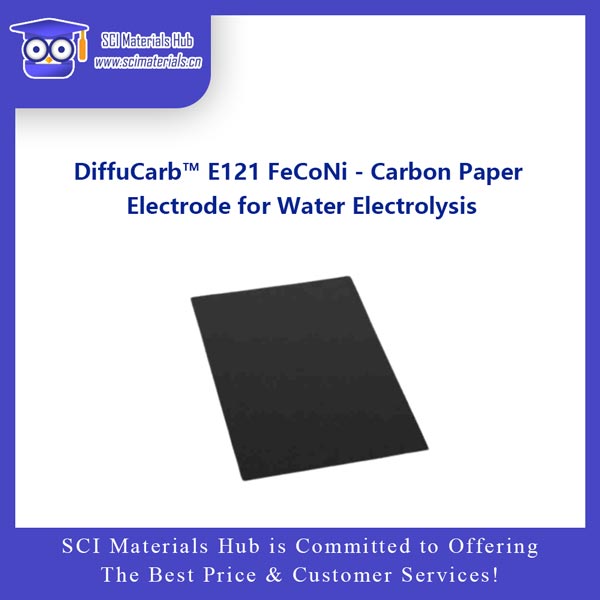
DiffuCarb™ E121 FeCoNi - Carbon Paper Electrode for Water Electrolysis
FeCoNi · AEM / ALK · A330R / A330T / A330P · Nafion / PTFE
DiffuCarb™ E121 FeCoNi-Carbon Paper (Electrolysis Water Electrode) is specifically designed for alkaline electrolysis water hydrogen production electrodes, offering a high cost-performance ratio. The carbon paper substrate is our standard A330R raw carbon paper, but it can also be customized based on user preferences, including options like Toray (030/060/090/120/050/1.1), AvCarb (MGL190/280/370), CP-H450/H850, platinum-coated carbon paper, titanium fiber paper, nickel fiber paper, and platinum-coated titanium fiber paper.
In both Anion Exchange Membrane (AEM) water electrolysis and Alkaline (ALK) water electrolysis systems, FeCoNi-carbon paper electrodes are an important choice due to their excellent electrocatalytic activity and stability. To optimize these electrodes' performance in different application environments, selecting the appropriate type of carbon paper and catalyst binder is crucial. Below is a detailed description of the use of A330R raw carbon paper, A330T hydrophobic carbon paper, A330P platinum-coated carbon paper, and different binder combinations (Nafion and PTFE) along with their advantages.
1. DiffuCarb™ E121 FeCoNi-Carbon Paper Electrode
A330R Raw Carbon Paper + Nafion Binder
High Ion Conductivity
Nafion is a proton exchange membrane material with high ion conductivity, which effectively promotes the transmission of OH⁻ ions. This characteristic helps increase the electrochemical reaction rate during water electrolysis, leading to higher current densities and more efficient water splitting reactions.
Catalyst Stability
When using A330R raw carbon paper, Nafion provides good catalyst adhesion, ensuring uniform distribution and long-term stability of the FeCoNi catalyst on the carbon paper. The use of Nafion helps maintain catalyst particle stability, preventing detachment or movement during electrolysis.
Applicable Temperature Range
Although Nafion may degrade at high temperatures, its stability and ion conductivity characteristics make it a reliable choice for electrolysis conditions at medium temperatures (below 80°C).
2. DiffuCarb™ E121T FeCoNi-Carbon Paper Electrode
A330T Hydrophobic Carbon Paper + PTFE Binder
Enhanced Durability and Stability
PTFE (polytetrafluoroethylene) has excellent chemical inertness and corrosion resistance, particularly under high pH and high potential alkaline electrolysis conditions. Using PTFE as a binder can effectively prevent the FeCoNi catalyst and carbon paper substrate from excessive oxidation, improving the electrode’s durability.
Suitable for High-Temperature Operation
PTFE has high thermal stability, withstanding temperatures up to 150°C, making it ideal for high-temperature water electrolysis operations. Using PTFE ensures that the electrode retains high electrochemical performance even under high-temperature conditions without degradation or failure.
Hydrophobic Properties for Gas and Water Management
The A330T hydrophobic carbon paper, combined with PTFE's hydrophobic properties, can effectively manage water and gas distribution, reducing water film formation and promoting the release of gases such as oxygen and hydrogen. This feature helps prevent electrode pores from being blocked by water, improving gas diffusion efficiency and overall electrolysis reaction efficiency.
3. DiffuCarb™ E121PT FeCoNi-Carbon Paper Electrode
A330P Platinum-Coated Carbon Paper + Nafion Binder
Enhanced Electron Conductivity
The A330P platinum-coated carbon paper, with its platinum layer, significantly improves the electrode's electron conductivity, reducing electrical resistance losses within the electrode. This is crucial for increasing electrolysis efficiency and reaction rates.
Catalyst Activity
The platinum layer not only improves electron conductivity but also provides additional catalytic activity centers, enhancing hydrogen and oxygen evolution efficiency during water electrolysis.
High Ion Conductivity of Nafion
Combining with Nafion binder further improves the electrode’s ion conductivity, ensuring effective OH⁻ ion transmission during electrolysis, which enhances reaction efficiency and overall performance. This configuration is ideal for medium-temperature applications and high-performance electrolysis reactions.
Carbon Paper & Binder Configuration Comparison
A330R + Nafion · A330T + PTFE · A330P + Nafion
A330R Raw Carbon Paper + Nafion Binder
Suitable for medium-temperature and conventional AEM or ALK water electrolysis systems, providing high ion conductivity and good catalyst stability.
A330T Hydrophobic Carbon Paper + PTFE Binder
Ideal for high-temperature, high-current density electrolysis applications. PTFE's high thermal stability and chemical inertness enhance electrode durability and corrosion resistance, making it particularly suited for industrial hydrogen production and wastewater treatment in harsh environments.
A330P Platinum-Coated Carbon Paper + Nafion Binder
Suitable for electrolysis systems requiring high conductivity and efficient ion transport. The combination of platinum-coated carbon paper and Nafion offers enhanced electrocatalytic performance and reaction efficiency, making it ideal for high-efficiency, fast-response electrolysis equipment.
Quick Model & Price Selection
Select electrode model, catalyst option, size and quantity to view the corresponding carbon paper, catalyst loading, unit price and total price.
Complete Model & Price Table
DiffuCarb™ E121 FeCoNi - Carbon Paper Electrode for Water Electrolysis
FeCoNi - Carbon Paper Electrode for Water Electrolysis
A330R raw carbon paper · 0.33 mm · Nafion binder
| Electrode Type | Carbon Paper & Thickness | Catalyst Loading | Catalyst | 5×5 cm² | 10×10 cm² | 15×15 cm² | 20×20 cm² |
|---|---|---|---|---|---|---|---|
| E121 0.2 mg/cm² 20% FeCoNi/XC72R - Carbon Paper Electrode | A330R,0.33mm | 0.2 mg/cm² FeCoNi | Accelerate® 20% FeCoNi on XC-72R | $66 | $220 | $404 | $660 |
| E121 0.3 mg/cm² 40% FeCoNi/XC72R - Carbon Paper Electrode | A330R,0.33mm | 0.3 mg/cm² FeCoNi | Accelerate® 40% FeCoNi on XC-72R | $70 | $224 | $424 | $680 |
| E121 0.5 mg/cm² 60% FeCoNi/XC72R - Carbon Paper Electrode | A330R,0.33mm | 0.5 mg/cm² FeCoNi | Accelerate® 60% FeCoNi on XC-72R | $76 | $236 | $444 | $700 |
| E121 1.0 mg/cm² FeCoNi - Carbon Paper Electrode | A330R,0.33mm | 1.0 mg/cm² FeCoNi | Accelerate® FeCoNi | $80 | $256 | $464 | $720 |
| E121 1.5 mg/cm² FeCoNi - Carbon Paper Electrode | A330R,0.33mm | 1.5 mg/cm² FeCoNi | Accelerate® FeCoNi | $88 | $304 | $560 | $880 |
| E121 2.0 mg/cm² FeCoNi - Carbon Paper Electrode | A330R,0.33mm | 2.0 mg/cm² FeCoNi | Accelerate® FeCoNi | $96 | $336 | $608 | $992 |
| E121 3.0 mg/cm² FeCoNi - Carbon Paper Electrode | A330R,0.33mm | 3.0 mg/cm² FeCoNi | Accelerate® FeCoNi | $104 | $368 | $672 | $1088 |
| E121 4.0 mg/cm² FeCoNi - Carbon Paper Electrode | A330R,0.33mm | 4.0 mg/cm² FeCoNi | Accelerate® FeCoNi | $112 | $400 | $768 | $1248 |
FeCoNi - Carbon Paper Electrode (Hydrophobic Interface) for Water Electrolysis
A330T hydrophobic carbon paper · 0.33 mm · PTFE binder
| Electrode Type | Carbon Paper & Thickness | Catalyst Loading | Catalyst | 5×5 cm² | 10×10 cm² | 15×15 cm² | 20×20 cm² |
|---|---|---|---|---|---|---|---|
| E121T 0.2 mg/cm² 20% FeCoNi/XC72R - PTFE Treated Carbon Paper Electrode | A330T,0.33mm | 0.2 mg/cm² FeCoNi | Accelerate® 20% FeCoNi on XC-72R | $66 | $220 | $404 | $660 |
| E121T 0.3 mg/cm² 40% FeCoNi/XC72R - PTFE Treated Carbon Paper Electrode | A330T,0.33mm | 0.3 mg/cm² FeCoNi | Accelerate® 40% FeCoNi on XC-72R | $70 | $224 | $424 | $680 |
| E121T 0.5 mg/cm² 60% FeCoNi/XC72R - PTFE Treated Carbon Paper Electrode | A330T,0.33mm | 0.5 mg/cm² FeCoNi | Accelerate® 60% FeCoNi on XC-72R | $76 | $236 | $444 | $700 |
| E121T 1.0 mg/cm² FeCoNi - PTFE Treated Carbon Paper Electrode | A330T,0.33mm | 1.0 mg/cm² FeCoNi | Accelerate® FeCoNi | $80 | $256 | $464 | $720 |
| E121T 1.5 mg/cm² FeCoNi - PTFE Treated Carbon Paper Electrode | A330T,0.33mm | 1.5 mg/cm² FeCoNi | Accelerate® FeCoNi | $88 | $304 | $560 | $880 |
| E121T 2.0 mg/cm² FeCoNi - PTFE Treated Carbon Paper Electrode | A330T,0.33mm | 2.0 mg/cm² FeCoNi | Accelerate® FeCoNi | $96 | $336 | $608 | $992 |
| E121T 3.0 mg/cm² FeCoNi - PTFE Treated Carbon Paper Electrode | A330T,0.33mm | 3.0 mg/cm² FeCoNi | Accelerate® FeCoNi | $104 | $368 | $672 | $1088 |
| E121T 4.0 mg/cm² FeCoNi - PTFE Treated Carbon Paper Electrode | A330T,0.33mm | 4.0 mg/cm² FeCoNi | Accelerate® FeCoNi | $112 | $400 | $768 | $1248 |
FeCoNi - Platinized Carbon Paper Electrode for Water Electrolysis
A330P platinum-coated carbon paper · 0.33 mm · Nafion binder
| Electrode Type | Carbon Paper & Thickness | Catalyst Loading | Catalyst | 5×5 cm² | 10×10 cm² | 15×15 cm² | 20×20 cm² |
|---|---|---|---|---|---|---|---|
| E121PT 0.2 mg/cm² 20% FeCoNi/XC72R - Platinized Carbon Paper Electrode | A330P,0.33mm | 0.2 mg/cm² FeCoNi | Accelerate® 20% FeCoNi on XC-72R | $86 | $300 | $584 | $980 |
| E121PT 0.3 mg/cm² 40% FeCoNi/XC72R - Platinized Carbon Paper Electrode | A330P,0.33mm | 0.3 mg/cm² FeCoNi | Accelerate® 40% FeCoNi on XC-72R | $90 | $304 | $604 | $1000 |
| E121PT 0.5 mg/cm² 60% FeCoNi/XC72R - Platinized Carbon Paper Electrode | A330P,0.33mm | 0.5 mg/cm² FeCoNi | Accelerate® 60% FeCoNi on XC-72R | $96 | $316 | $624 | $1020 |
| E121PT 1.0 mg/cm² FeCoNi - Platinized Carbon Paper Electrode | A330P,0.33mm | 1.0 mg/cm² FeCoNi | Accelerate® FeCoNi | $100 | $336 | $644 | $1040 |
| E121PT 1.5 mg/cm² FeCoNi - Platinized Carbon Paper Electrode | A330P,0.33mm | 1.5 mg/cm² FeCoNi | Accelerate® FeCoNi | $108 | $384 | $740 | $1200 |
| E121PT 2.0 mg/cm² FeCoNi - Platinized Carbon Paper Electrode | A330P,0.33mm | 2.0 mg/cm² FeCoNi | Accelerate® FeCoNi | $116 | $416 | $788 | $1312 |
| E121PT 3.0 mg/cm² FeCoNi - Platinized Carbon Paper Electrode | A330P,0.33mm | 3.0 mg/cm² FeCoNi | Accelerate® FeCoNi | $144 | $448 | $852 | $1408 |
| E121PT 4.0 mg/cm² FeCoNi - Platinized Carbon Paper Electrode | A330P,0.33mm | 4.0 mg/cm² FeCoNi | Accelerate® FeCoNi | $160 | $480 | $948 | $1568 |
For AEM applications, users can customize other types of binders, such as Fumion, PiperION, etc.
The thickness of the carbon paper substrate can be customized: 0.1-1.5 mm. Brand customization is available: Fueiceel®, Toray, AvCarb, etc.
The Following Information Can Be Customized
Catalyst loading · catalyst brand/model · ionomer/binder · carbon paper
International Orders & Shipping
For international orders, please ask us for quotes via
Clik here to put quick orders on our Alibaba / Amazon / ebay store.
Payments via Bank Transfer, Paypal, Credit card (via Taobao), Alipay, Wechat-pay are accepted.