

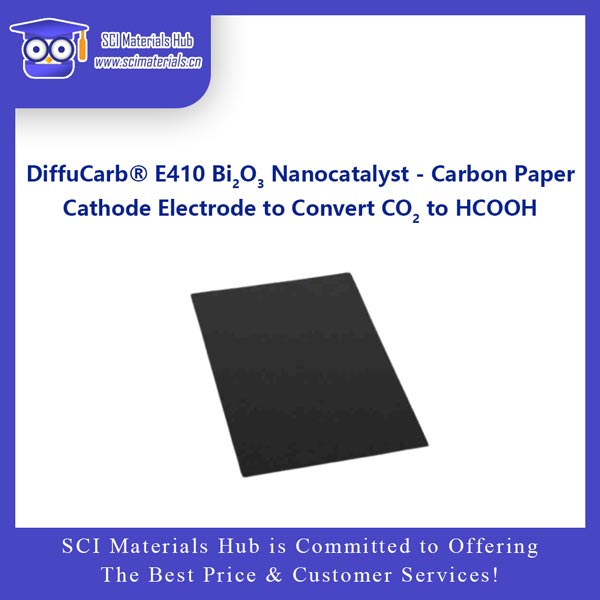
Product Overview
DiffuCarb™ E410 · Bi₂O₃ Nanocatalyst · Carbon Paper Cathode · CO₂ → HCOOH
Accelerate® Bi₂O₃ nanocatalyst is used for electrochemical reduction of CO₂ to formic acid (HCOOH). DiffuCarb™ E410 integrates nanoscale Bi₂O₃ particles with porous carbon paper to create a cathode platform for three-chamber solid-state formic-acid electrolyzers.
Nanoscale Bi₂O₃ provides a large specific surface area and abundant active sites for CO₂ adsorption and catalytic conversion, while the carbon paper supplies electronic conduction, porous mass-transfer pathways and mechanical support.
Bi₂O₃ Nanocatalyst
Provides a high-surface-area catalytic interface for CO₂ electroreduction.
CO₂RR Cathode
Designed for the cathode side of a three-chamber solid-state electrolyzer.
Porous Carbon Paper
Provides electrical conduction, gas diffusion and structural support.
Formic Acid Target
HCOOH is the target product stated in the supplied product information.
Structure & Key Features
Bi₂O₃ nanocatalyst layer + porous carbon paper substrate
Bi₂O₃ Electrocatalytic Activity
Bi₂O₃ is a wide-bandgap semiconductor. According to the supplied description, nanoscale particles provide increased surface area and more active sites, improving CO₂ adsorption and conversion while supporting selectivity toward formic acid.
Carbon Paper Conductivity & Gas Transport
Carbon paper provides electrical conductivity, mechanical stability and a porous structure that supports CO₂ diffusion and reactant delivery to the catalyst interface.
| Component | Material / Structure | Main Function |
|---|---|---|
| Catalyst Layer | Bi₂O₃ Nanocatalyst | Promotes cathodic CO₂ reduction toward formic acid |
| Substrate | Porous Carbon Paper | Electronic conduction, gas diffusion and mechanical support |
| Electrode Position | Cathode Side of Three-Chamber Solid-State Electrolyzer | Carries the CO₂RR cathodic reaction |
CO₂-to-Formic-Acid Reduction Process
CO₂ adsorption · electron/proton transfer · HCOOH formation
CO₂ Adsorption
CO₂ reaches and adsorbs on the Bi₂O₃ nanocatalyst interface.
Electron / Proton Transfer
The supplied material describes a process typically involving transfer of two electrons and two protons.
HCOOH Formation
CO₂ is reduced toward formic acid, while the three-chamber architecture helps separate and collect products.
Key Advantages
Selectivity · Faradaic-efficiency positioning · stability · sustainable carbon utilization
High Selectivity & Faradaic Efficiency
The supplied material states that Faradaic efficiency can typically reach above 80%, with formic acid as the target product.
Abundant Active Sites
Nanoscale Bi₂O₃ provides a large catalytic surface and improved catalyst utilization.
Sustainable Carbon Utilization
Converting CO₂ into value-added formic acid supports CCU and green-chemistry research.
Three-Chamber Architecture
The solid-electrolyte chamber helps separate products and reactants and supports downstream collection.
Experimental Validation & Operating Positioning
Long-term stability · high-purity product · continuous-operation research
Long-Term Stability
The supplied description states that the Bi₂O₃ nanocatalyst carbon-paper electrode maintains relatively stable catalytic performance and selectivity during continuous operation.
High-Purity Formic Acid Positioning
The three-chamber solid-state architecture helps separate products from reactants and supports downstream collection.
Continuous Electrolysis Research
Suitable for studies involving current density, reaction rate, product concentration and continuous-operation stability.
Application Potential
CO₂ utilization · green chemistry · energy conversion · scale-up research
CO₂ Resource Utilization
Supports research on converting industrial CO₂ into formic acid for carbon capture and utilization.
Green Chemistry & Energy Conversion
Can be integrated with renewable electricity for electrochemical formic-acid synthesis.
Scale-Up Potential
Suitable for process development from laboratory electrolyzers to larger-area electrodes and continuous systems.
Product Code / Description / Specification
Current pricing and stock status are available upon request
| Product Code | Product Description | 5×5 cm | 10×10 cm | 20×20 cm | Stock Status |
|---|---|---|---|---|---|
| E410 | DiffuCarb® E410 Bi₂O₃ Nanocatalyst - Carbon Paper Cathode Electrode to Convert CO₂ to HCOOH | Ask for quote | Ask for quote | Ask for quote | Ask for quote |
International Orders & Shipping
For quotations, bulk orders, custom configurations or international procurement, contact SCI Materials Hub.