
High-purity titanium cloth
Provides conductive, corrosion-resistant, and mechanically stable support.

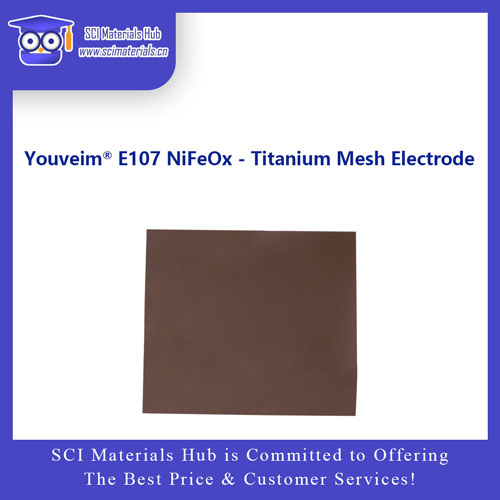
A configurable family of nickel–iron oxide electrocatalytic electrodes supported on high-purity titanium cloth. The E107 platform combines a corrosion-resistant porous metallic substrate, a uniformly spray-coated NiFeOx catalytic layer, and binder systems designed for different electrochemical interfaces, including Nafion, anion-conducting resin, PTFE, and gold-plated titanium cloth upgrade options.
Conductive weave · catalyst layer · tailored binder interface
The Youveim® E107 Series uses nickel–iron oxide as the active electrocatalytic material and high-purity titanium cloth as the porous conductive framework. Titanium cloth provides a stable metallic support with open channels for electrolyte transport, gas release, and electrical contact.
The NiFeOx layer is formed by a spray-coating process to create a uniform catalyst distribution across the woven substrate. This architecture is suitable for oxygen evolution reaction studies, water electrolysis research, fuel-cell-related electrochemical evaluation, and broader energy-conversion investigations.
The E107 family is organized around the electrochemical interface: E107N uses a Nafion system, E107A uses an anion-conducting resin system, E107T uses a PTFE hydrophobic interface, and E107G upgrades the substrate to gold-plated titanium cloth for high-reliability or corrosion-sensitive research.
This modular design helps researchers compare ionomer chemistry, wetting behavior, gas–liquid transport, catalyst-layer adhesion, and substrate conductivity within the same NiFeOx-centered product family.
Provides conductive, corrosion-resistant, and mechanically stable support.
Spray deposition supports consistent catalytic coverage across the woven substrate.
Nafion, anion-conducting resin, and PTFE target different ionic and wetting environments.
E107G strengthens conductivity and corrosion resistance for demanding test conditions.
Choose the model according to electrolyte chemistry, ion transport, wetting behavior, gas-release requirements, and substrate durability.
A standard high-performance configuration using Nafion as the binder system for stable catalyst-layer adhesion and broad electrochemical testing.
An alkaline-oriented interface developed to support anion transport and AEM-related electrochemical research.
A PTFE-containing configuration designed to improve gas–liquid transport and reduce persistent bubble coverage.
An upgraded configuration using gold-plated titanium cloth to enhance electrical conductivity and corrosion resistance.
The table presents the main differences in substrate, binder chemistry, interfacial behavior, applications, and selection logic.
| Model | Active Material | Substrate | Binder / Upgrade | Interface Character | Primary Application | Recommended When |
|---|---|---|---|---|---|---|
| E107N | NiFeOx | High-purity titanium cloth | Nafion | Chemically stable ionomer-assisted catalyst layer | General electrocatalytic testing, OER research, acidic or neutral comparative studies | A standard high-performance reference electrode is required |
| E107A | NiFeOx | High-purity titanium cloth | Anion-conducting resin | Alkaline-oriented anion-transport interface | Alkaline water electrolysis, AEM electrode research, hydroxide-transport studies | The experiment emphasizes alkaline ion transport or AEM compatibility |
| E107T | NiFeOx | High-purity titanium cloth | PTFE | Hydrophobic gas–liquid interface | Gas-release studies, high-current electrolysis, gas–liquid interface reactions | Bubble detachment, water management, or two-phase transport is important |
| E107G | NiFeOx | Gold-plated titanium cloth | Au-plated substrate | Enhanced conductivity and corrosion resistance | Special corrosive environments, long-duration testing, high-reliability electrochemical studies | Substrate reliability and contact stability are critical |
The E107 platform is designed around a NiFeOx catalyst layer, high-purity titanium cloth support, and spray-coated architecture.
E107 electrodes provide a modular way to evaluate catalyst activity, interface chemistry, wettability, conductivity, and gas-release behavior in electrochemical systems.
| Product Series | Youveim® E107 Series NiFeOx electrocatalytic electrode |
|---|---|
| Core Catalytic Material | NiFeOx nickel–iron oxide |
| Standard Substrate | High-purity titanium cloth |
| Upgrade Substrate | Gold-plated titanium cloth for E107G |
| Standard Process | Spray coating for catalytic-layer formation |
| Binder / Interface Options | Nafion, anion-conducting resin, PTFE, and Au-plated substrate upgrade |
| Primary Reaction Focus | Oxygen evolution reaction and related electrochemical oxidation studies |
| Application Direction | Water electrolysis, fuel-cell-related research, CO₂ electrolysis systems, industrial electrochemistry, and scientific testing |
| Customization Direction | Catalyst loading, electrode size, binder system, substrate treatment, and special interface requirements may be discussed |
The E107 platform integrates NiFeOx chemistry, titanium-cloth current collection, and tailored binder systems into a research-ready electrode structure.
Nickel–iron oxide provides active sites for oxygen evolution and related electrochemical reactions. The catalyst layer is designed to balance activity, electrical contact, and accessible surface area.
Titanium cloth offers corrosion resistance, electrical conductivity, mechanical strength, and a porous woven structure for electrolyte and gas transport.
The standard spray-coating process helps form an even catalyst layer on the titanium cloth and supports consistent electrode preparation.
Binder chemistry affects catalyst adhesion, ionic access, surface wetting, bubble detachment, gas–liquid management, and integration with membranes or flow-cell fixtures.
E107 electrodes are intended for advanced electrochemical studies where catalyst activity, interface chemistry, and current-collector performance must be evaluated together.
Use as a porous oxygen-evolution electrode for hydrogen-production research and electrolyzer component development.
Evaluate activity, overpotential, catalyst-layer stability, wetting behavior, and bubble release.
Support electrochemical oxidation and energy-conversion studies that require stable catalytic interfaces.
Use as an anodic component in paired electrolysis and conversion research where OER-side performance matters.
Compare binder systems, electrode architecture, substrate protection, and high-current electrochemical operation.
Choose a model to review its recommended use and the research variables it is designed to emphasize.
Select E107N when a stable Nafion-assisted catalyst layer is preferred for routine electrochemical testing, OER evaluation, and comparison against specialized alkaline, hydrophobic, or gold-plated configurations.
E107G is the upgraded member of the E107 family. By using gold-plated titanium cloth as the substrate, it further improves electrode conductivity and corrosion resistance while retaining the NiFeOx catalyst-layer concept.
This configuration is suitable for highly demanding experimental environments, long-duration electrochemical testing, special corrosive systems, and research programs where current-collector stability must be clearly separated from catalyst-layer behavior.
Protect the coated surface and document assembly conditions so that comparisons among samples and models remain meaningful.
Use clean, non-damaging tools and avoid rubbing or directly pressing the catalyst-coated region.
Identify the coated surface before installation and keep electrode orientation consistent during comparative tests.
Apply uniform cell compression and avoid excessive pressure that may deform the porous titanium cloth.
Document loading, active area, electrolyte, temperature, pretreatment, flow, reference system, and electrochemical protocol.
Explore international purchase options for Youveim® E107 Series NiFeOx-coated titanium mesh electrodes. Compare platform features, select a model, check reference USD pricing by catalyst loading and electrode size, and choose the ordering route that best fits your laboratory or engineering workflow.
Product availability may differ by country, model, loading, and size. Use the platform buttons below as purchase-entry placeholders and replace them with your official store, listing, or channel URLs before publishing the page.
Suitable for international buyers who prefer marketplace checkout, seller messaging, order tracking, and flexible product listing formats.
Visit eBayA familiar purchasing route for laboratories and individual researchers who value standardized checkout, account-based ordering, and delivery updates.
Visit AmazonDesigned for convenient cross-border ordering, product-option selection, seller communication, and international shipment management.
Visit AliExpressReview product demonstrations, electrode handling guidance, application examples, and inquiry links before selecting a purchasing platform.
Visit YouTubeThe best route depends on whether you prioritize direct checkout, account familiarity, cross-border ordering, seller communication, or technical product demonstrations.
| Platform | Channel Type | Best For | Ordering Method | Product Options | Buyer Communication | Recommended Action |
|---|---|---|---|---|---|---|
| eBay | Marketplace | Flexible international marketplace purchasing | Listing checkout or seller-assisted order | Standard models, sizes, and selected loadings | Seller messaging and order updates | Check the listing details before payment |
| Amazon | Marketplace | Familiar account-based laboratory purchasing | Standard product-page checkout | Common configurations and packaged sizes | Platform messaging and order support | Confirm model, loading, and delivery region |
| AliExpress | Cross-Border | International ordering with selectable variants | Product-option checkout or seller inquiry | Multiple size and loading combinations | Direct seller chat and order messages | Request confirmation for custom configurations |
| YouTube | Video & Inquiry | Product evaluation before purchase | Use video descriptions or channel contact links | Demonstrations, application guidance, and model introductions | Comments, channel links, or listed contact methods | Review technical content, then select a sales platform |
Use the interactive selector for a quick reference price, then review the complete table for all standard configurations. All displayed public prices are whole-dollar values.
| Model | NiFeOx Loading | 1 × 1 cm | 2 × 2 cm | 3 × 3 cm | 4 × 4 cm | 5 × 5 cm | 10 × 10 cm | 20 × 20 cm |
|---|---|---|---|---|---|---|---|---|
| E107N | 1.0 mg/cm² | $4 | $14 | $28 | $47 | $67 | $233 | $700 |
| 2.0 mg/cm² | $5 | $18 | $35 | $58 | $83 | $267 | $800 | |
| 3.0 mg/cm² | $7 | $25 | $50 | $75 | $100 | $300 | $900 | |
| 4.0 mg/cm² | $8 | $30 | $60 | $92 | $125 | $400 | $1,200 | |
| E107A | 1.0 mg/cm² | $5 | $15 | $31 | $51 | $73 | $257 | $770 |
| 2.0 mg/cm² | $6 | $19 | $39 | $64 | $92 | $293 | $880 | |
| 3.0 mg/cm² | $7 | $28 | $55 | $83 | $110 | $330 | $990 | |
| 4.0 mg/cm² | $9 | $33 | $66 | $101 | $138 | $440 | $1,320 | |
| E107T | 1.0 mg/cm² | $4 | $14 | $28 | $47 | $67 | $233 | $700 |
| 2.0 mg/cm² | $5 | $18 | $35 | $58 | $83 | $267 | $800 | |
| 3.0 mg/cm² | $7 | $25 | $50 | $75 | $100 | $300 | $900 | |
| 4.0 mg/cm² | $8 | $30 | $60 | $92 | $125 | $400 | $1,200 | |
| E107G | 1.0 mg/cm² | Request Quote | Request Quote | Request Quote | Request Quote | Request Quote | Request Quote | Request Quote |
| 2.0 mg/cm² | Request Quote | Request Quote | Request Quote | Request Quote | Request Quote | Request Quote | Request Quote | |
| 3.0 mg/cm² | Request Quote | Request Quote | Request Quote | Request Quote | Request Quote | Request Quote | Request Quote | |
| 4.0 mg/cm² | Request Quote | Request Quote | Request Quote | Request Quote | Request Quote | Request Quote | Request Quote |
The product codes represent different binder or interface systems. Confirm the final configuration with the seller when ordering, especially for custom dimensions, special loadings, or long-duration operation.
A general-purpose NiFeOx-coated titanium mesh electrode for electrochemical research and conventional laboratory evaluation.
Designed for stronger compatibility with alkaline and anion-exchange electrochemical systems.
A PTFE-oriented surface system intended to improve gas-liquid transport and manage gas release during electrochemical reactions.
An upgraded electrode intended for demanding environments where current-contact stability and corrosion resistance are priorities.
Prepare the technical details before contacting the seller to reduce confirmation time and avoid ordering an incorrect loading, size, or interface.
Choose E107N, E107A, E107T, or E107G based on the required binder, gas-management behavior, and durability target.
Specify the NiFeOx loading and geometric dimensions. Request a custom quotation when the required option is not listed.
Select the marketplace or information route that fits your region, purchasing account, communication needs, and checkout preference.
Confirm the model code, catalyst loading, dimensions, quantity, delivery address, shipping method, and expected lead time.
Standard products use research-grade titanium cloth or titanium mesh as the electrode substrate with NiFeOx as the functional catalytic material. Bulk orders, non-standard dimensions, special catalyst loadings, binder customization, precious-metal modification, and application-specific configurations require seller confirmation. Product images, delivery times, inventory, and final transaction prices may vary across international platforms.
Review the price table, confirm your model and dimensions, then use your preferred international channel to check availability or request a custom quotation.
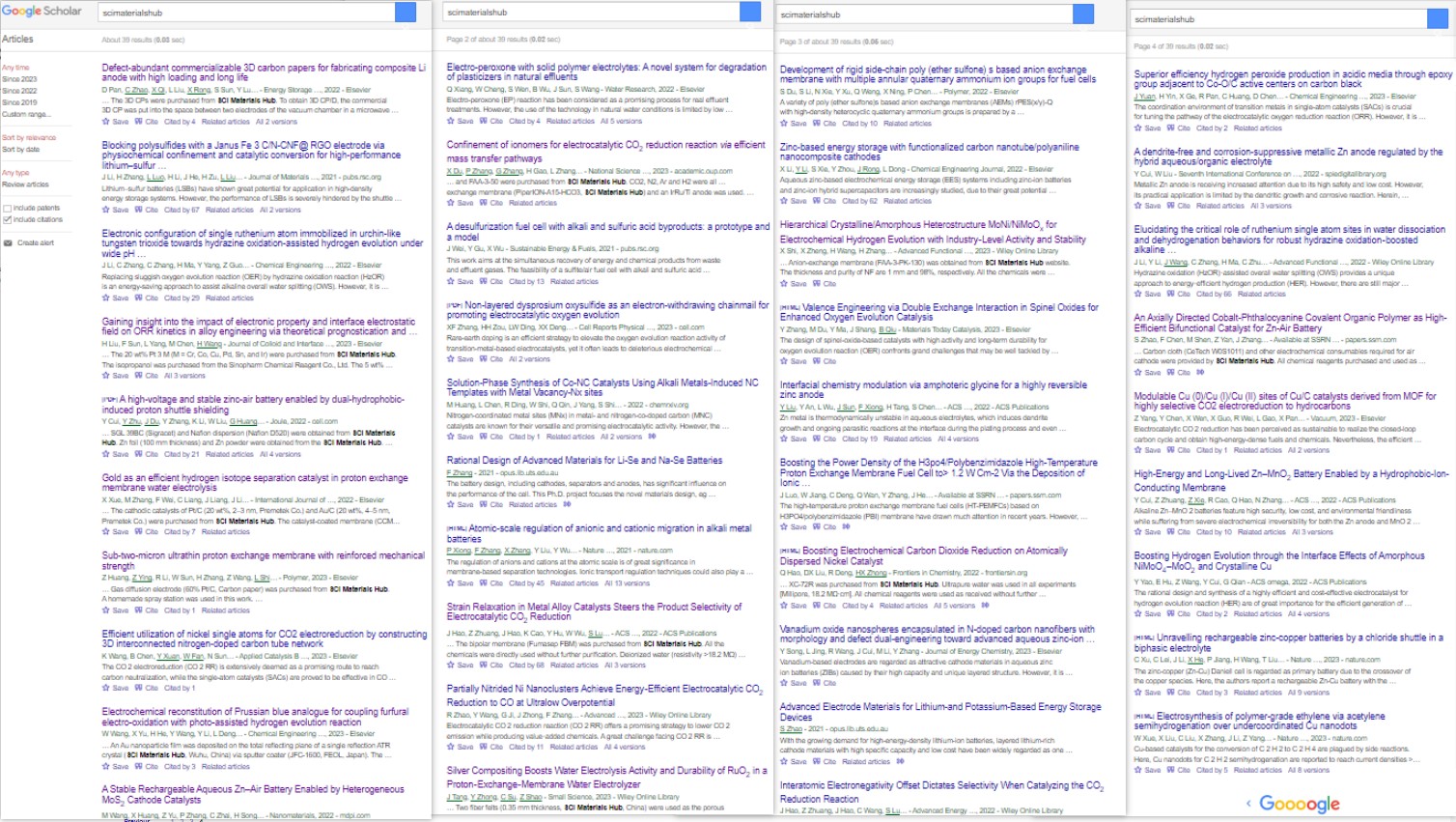
Partial references citing our materials (from Google Scholar)
Carbon Dioxide Reduction
1. ACS Nano Strain Relaxation in Metal Alloy Catalysts Steers the Product Selectivity of Electrocatalytic CO2 Reduction
The bipolar membrane (Fumasep FBM) in this paper was purchased from SCI Materials Hub, which was used in rechargeable Zn-CO2 battery tests. The authors reported a strain relaxation strategy to determine lattice strains in bimetal MNi alloys (M = Pd, Ag, and Au) and realized an outstanding CO2-to-CO Faradaic efficiency of 96.6% with outstanding activity and durability toward a Zn-CO2 battery.
2. Front. Chem. Boosting Electrochemical Carbon Dioxide Reduction on Atomically Dispersed Nickel Catalyst
In this paper, Vulcan XC-72R was purchased from SCI Materials Hub. Vulcan XC 72R carbon is the most common catalyst support used in the anode and cathode electrodes of Polymer Electrolyte Membrane Fuel Cells (PEMFC), Direct Methanol Fuel Cells (DMFC), Alkaline Fuel Cells (AFC), Microbial Fuel Cells (MFC), Phosphoric Acid Fuel Cells (PAFC), and many more!
3. Adv. Mater. Partially Nitrided Ni Nanoclusters Achieve Energy-Efficient Electrocatalytic CO2 Reduction to CO at Ultralow Overpotential
An AEM membrane (Sustainion X37-50 Grade RT, purchased from SCI Materials Hub) was activated in 1 M KOH for 24 h, washed with ultra-purity water prior to use.
4. Adv. Funct. Mater. Nanoconfined Molecular Catalysts in Integrated Gas Diffusion Electrodes for High-Current-Density CO2 Electroreduction
In this paper (Supporting Information), an anion exchanged membrane (Fumasep FAB-PK-130 obtained from SCI Materials Hub (www.scimaterials.cn)) was used to separate the catholyte and anolyte chambers.
SCI Materials Hub: we also recommend our Fumasep FAB-PK-75 for the use in a flow cell.
5. Appl. Catal. B Efficient utilization of nickel single atoms for CO2 electroreduction by constructing 3D interconnected nitrogen-doped carbon tube network
In this paper, the Nafion 117 membrane was obtained from SCI Materials Hub.
In this paper, Proton exchange membrane (Nafion 117), Nafion D520, and Toray 060 carbon paper were purchased from SCI Materials Hub.
7. National Science Review Confinement of ionomer for electrocatalytic CO2 reduction reaction via efficient mass transfer pathways
An anion exchange membrane (PiperION-A15-HCO3) was obtained from SCI Materials Hub.
8. Catalysis Communications Facilitating CO2 electroreduction to C2H4 through facile regulating {100} & {111} grain boundary of Cu2O
Carbon paper (TGPH060), membrane solution (Nafion D520), and ionic membrane (Nafion N117) were obtained from Wuhu Eryi Material Technology Co., Ltd (a company under SCI Materials Hub).
Batteries
1. J. Mater. Chem. A Blocking polysulfides with a Janus Fe3C/N-CNF@RGO electrode via physiochemical confinement and catalytic conversion for high-performance lithium–sulfur batteries
Graphene oxide (GO) in this paper was obtained from SCI Materials Hub. The authors introduced a Janus Fe3C/N-CNF@RGO electrode consisting of 1D Fe3C decorated N-doped carbon nanofibers (Fe3C/N-CNFs) side and 2D reduced graphene oxide (RGO) side as the free-standing carrier of Li2S6 catholyte to improve the overall electrochemical performance of Li-S batteries.
This paper used more than 10 kinds of materials from SCI Materials Hub and the authors gave detailed properity comparsion.
The commercial IEMs of Fumasep FAB-PK-130 and Nafion N117 were obtained from SCI Materials Hub.
Gas diffusion layers of GDL340 (CeTech) and SGL39BC (Sigracet) and Nafion dispersion (Nafion D520) were obtained from SCI Materials Hub.
Zn foil (100 mm thickness) and Zn powder were obtained from the SCI Materials Hub.
Commercial 20% Pt/C, 40% Pt/C and IrO2 catalysts were also obtained from SCI Materials Hub.
3. Journal of Energy Chemistry Vanadium oxide nanospheres encapsulated in N-doped carbon nanofibers with morphology and defect dual-engineering toward advanced aqueous zinc-ion batteries
In this paper, carbon cloth (W0S1011) was obtained from SCI Materials Hub. The flexible carbon cloth matrix guaranteed the stabilization of the electrode and improved the conductivity of the cathode.
4. Energy Storage Materials Defect-abundant commercializable 3D carbon papers for fabricating composite Li anode with high loading and long life
The 3D carbon paper (TGPH060 raw paper) were purchased from SCI Materials Hub.
5. Nanomaterials A Stable Rechargeable Aqueous Zn–Air Battery Enabled by Heterogeneous MoS2 Cathode Catalysts
Nafion D520 (5 wt%), and carbon paper (GDL340) were received from SCI-Materials-Hub.
Carbon cloth (W0S1011) and other electrochemical consumables required for air cathode were provided by SCI Materials Hub.
Oxygen Reduction Reaction
1. J. Chem. Eng. Superior Efficiency Hydrogen Peroxide Production in Acidic Media through Epoxy Group Adjacent to Co-O/C Active Centers on Carbon Black
In this paper, Vulcan XC 72 carbon black, ion membrane (Nafion N115, 127 μL), Nafion solution (D520, 5 wt%), and carbon paper (AvCarb GDS 2230 and Spectracarb 2050A-1050) were purchased from SCI Materials Hub.
2. Journal of Colloid and Interface Science Gaining insight into the impact of electronic property and interface electrostatic field on ORR kinetics in alloy engineering via theoretical prognostication and experimental validation
The 20 wt% Pt3M (M = Cr, Co, Cu, Pd, Sn, and Ir) were purchased from SCI Materials Hub. This work places emphasis on the kinetics of the ORR concerning Pt3M (M = Cr, Co, Cu, Pd, Sn, and Ir) catalysts, and integrates theoretical prognostication and experimental validation to illuminate the fundamental principles of alloy engineering.
Water Electrolysis
1. International Journal of Hydrogen Energy Gold as an efficient hydrogen isotope separation catalyst in proton exchange membrane water electrolysis
The cathodic catalysts of Pt/C (20 wt%, 2–3 nm) and Au/C (20 wt%, 4–5 nm) were purchased from SCI Materials Hub.
2. Small Science Silver Compositing Boosts Water Electrolysis Activity and Durability of RuO2 in a Proton-Exchange-Membrane Water Electrolyzer
Two fiber felts (0.35 mm thickness, SCI Materials Hub) were used as the porous transport layers at both the cathode and the anode.
3. Advanced Functional Materials Hierarchical Crystalline/Amorphous Heterostructure MoNi/NiMoOx for Electrochemical Hydrogen Evolution with Industry-Level Activity and Stability
Anion-exchange membrane (FAA-3-PK-130) was obtained from SCI Materials Hub website.
Fuel Cells
1. Polymer Sub-two-micron ultrathin proton exchange membrane with reinforced mechanical strength
Gas diffusion electrode (60% Pt/C, Carbon paper) was purchased from SCI Materials Hub.
Characterization
1. Chemical Engineering Journal Electrochemical reconstitution of Prussian blue analogue for coupling furfural electro-oxidation with photo-assisted hydrogen evolution reaction
An Au nanoparticle film was deposited on the total reflecting plane of a single reflection ATR crystal (SCI Materials Hub, Wuhu, China) via sputter coater.

|
We Provide A Broad Range of Materials, Instruments & Solutions in Advanced Science and Technologies | About Us |