
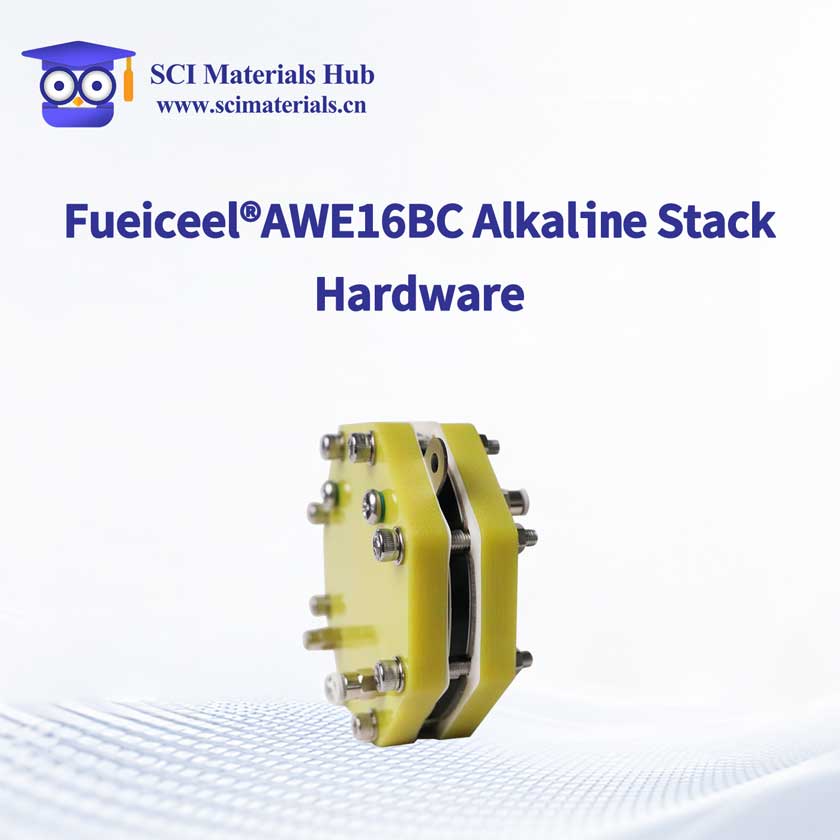

16 cm²/Cell Research-Grade Alkaline Water Electrolysis (AWE) Test Platform
Designed for the Development of Electrodes, Membranes, Catalysts, and Alkaline Water Electrolyzer Stacks
The Fueiceel® AWE16BC Series is a modular electrolyzer fixture platform specifically developed for alkaline water electrolysis (ALK/AWE) research and development. Featuring a standard 16 cm² active reaction area per Cell, it supports configurations ranging from a single-cell (1 Cell) to multi-cell stacks (20+ Cells). The platform is widely used for HER/OER catalyst evaluation, electrode development, membrane testing, electrolyzer structure optimization, stack development, and pilot-scale validation.
This product is positioned as a research electrolyzer fixture. It is supplied without membranes, electrodes, or catalyst materials, allowing users to freely configure different membrane, electrode, and catalyst systems according to specific experimental requirements. Compared with welded or permanently assembled electrolyzers, the AWE16BC is better suited for frequent assembly and disassembly, material replacement, and comparative studies, significantly improving R&D efficiency while reducing development costs.
A 30 wt% KOH (potassium hydroxide) solution is recommended as the circulating electrolyte. The fixture can be integrated with a circulation system, temperature control system, gas-liquid separation system, and DC power supply to form a complete ALK testing platform.
✓ Standard 16 cm² active reaction area for highly comparable experimental results
✓ Freely expandable from 1 Cell to 20+ Cells
✓ Seamless scale-up from single-cell to multi-cell stack configurations
✓ Modular structural design for repeated assembly and disassembly
✓ Compatible with various electrode, membrane, and catalyst systems
✓ Supports electrodes with different thicknesses
✓ High-precision flow field design with uniform electrolyte distribution
✓ Excellent gas-tight and liquid-tight sealing performance
✓ Customizable with various corrosion-resistant materials
✓ Suitable for laboratory research, bench-scale, and pilot-scale development
Under alkaline electrolyte conditions, the hydrogen evolution reaction (HER) occurs at the cathode, while the oxygen evolution reaction (OER) occurs at the anode.
Cathode (HER):
2H₂O + 2e⁻ → H₂ + 2OH⁻
Anode (OER):
4OH⁻ → O₂ + 2H₂O + 4e⁻
Overall Reaction:
2H₂O → 2H₂ + O₂
The membrane separates hydrogen and oxygen gases while allowing OH⁻ ions to migrate between the electrodes, maintaining charge balance within the cell.
| Item | Specification |
|---|---|
| Product Name | ALK Alkaline Water Electrolyzer Stack Fixture |
| Brand | Fueiceel® |
| Model | AWE16BC Series |
| Active Area per Cell | 16 cm² |
| Number of Cells | 1–20+ Cells |
| Recommended Electrolyte | 30 wt% KOH |
| Operating Temperature | 25–80°C |
| Operating Pressure | Atmospheric Pressure–0.5 MPa |
| Recommended Current Density | 50–1000 mA/cm² |
| Sealing Method | O-Ring Seal |
| Assembly Method | Bolt-Clamping Structure |
| Model | Number of Cells | Dimensions (Thickness × Width × Height, mm) |
|---|---|---|
| AWE16BC-1 | 1 Cell | 30 × 100 × 100 |
| AWE16BC-2 | 2 Cells | 38 × 100 × 100 |
| AWE16BC-3 | 3 Cells | 45 × 100 × 100 |
| AWE16BC-4 | 4 Cells | 52 × 100 × 100 |
| AWE16BC-5 | 5 Cells | 60 × 100 × 100 |
| AWE16BC-10 | 10 Cells | 98 × 100 × 100 |
| AWE16BC-15 | 15 Cells | 136 × 100 × 100 |
| AWE16BC-20 | 20 Cells | 174 × 100 × 100 |
Note: Dimensions are for reference only and can be customized according to the number of cells and specific configuration requirements.
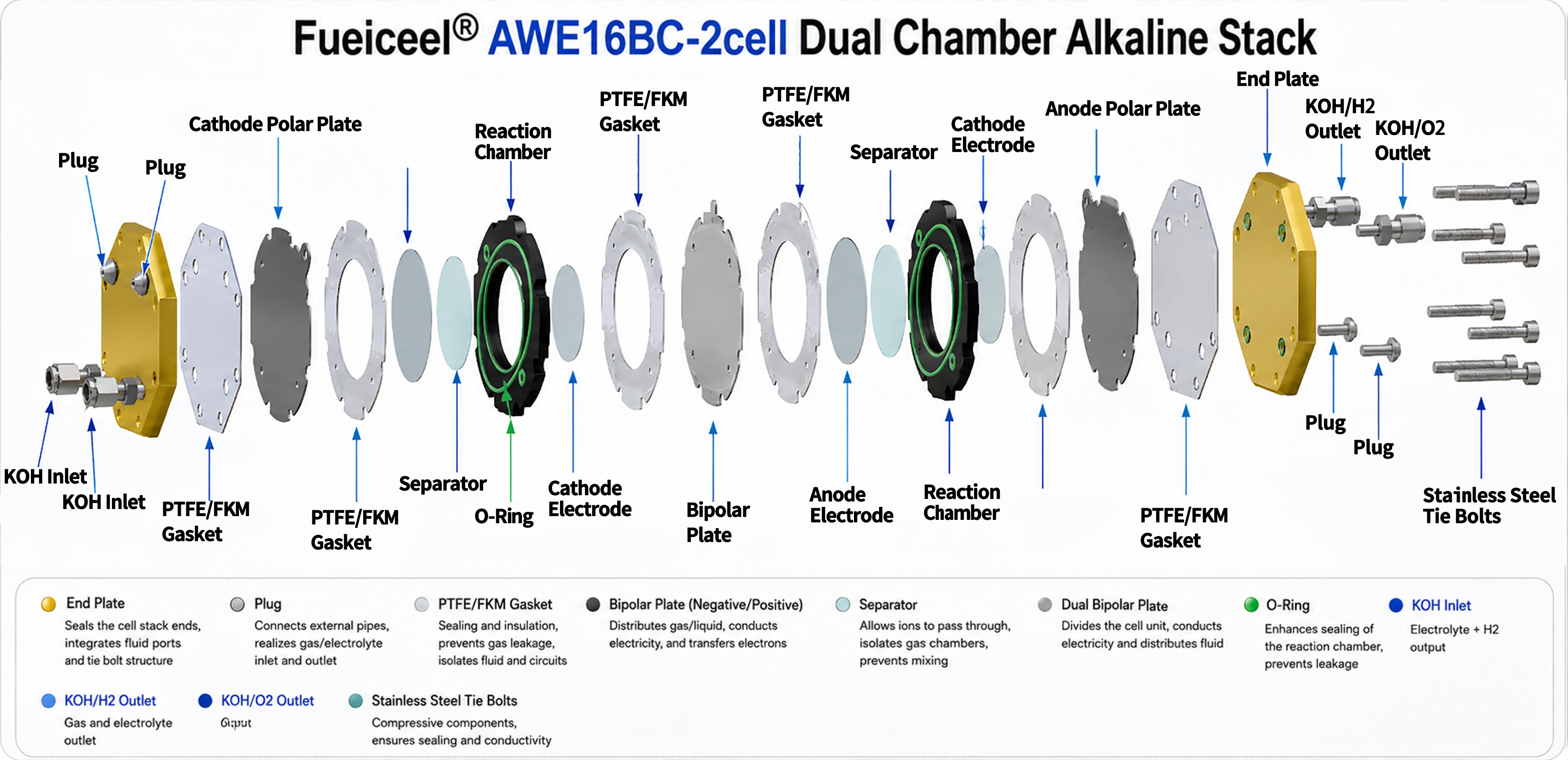
End Plates
Flow Field Plates
Reaction Chamber Components
O-Ring Sealing Components
Fitting Assembly
Fastening Bolt Assembly
Membrane
Cathode Electrode
Nickel Foam Backer Support Layer
Anode Electrode
Catalyst
KOH Electrolyte
Electrolyte Circulation System
Power Supply System
| Component | Function |
|---|---|
| End Plates | Provide mechanical support and clamping force |
| Flow Field Plates | Current collection and electrolyte distribution |
| Electrode (User-Supplied) | Active medium for HER/OER reactions |
| Nickel Foam Backer | Thickness compensation and mechanical support |
| Membrane (User-Supplied) | OH⁻ ion conduction and gas separation |
| O-Ring | Gas and liquid sealing |
| Fittings | Electrolyte inlet and outlet connections |
| Bolts | Provide uniform clamping force |
A fixed reaction chamber design is adopted to facilitate experimental standardization and reliable data comparison.
| Position | Chamber Depth |
|---|---|
| Cathode Reaction Chamber | 3.2 mm |
| Anode Reaction Chamber | 2.0 mm |
To ensure intimate contact between the electrodes and the membrane, the total electrode assembly thickness should match the corresponding reaction chamber depth.
Cathode Flow Field Plate → Nickel Foam Backer → Cathode Electrode → Membrane
Target Thickness: 3.2 mm
Membrane → Anode Electrode → Nickel Foam Backer → Anode Flow Field Plate
Target Thickness: 2.0 mm
Compensates for insufficient electrode thickness
Provides mechanical support
Improves current collection
Reduces contact resistance
Enhances clamping uniformity
When the electrode thickness is insufficient, one or more layers of nickel foam can be used as a backer to compensate for the thickness, ensuring full contact between the electrode and the membrane.
| Membrane Model | Features |
|---|---|
| DiffuLayer™ ALK Porous Membrane | Low resistance and high OH⁻ ion transport efficiency |
| DiffuLayer™ PPS Porous Membrane | Excellent alkali resistance and high-temperature stability |
| Zirfon® PPS Composite Membrane | Widely used in industrial ALK electrolyzers with low gas permeability |
Compatible with other ALK membranes of matching dimensions.
Nickel foam, nickel mesh, nickel felt, sintered nickel fiber felt, Raney Ni, NiMo, NiMoN, CoNi alloys, Pt-supported electrodes, and others.
Nickel foam, nickel mesh, nickel felt, NiFe-LDH, NiCo-LDH, NiFeOx, CoFeOx, IrO₂, RuO₂, and others.
316L corrosion-resistant stainless steel
904L corrosion-resistant stainless steel
Corrosion-resistant nickel
Gold-plated nickel
Hastelloy
Corrosion-resistant stainless steel
Corrosion-resistant nickel
Hastelloy
Customization is available for both laboratory research and industrial applications.
Verify that all flow field plates, electrodes, membrane, nickel foam backers, O-rings, and bolts are complete. Inspect the flow channels for blockage, ensure the membrane is free from damage, and confirm that the O-rings are in good condition.
Pretreat the membrane according to the manufacturer's recommendations, such as soaking in deionized water, KOH activation, or hot alkaline treatment. Keep the membrane hydrated before installation.
Cathode Flow Field Plate → Nickel Foam Backer → Cathode Electrode → Membrane
Membrane → Anode Electrode → Nickel Foam Backer → Anode Flow Field Plate
Install the O-rings, fittings, and end plates, ensuring that each O-ring is fully seated in its sealing groove.
Tighten the bolts gradually in a diagonal (cross) sequence:
First Pass: 30% of the target torque
Second Pass: 60% of the target torque
Final Pass: 100% of the target torque
Avoid fully tightening one side at a time.
Perform gas-tightness and liquid-tightness tests using deionized water before filling the system with the KOH electrolyte. Confirm that there are no leaks before operation.
KOH Reservoir → Circulation Pump → Electrolyzer Stack Fixture → Gas-Liquid Separator → KOH Reservoir
Prepare a 30 wt% KOH electrolyte solution.
Fill the system and remove trapped air.
Start the circulation pump.
Check the sealing performance of the system.
Connect the DC power supply.
Gradually increase the current density.
Collect H₂ and O₂ while recording the experimental data.
Suitable for catalyst screening, electrode evaluation, and reaction mechanism studies.
The multi-cell stack adopts a bipolar plate series configuration, in which each cell operates at the same current while the voltages are accumulated. This design effectively increases the overall hydrogen production rate and more closely simulates the operating conditions of industrial alkaline electrolyzers.
| Model | Total Active Reaction Area |
|---|---|
| AWE16BC-2 | 32 cm² |
| AWE16BC-5 | 80 cm² |
| AWE16BC-10 | 160 cm² |
| AWE16BC-20 | 320 cm² |
Suitable for stack development, flow field optimization, scale-up validation, and pilot-scale research.
Corrosion-resistant gear pump, corrosion-resistant peristaltic pump, KOH electrolyte reservoir, and in-line filtration system.
Constant-temperature water bath, heated circulation system, and PID intelligent temperature controller.
Hydrogen gas-liquid separator, oxygen gas-liquid separator, and gas flow meter.
Constant-current DC power supply, constant-voltage DC power supply, and electrolyzer stack testing power supply.
PTFE tubing, FEP tubing, PFA tubing, and PVDF corrosion-resistant fittings.
Alkaline Water Electrolysis (AWE) for Hydrogen Production
HER Catalyst Development and Evaluation
OER Catalyst Development and Evaluation
Nickel-Based Electrode Research
Membrane Performance Evaluation
Electrode Structure Optimization
Electrolyzer Design and Development
Electrolyzer Stack Scale-Up Validation
Pilot-Scale System Research
University Teaching and Laboratory Experiments
Q: Does the product include membranes and electrodes?
A: No. This product is supplied as a research electrolyzer fixture only, allowing users to freely select membranes, electrodes, and catalyst systems according to their specific research requirements.
Q: Why is a fixture-type structure adopted?
A: The fixture design enables repeated assembly and disassembly, making it easy to replace membranes, electrodes, and catalysts. It is particularly suitable for material screening, electrolyzer optimization, and research and development.
Q: Why is a nickel foam backer required?
A: The nickel foam backer compensates for insufficient electrode thickness, ensures intimate contact between the electrode and membrane, reduces contact resistance, and improves test repeatability.
Q: Which membrane is recommended?
A: For general laboratory research, the DiffuLayer™ ALK Porous Membrane is recommended. For long-term durability testing, the DiffuLayer™ PPS Porous Membrane is recommended. For industrial ALK simulation and stack development, the Zirfon® PPS Composite Membrane is recommended.
Q: What electrolyte is recommended?
A: A 30 wt% KOH solution is recommended, providing high ionic conductivity, excellent long-term stability, and representative industrial operating conditions.
Q: How should I choose between a single-cell and a multi-cell configuration?
A: A single-cell configuration is ideal for material screening and mechanism studies, while a multi-cell configuration is recommended for stack development, system integration, and scale-up validation.
Standard 16 cm²/Cell testing platform | Expandable from 1 to 20+ Cells | Compatible with a wide range of electrode and membrane systems | Designed for frequent assembly, disassembly, and material replacement | Ideal for HER/OER catalyst development, membrane research, electrolyzer optimization, and stack engineering validation.
The Fueiceel® AWE16BC Series is more than just an ALK alkaline water electrolyzer testing fixture. It is a comprehensive research platform supporting the entire development process—from material research and single-cell evaluation to electrolyzer stack scale-up and pilot-scale validation.
📧 Email: contact@scimaterials.cn
📞 WhatsApp & Tel: +86 153-7569-8751
🔗 Place quick orders on our eBay / Amazon / Alibaba stores.
🌐 We ship worldwide via DHL, FedEx, UPS, SF-Express, or other requested carriers.
📦 Bulk quantities with discount available upon request.
💳 Payment methods accepted: Bank Wire Transfer, PayPal, Credit Card (via Taobao), Alipay, WeChat Pay
Version: Standard Research Fixture (Electrodes, Membrane, KOH Electrolyte, and Power Supply System Not Included)
| Model | Number of Cells | Active Area | Reference Dimensions (mm) | Reference Price($) |
|---|---|---|---|---|
| AWE16BC-1 | 1 Cell | 16 cm² | 30 × 100 × 100 | 760 |
| AWE16BC-2 | 2 Cells | 32 cm² | 38 × 100 × 100 | 840 |
| AWE16BC-3 | 3 Cells | 48 cm² | 45 × 100 × 100 | 920 |
| AWE16BC-4 | 4 Cells | 64 cm² | 52 × 100 × 100 | 1,000 |
| AWE16BC-5 | 5 Cells | 80 cm² | 60 × 100 × 100 | 1,100 |
| AWE16BC-10 | 10 Cells | 160 cm² | 98 × 100 × 100 | 1,700 |
| AWE16BC-15 | 15 Cells | 240 cm² | 136 × 100 × 100 | 2,500 |
| AWE16BC-20 | 20 Cells | 320 cm² | 174 × 100 × 100 | 3,360 |
End Plates
Flow Field Plates
Reaction Chamber Components
O-Ring Sealing System
Bolt Fastening Assembly
Standard Inlet and Outlet Fittings
Membrane (Zirfon®, DiffuLayer™, etc.)
Cathode and Anode Electrodes
Catalyst Materials
Nickel Foam Backer
KOH Electrolyte
Circulation Pump and Electrolyte Reservoir System
Power Supply System
🧪 Upgrade from engineering plastic to 316L / 904L Stainless Steel, Nickel, or Hastelloy Flow Field Plates
🔩 Gold-Plated Conductive Surface Upgrade
🧩 Custom Flow Field Designs (Serpentine / Parallel / Pin-Type)
⚙️ Custom Cell Configurations (1–30+ Cells)
🧊 High-Pressure Version (>0.5 MPa)
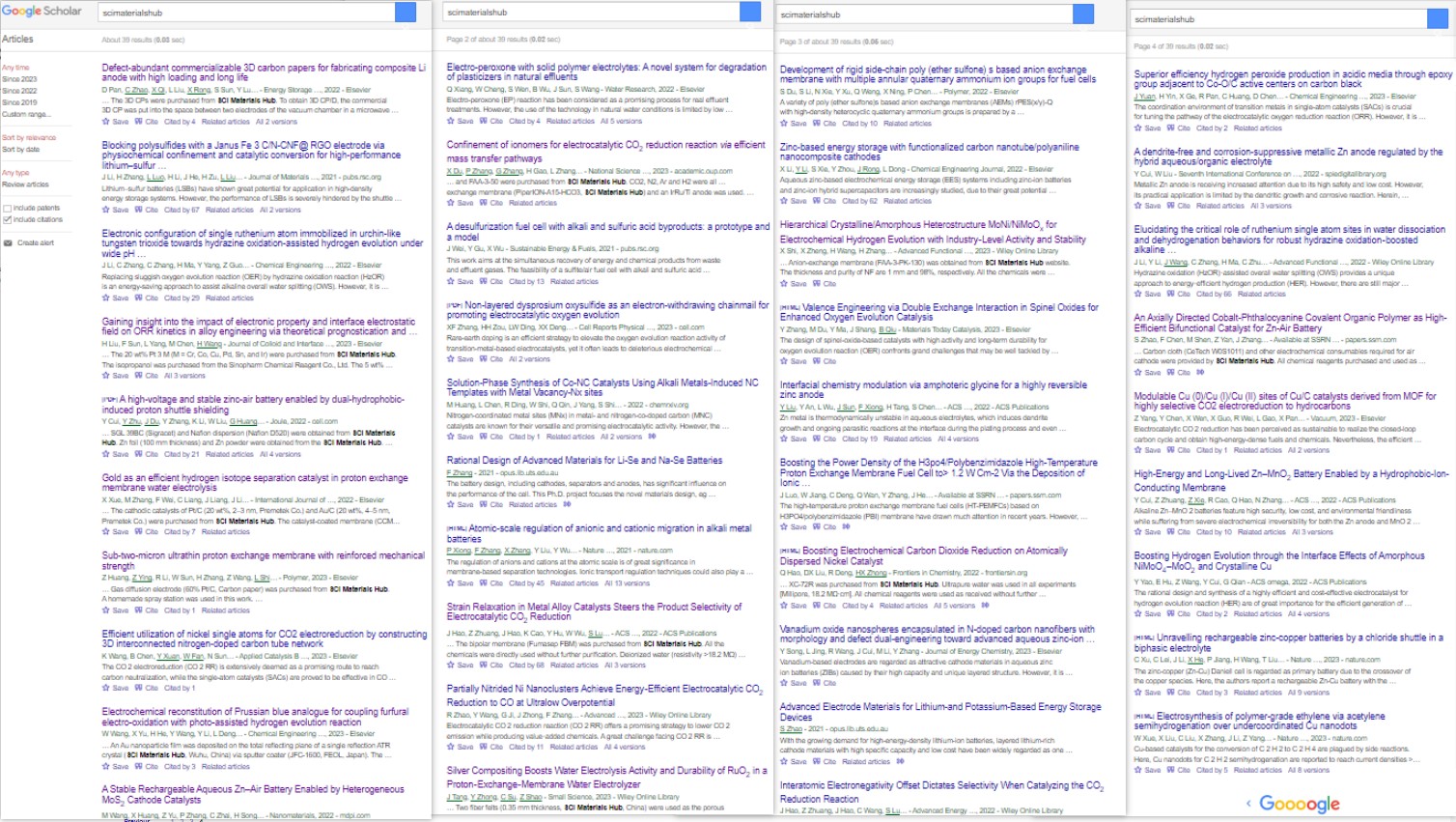
Partial references citing our materials (from Google Scholar)
Carbon Dioxide Reduction
1. ACS Nano Strain Relaxation in Metal Alloy Catalysts Steers the Product Selectivity of Electrocatalytic CO2 Reduction
The bipolar membrane (Fumasep FBM) in this paper was purchased from SCI Materials Hub, which was used in rechargeable Zn-CO2 battery tests. The authors reported a strain relaxation strategy to determine lattice strains in bimetal MNi alloys (M = Pd, Ag, and Au) and realized an outstanding CO2-to-CO Faradaic efficiency of 96.6% with outstanding activity and durability toward a Zn-CO2 battery.
2. Front. Chem. Boosting Electrochemical Carbon Dioxide Reduction on Atomically Dispersed Nickel Catalyst
In this paper, Vulcan XC-72R was purchased from SCI Materials Hub. Vulcan XC 72R carbon is the most common catalyst support used in the anode and cathode electrodes of Polymer Electrolyte Membrane Fuel Cells (PEMFC), Direct Methanol Fuel Cells (DMFC), Alkaline Fuel Cells (AFC), Microbial Fuel Cells (MFC), Phosphoric Acid Fuel Cells (PAFC), and many more!
3. Adv. Mater. Partially Nitrided Ni Nanoclusters Achieve Energy-Efficient Electrocatalytic CO2 Reduction to CO at Ultralow Overpotential
An AEM membrane (Sustainion X37-50 Grade RT, purchased from SCI Materials Hub) was activated in 1 M KOH for 24 h, washed with ultra-purity water prior to use.
4. Adv. Funct. Mater. Nanoconfined Molecular Catalysts in Integrated Gas Diffusion Electrodes for High-Current-Density CO2 Electroreduction
In this paper (Supporting Information), an anion exchanged membrane (Fumasep FAB-PK-130 obtained from SCI Materials Hub (www.scimaterials.cn)) was used to separate the catholyte and anolyte chambers.
SCI Materials Hub: we also recommend our Fumasep FAB-PK-75 for the use in a flow cell.
5. Appl. Catal. B Efficient utilization of nickel single atoms for CO2 electroreduction by constructing 3D interconnected nitrogen-doped carbon tube network
In this paper, the Nafion 117 membrane was obtained from SCI Materials Hub.
In this paper, Proton exchange membrane (Nafion 117), Nafion D520, and Toray 060 carbon paper were purchased from SCI Materials Hub.
7. National Science Review Confinement of ionomer for electrocatalytic CO2 reduction reaction via efficient mass transfer pathways
An anion exchange membrane (PiperION-A15-HCO3) was obtained from SCI Materials Hub.
8. Catalysis Communications Facilitating CO2 electroreduction to C2H4 through facile regulating {100} & {111} grain boundary of Cu2O
Carbon paper (TGPH060), membrane solution (Nafion D520), and ionic membrane (Nafion N117) were obtained from Wuhu Eryi Material Technology Co., Ltd (a company under SCI Materials Hub).
Batteries
1. J. Mater. Chem. A Blocking polysulfides with a Janus Fe3C/N-CNF@RGO electrode via physiochemical confinement and catalytic conversion for high-performance lithium–sulfur batteries
Graphene oxide (GO) in this paper was obtained from SCI Materials Hub. The authors introduced a Janus Fe3C/N-CNF@RGO electrode consisting of 1D Fe3C decorated N-doped carbon nanofibers (Fe3C/N-CNFs) side and 2D reduced graphene oxide (RGO) side as the free-standing carrier of Li2S6 catholyte to improve the overall electrochemical performance of Li-S batteries.
This paper used more than 10 kinds of materials from SCI Materials Hub and the authors gave detailed properity comparsion.
The commercial IEMs of Fumasep FAB-PK-130 and Nafion N117 were obtained from SCI Materials Hub.
Gas diffusion layers of GDL340 (CeTech) and SGL39BC (Sigracet) and Nafion dispersion (Nafion D520) were obtained from SCI Materials Hub.
Zn foil (100 mm thickness) and Zn powder were obtained from the SCI Materials Hub.
Commercial 20% Pt/C, 40% Pt/C and IrO2 catalysts were also obtained from SCI Materials Hub.
3. Journal of Energy Chemistry Vanadium oxide nanospheres encapsulated in N-doped carbon nanofibers with morphology and defect dual-engineering toward advanced aqueous zinc-ion batteries
In this paper, carbon cloth (W0S1011) was obtained from SCI Materials Hub. The flexible carbon cloth matrix guaranteed the stabilization of the electrode and improved the conductivity of the cathode.
4. Energy Storage Materials Defect-abundant commercializable 3D carbon papers for fabricating composite Li anode with high loading and long life
The 3D carbon paper (TGPH060 raw paper) were purchased from SCI Materials Hub.
5. Nanomaterials A Stable Rechargeable Aqueous Zn–Air Battery Enabled by Heterogeneous MoS2 Cathode Catalysts
Nafion D520 (5 wt%), and carbon paper (GDL340) were received from SCI-Materials-Hub.
Carbon cloth (W0S1011) and other electrochemical consumables required for air cathode were provided by SCI Materials Hub.
Oxygen Reduction Reaction
1. J. Chem. Eng. Superior Efficiency Hydrogen Peroxide Production in Acidic Media through Epoxy Group Adjacent to Co-O/C Active Centers on Carbon Black
In this paper, Vulcan XC 72 carbon black, ion membrane (Nafion N115, 127 μL), Nafion solution (D520, 5 wt%), and carbon paper (AvCarb GDS 2230 and Spectracarb 2050A-1050) were purchased from SCI Materials Hub.
2. Journal of Colloid and Interface Science Gaining insight into the impact of electronic property and interface electrostatic field on ORR kinetics in alloy engineering via theoretical prognostication and experimental validation
The 20 wt% Pt3M (M = Cr, Co, Cu, Pd, Sn, and Ir) were purchased from SCI Materials Hub. This work places emphasis on the kinetics of the ORR concerning Pt3M (M = Cr, Co, Cu, Pd, Sn, and Ir) catalysts, and integrates theoretical prognostication and experimental validation to illuminate the fundamental principles of alloy engineering.
Water Electrolysis
1. International Journal of Hydrogen Energy Gold as an efficient hydrogen isotope separation catalyst in proton exchange membrane water electrolysis
The cathodic catalysts of Pt/C (20 wt%, 2–3 nm) and Au/C (20 wt%, 4–5 nm) were purchased from SCI Materials Hub.
2. Small Science Silver Compositing Boosts Water Electrolysis Activity and Durability of RuO2 in a Proton-Exchange-Membrane Water Electrolyzer
Two fiber felts (0.35 mm thickness, SCI Materials Hub) were used as the porous transport layers at both the cathode and the anode.
3. Advanced Functional Materials Hierarchical Crystalline/Amorphous Heterostructure MoNi/NiMoOx for Electrochemical Hydrogen Evolution with Industry-Level Activity and Stability
Anion-exchange membrane (FAA-3-PK-130) was obtained from SCI Materials Hub website.
Fuel Cells
1. Polymer Sub-two-micron ultrathin proton exchange membrane with reinforced mechanical strength
Gas diffusion electrode (60% Pt/C, Carbon paper) was purchased from SCI Materials Hub.
Characterization
1. Chemical Engineering Journal Electrochemical reconstitution of Prussian blue analogue for coupling furfural electro-oxidation with photo-assisted hydrogen evolution reaction
An Au nanoparticle film was deposited on the total reflecting plane of a single reflection ATR crystal (SCI Materials Hub, Wuhu, China) via sputter coater.

|
We Provide A Broad Range of Materials, Instruments & Solutions in Advanced Science and Technologies | About Us |