
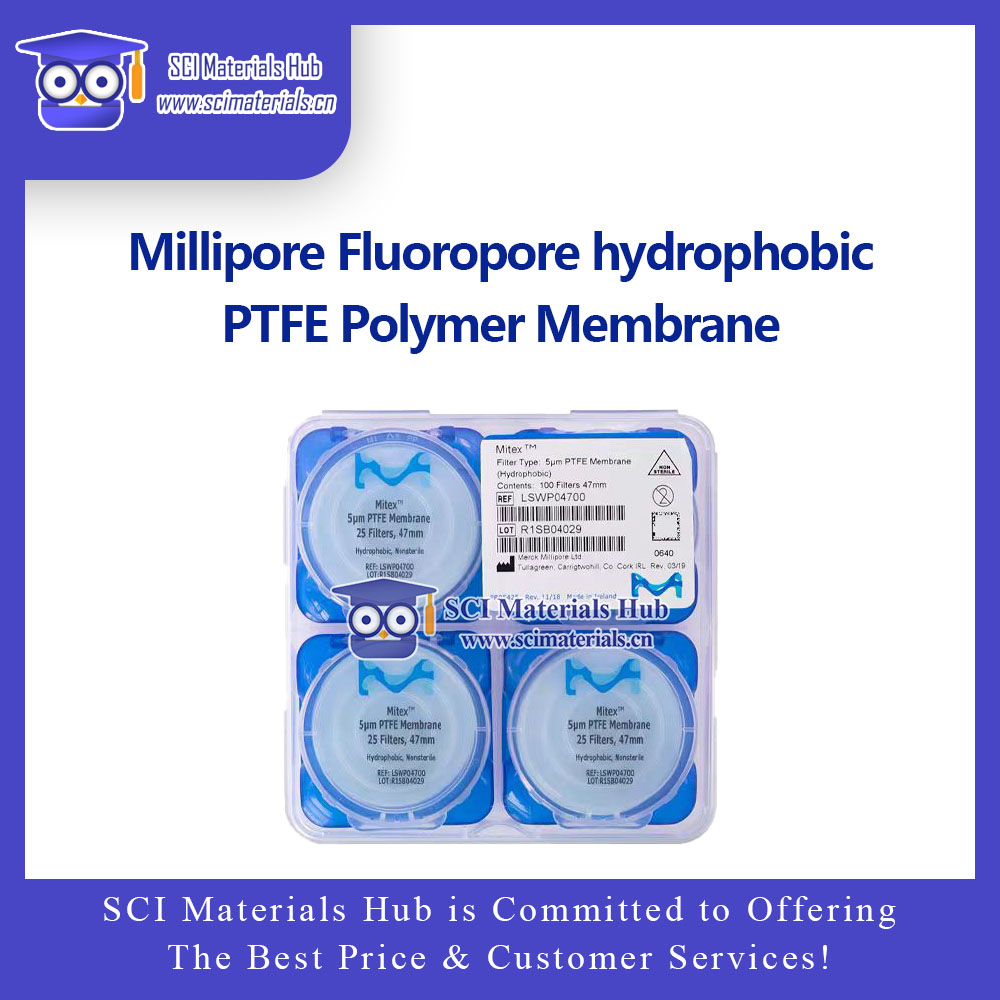
Millipore Omnipore™ and Fluoropore™ are both PTFE (polytetrafluoroethylene) microporous membrane series under Merck Millipore, designed for applications requiring high chemical compatibility. Omnipore™ is a hydrophilic PTFE membrane that can be used directly for aqueous solutions, acidic solutions, alkaline solutions, and a wide range of organic solvents. Fluoropore™ is a hydrophobic PTFE membrane, typically laminated with a polyethylene/polypropylene support layer, suitable for acid, alkali, and solvent clarification, air monitoring, gas filtration, and venting applications. The manufacturer specifically notes that Fluoropore™ catalog numbers containing "FHUP" are unsupported/non-laminated structures.
| Feature | Omnipore™ Hydrophilic PTFE Membrane | Fluoropore™ Hydrophobic PTFE Membrane |
|---|---|---|
| Material | Hydrophilic PTFE (polytetrafluoroethylene) | Hydrophobic PTFE (polytetrafluoroethylene), commonly with polyethylene/polypropylene support layer |
| Wettability | Hydrophilic, ready-to-use for aqueous samples | Hydrophobic, suitable for organic solvents, gas filtration, venting, and air monitoring |
| Chemical Compatibility | Compatible with nearly all solvents, acids, and alkaline solutions | Broad chemical compatibility, suitable for acids, bases, and solvent clarification |
| Porosity Advantage | High porosity provides high flow rates | High porosity provides high flow rates and consistent performance |
| Typical Applications | Aqueous solution filtration, acid/base solution clarification, HPLC/UPLC/LC-MS/MS mobile phase filtration, microplastic analysis | Acid/base/solvent clarification, air monitoring, gas filtration and venting, UV spectroscopy, particle monitoring, mobile phase filtration |
| Suitable Samples | Aqueous samples, acidic/alkaline samples, polar/non-polar solvent samples | Organic solvent samples, aggressive chemicals, gases or venting systems |
| Sterility | Commonly supplied non-sterile; verify by specific catalog number | Commonly supplied non-sterile; verify by specific catalog number |
The following parameters are compiled from Merck Millipore official product performance sheets. The Filter Code typically corresponds to the first four digits of the catalog number. Bubble point test conditions are based on methanol. Omnipore™ flow performance data are reference values for 47 mm discs at 20°C under 8.97" Hg vacuum, filtering 100 mL of water.
| Series | Membrane Property | Filter Code | Pore Size | Bubble Point | Thickness | Reference Flow Performance | Air Flow Rate | Max Operating Temp | Porosity | Typical Applications |
|---|---|---|---|---|---|---|---|---|---|---|
| Fluoropore™ | Hydrophobic PTFE | FGLP | 0.2 μm | 1.0 bar | 150 μm | 24 mL/min/cm² | 5 L/min/cm² | 130°C | 85% | Acid/base/solvent clarification, air monitoring, gas filtration, UV spectroscopy |
| Fluoropore™ | Hydrophobic PTFE | FHLP | 0.45 μm | 0.63 bar | 150 μm | 60 mL/min/cm² | 8 L/min/cm² | 130°C | 85% | Acid/base/solvent clarification, air monitoring, gas filtration, UV spectroscopy |
| Fluoropore™ | Hydrophobic PTFE | FALP | 1.0 μm | 0.5 bar | 150 μm | 110 mL/min/cm² | 16 L/min/cm² | 130°C | 85% | Coarse particle filtration, solvent pre-filtration, gas filtration |
| Fluoropore™ | Hydrophobic PTFE | FSLW | 3.0 μm | 1.0 bar | 150 μm | 286 mL/min/cm² | 20 L/min/cm² | 130°C | 85% | High-flow pre-filtration, particle monitoring, gas venting |
| Fluoropore™ | Hydrophobic PTFE, unsupported | FHUP | 0.45 μm | 0.63 bar | 50 μm | 75 mL/min/cm² | 9 L/min/cm² | 130°C | N/A | Specialized filtration requiring unsupported PTFE membrane |
| Omnipore™ | Hydrophilic PTFE | JVWP | 0.1 μm | 23.6 bar | 30 μm | 100 | — | Refer to specific catalog | Refer to specific catalog | Fine particle retention, acid/base solution clarification, aqueous filtration |
| Omnipore™ | Hydrophilic PTFE | JGWP | 0.2 μm | 13.6 bar | 65 μm | 50 | — | Typically 130°C | Typically 80% | Aqueous filtration, mobile phase filtration, microplastic analysis |
| Omnipore™ | Hydrophilic PTFE | JHWP | 0.45 μm | 7.9 bar | 65 μm | 15 | — | Refer to specific catalog | Refer to specific catalog | General clarification, acid/base solution filtration |
| Omnipore™ | Hydrophilic PTFE | JAWP | 1.0 μm | 3.6 bar | 85 μm | 5 | — | Refer to specific catalog | Refer to specific catalog | Coarse particle removal, sample pre-filtration |
| Omnipore™ | Hydrophilic PTFE | JMWP | 5.0 μm | 2.1 bar | 85 μm | 1.5 | — | Refer to specific catalog | Refer to specific catalog | Large particle removal, rapid pre-filtration |
| Omnipore™ | Hydrophilic PTFE | JCWP | 10.0 μm | 0.7 bar | 85 μm | 0.5 | — | Refer to specific catalog | Refer to specific catalog | Large particle sample clarification, pretreatment filtration |
Omnipore™ is better suited for applications that require direct filtration of aqueous systems, such as aqueous solution filtration, acidic solution clarification, alkaline solution clarification, HPLC/UPLC/LC-MS/MS mobile phase filtration, and microplastic analysis. Its hydrophilic PTFE material combines the chemical inertness of PTFE with compatibility for aqueous samples, making it ideal for filtration scenarios that demand high chemical compatibility without the need for additional pre-wetting steps.
Fluoropore™ is better suited for organic solvents, strong acids/bases, gas filtration, and air monitoring applications, including acid/base/solvent clarification, venting and exhaust gas filtration, UV spectroscopy sample preparation, particle monitoring, microplastic analysis, and HPLC/UPLC/LC-MS/MS mobile phase filtration. Because hydrophobic PTFE does not wet naturally with water, aqueous samples typically require pre-wetting according to protocol or the use of Omnipore™ hydrophilic PTFE instead.
| Application Scenario | Recommended Series | Recommended Pore Size | Selection Rationale |
|---|---|---|---|
| Direct aqueous solution filtration | Omnipore™ | 0.2 μm / 0.45 μm | Hydrophilic PTFE, suitable for aqueous samples, no complex pre-wetting required |
| Acid/base solution clarification | Omnipore™ or Fluoropore™ | 0.2 μm / 0.45 μm | Both offer good chemical inertness; Omnipore™ preferred for aqueous acid/base, Fluoropore™ for non-aqueous systems |
| Organic solvent filtration | Fluoropore™ | 0.2 μm / 0.45 μm | Hydrophobic PTFE offers good compatibility with most organic solvents |
| HPLC/UPLC/LC-MS/MS mobile phase filtration | Omnipore™ or Fluoropore™ | 0.2 μm / 0.45 μm | Select hydrophilic or hydrophobic PTFE based on mobile phase aqueous/organic ratio |
| Air monitoring / gas filtration | Fluoropore™ | 0.45 μm / 1.0 μm / 3.0 μm | Hydrophobic PTFE allows gas passage and venting protection |
| Coarse particle pre-filtration | Omnipore™ or Fluoropore™ | 1.0 μm / 3.0 μm / 5.0 μm / 10.0 μm | Larger pores provide higher flow rates, suitable for sample pretreatment |
| Fine particle retention | Omnipore™ | 0.1 μm / 0.2 μm | Smaller pores offer stronger retention, suitable for high-precision filtration |
In general, 0.1 μm, 0.2 μm, or 0.22 μm are commonly used for applications requiring higher retention, while 0.45 μm is commonly used for routine clarification. Membrane pore size affects both retention capability and flow rate — smaller pores provide stronger retention but typically result in slower filtration speeds.
Select the appropriate pore size based on sample type: 0.45 μm for routine clarification, or 0.2 μm/0.1 μm for high-precision particle removal.
Place the membrane flat into the filter holder, ensuring it is free from wrinkles, damage, and contamination.
Pre-wet the membrane with a small volume of the sample solution or a compatible solvent to eliminate air bubbles from the membrane surface.
Pour the sample into the filter funnel and begin filtration using vacuum filtration, positive pressure, or a filter holder setup.
After filtration, collect the filtrate or retain the membrane surface particles for subsequent analysis based on the experimental objective.
For organic solvent filtration, select the appropriate pore size Fluoropore™ membrane directly.
If aqueous samples must be filtered with hydrophobic PTFE, pre-wet the membrane with methanol, ethanol, or another compatible organic solvent first, then rinse with water or buffer. If pre-wetting is not desired, Omnipore™ is recommended instead.
For gas filtration or venting applications, confirm gas flow direction, pressure range, and seal integrity to avoid membrane damage from overpressure.
Before filtering aggressive solutions, verify the chemical compatibility of the entire system, including the membrane, support layer, gaskets, filter funnel, and connectors.
After use, dispose of the membrane according to sample hazard classification and laboratory safety regulations to avoid secondary contamination from residual solvents, acids/bases, or hazardous particles.
| Precautions | Description |
|---|---|
| Distinguish hydrophilic/hydrophobic | For aqueous samples, prioritize Omnipore™; for organic solvents and gas filtration, prioritize Fluoropore™ |
| Note FHUP special structure | Fluoropore™ catalog numbers containing "FHUP" are unsupported/non-laminated; their mechanical support differs from standard laminated versions |
| Avoid membrane surface damage | Use clean forceps to handle the membrane by the edges to prevent fingerprints, oil contamination, or creases from affecting performance |
| Control filtration pressure | Excessive pressure may cause membrane deformation, rupture, or increased particle breakthrough |
| Pre-filter high-particle samples | For turbid samples, use a larger pore size membrane or pre-filter to reduce clogging |
| Verify full-system compatibility | PTFE membranes have high chemical compatibility, but filter holders, gaskets, support layers, and connectors must also be compatible with the sample |
| Non-sterile ≠ sterile filtration ready | Most disc membranes are supplied non-sterile; if used for microbiological applications, confirm sterilization method and application requirements |
Q1: What is the main difference between Omnipore™ and Fluoropore™?
A: Omnipore™ is a hydrophilic PTFE membrane, suitable for aqueous solutions, acidic/alkaline solutions, and samples with higher aqueous content. Fluoropore™ is a hydrophobic PTFE membrane, suitable for organic solvents, gas filtration, venting, and air monitoring.
Q2: Should I choose Omnipore™ or Fluoropore™ for water samples?
A: Omnipore™ is the preferred choice. If Fluoropore™ is used for aqueous samples, pre-wetting with a compatible organic solvent is typically required; otherwise, water will not naturally pass through the hydrophobic PTFE membrane.
Q3: Which membrane should I choose for organic solvent filtration?
A: Fluoropore™ hydrophobic PTFE is generally recommended. If the sample contains a significant aqueous phase, Omnipore™ hydrophilic PTFE may also be considered depending on the system composition.
Q4: How do I choose between 0.2 μm and 0.45 μm?
A: 0.2 μm is better suited for high-retention requirements, fine particle removal, and instrumental analysis sample preparation. 0.45 μm is better for routine clarification, offering faster flow rates and lower clogging tendency.
Q5: Can Fluoropore™ be used for air monitoring?
A: Yes. Air monitoring, venting and exhaust gas filtration, and UV spectroscopy are among the applications listed by the manufacturer. The hydrophobic PTFE structure is suitable for gas passage and related particle collection applications.
Q6: Can Omnipore™ filter strong acids and bases?
A: Omnipore™ hydrophilic PTFE is described by the manufacturer as compatible with nearly all solvents, acids, and alkaline solutions. However, in practice, the entire filtration system — including holders, seals, and connectors — should also be verified for compatibility with the specific acid/base system.
Q7: What is the difference between FHUP and standard Fluoropore™?
A: FHUP is an unsupported/non-laminated structure with a thinner profile, suitable for specific experimental needs. Standard Fluoropore™ is typically laminated with a support layer, offering better mechanical handling performance for routine use.
Millipore Omnipore™ and Fluoropore™ are both high-chemical-compatibility PTFE membrane products. For filtering aqueous solutions, acid/base aqueous systems, mobile phases, and microplastic samples, prioritize Omnipore™ hydrophilic PTFE. For filtering organic solvents, aggressive solvents, gases, air samples, or venting protection applications, prioritize Fluoropore™ hydrophobic PTFE. When making a final selection, consider the sample matrix, pore size, flow rate requirements, need for a support layer, filtration pressure, membrane diameter, and overall filtration device compatibility.
📧 Email: contact@scimaterials.cn
📞 WhatsApp & Tel: +86 153-7569-8751
🔗 Place quick orders on our eBay / Amazon / Alibaba stores.
🌐 We ship worldwide via DHL, FedEx, UPS, SF-Express, or other requested carriers.
📦 Bulk quantities with discount available upon request.
💳 Payment methods accepted: Bank Wire Transfer, PayPal, Credit Card (via Taobao), Alipay, WeChat Pay
| Product Name | 0.22μm | 0.45μm (FHLP) | 0.45μm (FHUP) | 1.0μm | 3.0μm (FTHP) | 3.0μm (FSLW) | 5.0μm (FMLW) | 5.0μm (LSWP) | 10.0μm (LCWP) |
|---|---|---|---|---|---|---|---|---|---|
| Millipore Hydrophobic PTFE Membrane, Φ13mm, 100/pk | FGLP01300 $746 | FHLP01300 $746 | — | FALP01300 $746 | — | — | — | LSWP01300 $730 | LCWP01300 $730 |
| Millipore Hydrophobic PTFE Membrane, Φ15.5mm, 100/pk | — | — | — | FALP01550 $1,524 | — | — | — | — | — |
| Millipore Hydrophobic PTFE Membrane, Φ19mm, 100/pk | — | — | — | FALP01900 $1,201 | — | — | — | — | — |
| Millipore Hydrophobic PTFE Membrane, Φ25mm, 100/pk | FGLP02500 $944 | FHLP02500 $944 | — | FALP02500 $944 | — | FSLW02500 $944 | FMLW02500 $1,307 | LSWP02500 $909 | LCWP02500 $909 |
| Millipore Hydrophobic PTFE Membrane, Φ37mm, 100/pk | — | FHLP03700 $1,153 | — | FALP03700 $1,153 | — | FSLW03700 $1,153 | FMLW03700 $1,606 | — | — |
| Millipore Hydrophobic PTFE Membrane, Φ47mm, 100/pk | FGLP04700 $1,258 | FHLP04700 $1,258 | FHUP04700 $1,741 | FALP04700 $1,258 | — | FSLW04700 $1,258 | FMLW04700 $1,744 | LSWP04700 $1,299 | — |
| Millipore Hydrophobic PTFE Membrane, Φ47mm, 50/pk | — | — | — | — | FTHP04750 $504 | — | — | — | — |
| Millipore Hydrophobic PTFE Membrane, Φ90mm, 50/pk | FGLP09050 $2,001 | FHLP09050 $2,001 | — | FALP09050 $2,001 | — | — | — | — | — |
| Millipore Hydrophobic PTFE Membrane, Φ90mm, 25/pk | — | — | — | — | — | FSLW09025 $1,066 | — | LSWP09025 $1,120 | LCWP09025 $1,120 |
| Millipore Hydrophobic PTFE Membrane, Φ142mm, 50/pk | FGLP14250 $2,468 | FHLP14250 $2,468 | — | FALP14250 $2,468 | — | — | — | LSWP14250 $2,395 | LCWP14250 $2,395 |
| Millipore Hydrophobic PTFE Membrane, Φ142mm, 10/pk | — | — | — | — | — | FSLW14200 $540 | — | — | — |
Partial references citing our materials (from Google Scholar)
Carbon Dioxide Reduction
1. ACS Nano Strain Relaxation in Metal Alloy Catalysts Steers the Product Selectivity of Electrocatalytic CO2 Reduction
The bipolar membrane (Fumasep FBM) in this paper was purchased from SCI Materials Hub, which was used in rechargeable Zn-CO2 battery tests. The authors reported a strain relaxation strategy to determine lattice strains in bimetal MNi alloys (M = Pd, Ag, and Au) and realized an outstanding CO2-to-CO Faradaic efficiency of 96.6% with outstanding activity and durability toward a Zn-CO2 battery.
2. Front. Chem. Boosting Electrochemical Carbon Dioxide Reduction on Atomically Dispersed Nickel Catalyst
In this paper, Vulcan XC-72R was purchased from SCI Materials Hub. Vulcan XC 72R carbon is the most common catalyst support used in the anode and cathode electrodes of Polymer Electrolyte Membrane Fuel Cells (PEMFC), Direct Methanol Fuel Cells (DMFC), Alkaline Fuel Cells (AFC), Microbial Fuel Cells (MFC), Phosphoric Acid Fuel Cells (PAFC), and many more!
3. Adv. Mater. Partially Nitrided Ni Nanoclusters Achieve Energy-Efficient Electrocatalytic CO2 Reduction to CO at Ultralow Overpotential
An AEM membrane (Sustainion X37-50 Grade RT, purchased from SCI Materials Hub) was activated in 1 M KOH for 24 h, washed with ultra-purity water prior to use.
4. Adv. Funct. Mater. Nanoconfined Molecular Catalysts in Integrated Gas Diffusion Electrodes for High-Current-Density CO2 Electroreduction
In this paper (Supporting Information), an anion exchanged membrane (Fumasep FAB-PK-130 obtained from SCI Materials Hub (www.scimaterials.cn)) was used to separate the catholyte and anolyte chambers.
SCI Materials Hub: we also recommend our Fumasep FAB-PK-75 for the use in a flow cell.
5. Appl. Catal. B Efficient utilization of nickel single atoms for CO2 electroreduction by constructing 3D interconnected nitrogen-doped carbon tube network
In this paper, the Nafion 117 membrane was obtained from SCI Materials Hub.
In this paper, Proton exchange membrane (Nafion 117), Nafion D520, and Toray 060 carbon paper were purchased from SCI Materials Hub.
7. National Science Review Confinement of ionomer for electrocatalytic CO2 reduction reaction via efficient mass transfer pathways
An anion exchange membrane (PiperION-A15-HCO3) was obtained from SCI Materials Hub.
8. Catalysis Communications Facilitating CO2 electroreduction to C2H4 through facile regulating {100} & {111} grain boundary of Cu2O
Carbon paper (TGPH060), membrane solution (Nafion D520), and ionic membrane (Nafion N117) were obtained from Wuhu Eryi Material Technology Co., Ltd (a company under SCI Materials Hub).
Batteries
1. J. Mater. Chem. A Blocking polysulfides with a Janus Fe3C/N-CNF@RGO electrode via physiochemical confinement and catalytic conversion for high-performance lithium–sulfur batteries
Graphene oxide (GO) in this paper was obtained from SCI Materials Hub. The authors introduced a Janus Fe3C/N-CNF@RGO electrode consisting of 1D Fe3C decorated N-doped carbon nanofibers (Fe3C/N-CNFs) side and 2D reduced graphene oxide (RGO) side as the free-standing carrier of Li2S6 catholyte to improve the overall electrochemical performance of Li-S batteries.
This paper used more than 10 kinds of materials from SCI Materials Hub and the authors gave detailed properity comparsion.
The commercial IEMs of Fumasep FAB-PK-130 and Nafion N117 were obtained from SCI Materials Hub.
Gas diffusion layers of GDL340 (CeTech) and SGL39BC (Sigracet) and Nafion dispersion (Nafion D520) were obtained from SCI Materials Hub.
Zn foil (100 mm thickness) and Zn powder were obtained from the SCI Materials Hub.
Commercial 20% Pt/C, 40% Pt/C and IrO2 catalysts were also obtained from SCI Materials Hub.
3. Journal of Energy Chemistry Vanadium oxide nanospheres encapsulated in N-doped carbon nanofibers with morphology and defect dual-engineering toward advanced aqueous zinc-ion batteries
In this paper, carbon cloth (W0S1011) was obtained from SCI Materials Hub. The flexible carbon cloth matrix guaranteed the stabilization of the electrode and improved the conductivity of the cathode.
4. Energy Storage Materials Defect-abundant commercializable 3D carbon papers for fabricating composite Li anode with high loading and long life
The 3D carbon paper (TGPH060 raw paper) were purchased from SCI Materials Hub.
5. Nanomaterials A Stable Rechargeable Aqueous Zn–Air Battery Enabled by Heterogeneous MoS2 Cathode Catalysts
Nafion D520 (5 wt%), and carbon paper (GDL340) were received from SCI-Materials-Hub.
Carbon cloth (W0S1011) and other electrochemical consumables required for air cathode were provided by SCI Materials Hub.
Oxygen Reduction Reaction
1. J. Chem. Eng. Superior Efficiency Hydrogen Peroxide Production in Acidic Media through Epoxy Group Adjacent to Co-O/C Active Centers on Carbon Black
In this paper, Vulcan XC 72 carbon black, ion membrane (Nafion N115, 127 μL), Nafion solution (D520, 5 wt%), and carbon paper (AvCarb GDS 2230 and Spectracarb 2050A-1050) were purchased from SCI Materials Hub.
2. Journal of Colloid and Interface Science Gaining insight into the impact of electronic property and interface electrostatic field on ORR kinetics in alloy engineering via theoretical prognostication and experimental validation
The 20 wt% Pt3M (M = Cr, Co, Cu, Pd, Sn, and Ir) were purchased from SCI Materials Hub. This work places emphasis on the kinetics of the ORR concerning Pt3M (M = Cr, Co, Cu, Pd, Sn, and Ir) catalysts, and integrates theoretical prognostication and experimental validation to illuminate the fundamental principles of alloy engineering.
Water Electrolysis
1. International Journal of Hydrogen Energy Gold as an efficient hydrogen isotope separation catalyst in proton exchange membrane water electrolysis
The cathodic catalysts of Pt/C (20 wt%, 2–3 nm) and Au/C (20 wt%, 4–5 nm) were purchased from SCI Materials Hub.
2. Small Science Silver Compositing Boosts Water Electrolysis Activity and Durability of RuO2 in a Proton-Exchange-Membrane Water Electrolyzer
Two fiber felts (0.35 mm thickness, SCI Materials Hub) were used as the porous transport layers at both the cathode and the anode.
3. Advanced Functional Materials Hierarchical Crystalline/Amorphous Heterostructure MoNi/NiMoOx for Electrochemical Hydrogen Evolution with Industry-Level Activity and Stability
Anion-exchange membrane (FAA-3-PK-130) was obtained from SCI Materials Hub website.
Fuel Cells
1. Polymer Sub-two-micron ultrathin proton exchange membrane with reinforced mechanical strength
Gas diffusion electrode (60% Pt/C, Carbon paper) was purchased from SCI Materials Hub.
Characterization
1. Chemical Engineering Journal Electrochemical reconstitution of Prussian blue analogue for coupling furfural electro-oxidation with photo-assisted hydrogen evolution reaction
An Au nanoparticle film was deposited on the total reflecting plane of a single reflection ATR crystal (SCI Materials Hub, Wuhu, China) via sputter coater.

|
We Provide A Broad Range of Materials, Instruments & Solutions in Advanced Science and Technologies | About Us |