
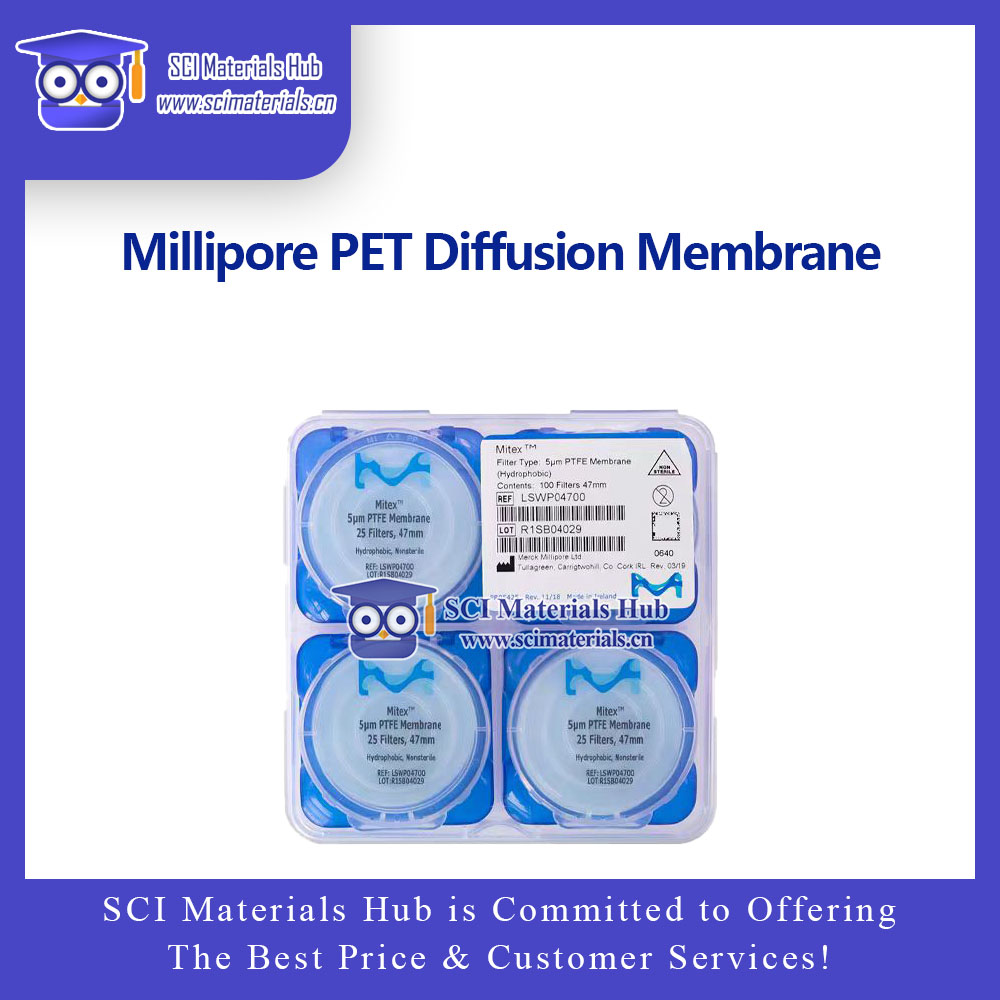
Millicell PET / PC diffusion membranes are microporous membrane materials suitable for diffusion, permeation, barrier evaluation, and isolation support experiments, available in custom circular or square cut sizes based on experimental requirements. This product series mainly includes PET diffusion membranes and PC diffusion membranes, both of which can serve as insulating membranes, diffusion membranes, permeation testing membranes, or support membranes for cell barrier experiments.
PET diffusion membranes are based on polyester membrane materials, with common models including PIHT and PSRP, covering pore sizes of 0.4μm, 1.0μm, 3.0μm, and 8.0μm. They are suitable for cell barrier diffusion cells, drug permeation experiments, fuel cell permeation testing, and isolation and diffusion studies in electrochemical systems. PC diffusion membranes are based on polycarbonate membrane materials, with common models including PSHT and PSST, covering pore sizes of 0.4μm, 3.0μm, 5.0μm, and 8.0μm. They are suitable for experimental scenarios requiring defined pore size consistency, particle permeability, and diffusion behavior.
The product supports circular sizes of 12mm and 25mm, as well as square sizes of 12×12mm, 24×24mm, and 48×48mm, and can also be custom cut according to customer fixtures, cell bodies, diffusion cells, Transwell-like structures, or custom-designed apparatus. The product is suitable for research experiments, fuel cells, electrolyte diffusion, cell barrier models, drug permeation evaluation, material permeability studies, and custom laboratory device development.
| Product Name | Material | Thickness | Model | Pore Size Options | Membrane Type | Available Shapes & Sizes | Customization Service | Typical Applications |
|---|---|---|---|---|---|---|---|---|
| Millicell PET Diffusion Membrane | PET Polyester | 10μm | PIHT/PSRP | 0.4/1.0/3.0/8.0μm | Insulating/Diffusion Membrane | Circular 12/25mm; Square 12×12/24×24/48×48mm | Custom cutting supported | Fuel cell permeation, cell barrier diffusion cells, drug diffusion, ion/molecule permeability testing |
| Millicell PC Diffusion Membrane | PC Polycarbonate | 10μm | PSHT/PSST | 0.4/3.0/5.0/8.0μm | Insulating/Diffusion Membrane | Circular 12/25mm; Square 12×12/24×24/48×48mm | Custom cutting supported | Fuel cell permeation, cell barrier diffusion cells, particle permeability studies, diffusion testing |
| Comparison Item | PET Diffusion Membrane | PC Diffusion Membrane |
|---|---|---|
| Material Characteristics | Polyester-based membrane, suitable for cell barrier, diffusion, and permeation experiments | Polycarbonate-based membrane, suitable for pore size control, particle permeability, and diffusion studies |
| Available Pore Sizes | 0.4/1.0/3.0/8.0μm | 0.4/3.0/5.0/8.0μm |
| Recommended Scenarios | Cell barrier diffusion cells, drug permeation, fuel cell permeation testing | Particle diffusion, molecular permeability, fuel cell permeation, cell diffusion models |
| Common Sizes | Circular 12/25mm; Square 12×12/24×24/48×48mm | Circular 12/25mm; Square 12×12/24×24/48×48mm |
| Customization Suitability | Suitable for discs, squares, and custom-shaped cutting | Suitable for discs, squares, and custom-shaped cutting |
| Selection Advice | Prioritize for cell culture, barrier models, and drug diffusion applications | Prioritize for particle permeability, pore size uniformity, and diffusion behavior studies |
PET diffusion membranes offer pore sizes of 0.4μm, 1.0μm, 3.0μm, and 8.0μm, while PC diffusion membranes offer 0.4μm, 3.0μm, 5.0μm, and 8.0μm. Smaller pore sizes are suitable for cell barriers, molecular diffusion, and fine permeability studies; larger pore sizes are suitable for particle migration, cell-related experiments, rapid diffusion, and high-throughput permeation testing.
Both PET and PC materials can serve as insulating membranes in experimental setups, suitable for certain fuel cell, electrochemical diffusion cell, ion migration test, and permeation test structures, enabling physical isolation between two chambers and construction of diffusion pathways.
The product supports common sizes including circular 12mm and 25mm, and square 12×12mm, 24×24mm, and 48×48mm. Custom cutting is also available based on customer fixtures, diffusion cells, electrolytic cells, fuel cell test fixtures, or custom-designed apparatus, reducing secondary processing errors and improving experimental assembly efficiency.
In fuel cell and electrochemical testing, these diffusion membranes can be used to isolate two chambers and construct defined diffusion interfaces, suitable for studying permeation behavior of water, alcohol-based fuels, electrolytes, ions, or small molecules through the membrane.
In cell barrier models, PET/PC diffusion membranes can serve as support interfaces for cell growth, attachment, or diffusion evaluation, used in drug permeation experiments, barrier integrity assessment, cell migration studies, and in vitro diffusion cell experiments.
Many experimental setups are not standard commercial sizes, such as custom diffusion cells, miniature fuel cell fixtures, H-type cells, Franz diffusion cells, microfluidic fixtures, or specialized electrochemical reaction cells. Custom cutting can be processed according to actual device dimensions, improving assembly fit and sealing stability.
Millicell PET/PC diffusion membranes can be used for fuel cell-related permeation testing, such as alcohol-based fuel permeation, electrolyte diffusion, ion migration, small molecule penetration, and membrane performance comparison studies. By fixing the membrane between two chambers, a stable diffusion interface can be established, facilitating observation of concentration changes, electrochemical signal variations, or permeation rate differences.
The product can be used in diffusion cell experiments for cell barrier models, such as drug transmembrane diffusion, cell monolayer barrier evaluation, nutrient permeation experiments, cell migration assays, and in vitro permeation model construction. Based on cell type and experimental objectives, different materials, pore sizes, and dimensions can be selected.
In drug development and formulation evaluation, PET/PC diffusion membranes can serve as barrier membrane materials for drug release or permeation experiments, simulating the diffusion process of drugs from donor to receptor compartments. They are suitable for sustained-release systems, gel systems, nanocarrier studies, and small molecule drug diffusion research.
In electrochemical and materials experiments, these membranes can be used for isolation between two electrolyte chambers, small molecule diffusion observation, ion migration trend analysis, and electrolyte permeability evaluation. Depending on the test system, PET or PC material and appropriate pore size can be selected.
PC diffusion membranes are suitable for particle permeability evaluation, particle migration, nanoparticle diffusion, and suspension system filtration/diffusion studies. Different pore sizes can be used to size-select or restrict migration of particles of different sizes.
For laboratory-constructed diffusion cells, fuel cell fixtures, electrochemical cells, micro-reaction cells, H-type diffusion cells, and custom test devices, discs, squares, or custom-shaped pieces can be cut to actual dimensions to improve experimental consistency.
| Pore Size | Recommended Applications | Selection Rationale |
|---|---|---|
| 0.4μm | Cell barriers, drug diffusion, small molecule permeability, particle restriction | Suitable for finer diffusion control and barrier model experiments |
| 1.0μm | PET cell-related experiments, molecular diffusion, faster permeability experiments | Suitable for PET diffusion applications requiring higher permeability rates |
| 3.0μm | Cell migration, particle permeability, medium-pore diffusion testing | Suitable for cell or particle migration-related experiments |
| 5.0μm | PC particle permeability, cell migration, larger particle diffusion | Suitable for larger particle or cell-related permeability experiments in PC membrane systems |
| 8.0μm | High-permeability diffusion, cell migration, larger particle penetration | Suitable for experiments requiring high permeability rates or larger target particle sizes |
| Size | Recommended Uses | Compatible Scenarios |
|---|---|---|
| Circular 12mm | Small diffusion cells, small-area fixtures, micro-reaction cells | Suitable for small sample volumes, low-cost screening experiments |
| Circular 25mm | Standard diffusion cells, filter fixtures, electrochemical cells | Suitable for medium-area diffusion and routine experiments |
| Square 12×12mm | Small square fixtures, micro-test windows | Suitable for small-area custom devices |
| Square 24×24mm | Medium-area diffusion cells, fuel cell fixtures | Suitable for routine custom cutting experiments |
| Square 48×48mm | Large-area diffusion testing, sheet-type fixtures, batch cutting | Suitable for larger-area permeation or diffusion studies |
Before use, clarify the experimental purpose, such as fuel cell permeation testing, cell barrier diffusion, drug release, particle migration, ion diffusion, or electrolyte isolation. Different objectives correspond to different material, pore size, and size selections.
If the experiment is oriented toward cell barriers, drug diffusion, and routine biological experiments, PET diffusion membranes may be prioritized; if the experiment is oriented toward particle permeability, pore size control, and diffusion behavior evaluation, PC diffusion membranes may be prioritized. Smaller pore sizes provide stronger barrier capability; larger pore sizes generally provide higher permeability rates.
Select cutting specifications based on the effective window dimensions of the diffusion cell, fixture, fuel cell test apparatus, or custom reaction cell. Standard options include circular 12mm and 25mm, or square 12×12mm, 24×24mm, and 48×48mm; custom sizes are available for special dimensions.
Use clean forceps to handle the membrane by the edges, avoiding direct contact with the effective diffusion area. Place the membrane flat into the fixture, diffusion cell, or support structure, ensuring it is free from wrinkles, curling, and damage, with edges properly sealed.
According to the experimental design, add corresponding media to both sides of the membrane, such as fuel, electrolyte, buffer, culture medium, drug solution, or nanoparticle suspension. Avoid generating excessive air bubbles when adding liquids, as bubbles can affect the effective diffusion area and experimental reproducibility.
After starting the experiment, collect samples at preset time points and measure concentration changes, conductivity changes, absorbance changes, electrochemical signal changes, fluorescence signal changes, or cell-related indicators. For cell experiments, maintain appropriate temperature, humidity, CO₂ conditions, and aseptic technique.
Calculate diffusion rate, permeability coefficient, flux, or retention efficiency based on concentration changes between donor and receptor compartments. Different pore sizes, materials, and thicknesses can affect experimental results; therefore, it is recommended to maintain consistent membrane material, pore size, and cutting area within the same experimental series.
After the experiment, dispose of the membrane according to sample properties. If the sample involves biological contamination, organic solvents, corrosive media, or electrochemical reaction solutions, follow laboratory safety regulations for disposal. These cut membranes are generally recommended for single use.
Keep the membrane surface flat during installation, avoiding wrinkles, scratches, and localized stretching.
Use clean forceps to handle the membrane by the edges; avoid direct contact with the effective diffusion area.
Poor sealing of the diffusion cell or fixture may cause bypass leakage, affecting permeation and diffusion results.
Before use, confirm compatibility of PET or PC material with the experimental media, solvents, electrolytes, or culture media.
For cell experiments, select the appropriate sterilization method and verify that the sterilization process does not affect membrane performance.
For fuel cell or electrochemical systems, avoid excessive mechanical compression that may cause membrane surface damage.
Custom cutting dimensions should match the actual effective window and seal dimensions to avoid leakage from undersized pieces or wrinkling from oversized pieces.
If the experiment requires precise control of diffusion area, record the effective exposed area rather than just the overall cut dimensions.
Diffusion rates vary significantly between different pore sizes; parallel control experiments are recommended.
These membranes are generally not recommended for reuse to avoid contamination, pore structure changes, or experimental variability.
Q1: What are Millicell PET/PC diffusion membranes primarily used for?
A: They are primarily used for fuel cell permeation testing, cell barrier diffusion cells, drug permeation experiments, ion diffusion, electrolyte isolation, particle permeability studies, and custom experimental device compatibility.
Q2: What is the difference between PET and PC diffusion membranes?
A: PET diffusion membranes are suitable for cell barriers, drug diffusion, and routine permeability experiments; PC diffusion membranes are better suited for particle permeability, pore size control, and diffusion behavior studies. The actual choice should be based on the experimental system, pore size requirements, and media compatibility.
Q3: Can custom cutting be provided?
A: Yes. Standard support includes circular 12mm and 25mm, and square 12×12mm, 24×24mm, and 48×48mm. Custom cutting is also available based on diffusion cells, fixtures, or custom device requirements.
Q4: How do I choose between 0.4μm, 3.0μm, 5.0μm, and 8.0μm?
A: 0.4μm is suitable for fine barriers and small molecule diffusion control; 3.0μm is suitable for cell migration and medium particle diffusion; 5.0μm is suitable for PC membrane particle permeability studies; 8.0μm is suitable for high permeability rates or larger particle migration experiments.
Q5: Can these be used for fuel cell permeation experiments?
A: Yes. These membranes can be used for permeation and diffusion studies of fuels, electrolytes, small molecules, or ions between two chambers, suitable for fuel cell material evaluation and permeation behavior comparison experiments.
Q6: Can these be used for cell barrier diffusion cells?
A: Yes. PET/PC membranes can serve as support membranes in cell barrier diffusion cells for drug permeation, cell migration, barrier integrity assessment, and cell monolayer diffusion experiments. Pore size should be selected based on cell type and experimental objectives.
Q7: How do I choose between circular and square shapes?
A: Circular shapes are suitable for circular filters, diffusion cells, fixtures, and electrochemical cells; square shapes are suitable for sheet-type fixtures, fuel cell test windows, square diffusion cells, and custom devices. Selection should be based on effective diffusion area and sealing structure.
Q8: What is the advantage of 10μm membrane thickness?
A: The 10μm thickness is relatively thin, helping to reduce diffusion path length and improve permeability efficiency, suitable for diffusion, permeation, and barrier model experiments. However, actual experimental results still depend on pore size, material, media system, and fixture structure.
Q9: Can the membranes be reused?
A: Reuse is generally not recommended, as it may lead to contamination, pore structure changes, membrane surface damage, and reduced experimental reproducibility. Single use is especially recommended for cell experiments and precision diffusion studies.
Q10: Why does leakage occur during use?
A: Common causes include undersized membrane dimensions, uneven seal compression, membrane wrinkling, insufficient fixture pressure, or damaged membrane edges. Reconfirm cutting dimensions, effective window, seal position, and assembly pressure.
Q11: Is sterilization required before cell experiments?
A: If used for cell culture or cell barrier experiments, appropriate sterile processing for the experimental system is typically required. Different membrane materials and pore sizes may have different tolerance to sterilization methods; small-scale validation is recommended.
Q12: Can these be used with organic solvent systems?
A: Suitability depends on the compatibility of PET or PC material with the specific solvent. Before using organic solvents, strong acids, strong bases, or specialty electrolytes, small-scale immersion and performance validation are recommended.
Millicell PET/PC diffusion membranes are microporous membrane materials suitable for diffusion, permeation, isolation, and barrier experiments, applicable to fuel cell permeation testing, cell barrier diffusion cells, drug permeation, electrolyte diffusion, particle migration, and custom experimental device compatibility. PET membranes are suitable for cell barrier and drug diffusion applications, while PC membranes are suitable for particle permeability and diffusion behavior studies. The product supports circular 12mm and 25mm, and square 12×12mm, 24×24mm, and 48×48mm sizes, with custom cutting available based on experimental apparatus requirements.
For fine diffusion control and barrier experiments, 0.4μm pore size is recommended; for cell migration or medium particle permeability, 3.0μm or 5.0μm is recommended; for high permeability rates or larger particle migration, 8.0μm is recommended. Proper selection of material, pore size, and cutting dimensions can improve experimental assembly stability, diffusion data reproducibility, and sample testing efficiency.
📧 Email: contact@scimaterials.cn
📞 WhatsApp & Tel: +86 153-7569-8751
🔗 Place quick orders on our eBay / Amazon / Alibaba stores.
🌐 We ship worldwide via DHL, FedEx, UPS, SF-Express, or other requested carriers.
📦 Bulk quantities with discount available upon request.
💳 Payment methods accepted: Bank Wire Transfer, PayPal, Credit Card (via Taobao), Alipay, WeChat Pay
Specifications: Pore Size 0.4μm – 8.0μm
| Model / Pore Size | Φ12mm | Φ25mm | 12×12mm | 24×24mm | 48×48mm |
|---|---|---|---|---|---|
| PIHT / 0.4μm | Inquiry | Inquiry | Inquiry | Inquiry | Inquiry |
| PIHT / 1.0μm | Inquiry | Inquiry | Inquiry | Inquiry | Inquiry |
| PIHT / 3.0μm | Inquiry | Inquiry | Inquiry | Inquiry | Inquiry |
| PIHT / 8.0μm | Inquiry | Inquiry | Inquiry | Inquiry | Inquiry |
| PSRP / 0.4μm | Inquiry | Inquiry | Inquiry | Inquiry | Inquiry |
| PSRP / 1.0μm | Inquiry | Inquiry | Inquiry | Inquiry | Inquiry |
| PSRP / 3.0μm | Inquiry | Inquiry | Inquiry | Inquiry | Inquiry |
| PSRP / 8.0μm | Inquiry | Inquiry | Inquiry | Inquiry | Inquiry |
Partial references citing our materials (from Google Scholar)

Carbon Dioxide Reduction
1. ACS Nano Strain Relaxation in Metal Alloy Catalysts Steers the Product Selectivity of Electrocatalytic CO2 Reduction
The bipolar membrane (Fumasep FBM) in this paper was purchased from SCI Materials Hub, which was used in rechargeable Zn-CO2 battery tests. The authors reported a strain relaxation strategy to determine lattice strains in bimetal MNi alloys (M = Pd, Ag, and Au) and realized an outstanding CO2-to-CO Faradaic efficiency of 96.6% with outstanding activity and durability toward a Zn-CO2 battery.
2. Front. Chem. Boosting Electrochemical Carbon Dioxide Reduction on Atomically Dispersed Nickel Catalyst
In this paper, Vulcan XC-72R was purchased from SCI Materials Hub. Vulcan XC 72R carbon is the most common catalyst support used in the anode and cathode electrodes of Polymer Electrolyte Membrane Fuel Cells (PEMFC), Direct Methanol Fuel Cells (DMFC), Alkaline Fuel Cells (AFC), Microbial Fuel Cells (MFC), Phosphoric Acid Fuel Cells (PAFC), and many more!
3. Adv. Mater. Partially Nitrided Ni Nanoclusters Achieve Energy-Efficient Electrocatalytic CO2 Reduction to CO at Ultralow Overpotential
An AEM membrane (Sustainion X37-50 Grade RT, purchased from SCI Materials Hub) was activated in 1 M KOH for 24 h, washed with ultra-purity water prior to use.
4. Adv. Funct. Mater. Nanoconfined Molecular Catalysts in Integrated Gas Diffusion Electrodes for High-Current-Density CO2 Electroreduction
In this paper (Supporting Information), an anion exchanged membrane (Fumasep FAB-PK-130 obtained from SCI Materials Hub (www.scimaterials.cn)) was used to separate the catholyte and anolyte chambers.
SCI Materials Hub: we also recommend our Fumasep FAB-PK-75 for the use in a flow cell.
5. Appl. Catal. B Efficient utilization of nickel single atoms for CO2 electroreduction by constructing 3D interconnected nitrogen-doped carbon tube network
In this paper, the Nafion 117 membrane was obtained from SCI Materials Hub.
In this paper, Proton exchange membrane (Nafion 117), Nafion D520, and Toray 060 carbon paper were purchased from SCI Materials Hub.
7. National Science Review Confinement of ionomer for electrocatalytic CO2 reduction reaction via efficient mass transfer pathways
An anion exchange membrane (PiperION-A15-HCO3) was obtained from SCI Materials Hub.
8. Catalysis Communications Facilitating CO2 electroreduction to C2H4 through facile regulating {100} & {111} grain boundary of Cu2O
Carbon paper (TGPH060), membrane solution (Nafion D520), and ionic membrane (Nafion N117) were obtained from Wuhu Eryi Material Technology Co., Ltd (a company under SCI Materials Hub).
Batteries
1. J. Mater. Chem. A Blocking polysulfides with a Janus Fe3C/N-CNF@RGO electrode via physiochemical confinement and catalytic conversion for high-performance lithium–sulfur batteries
Graphene oxide (GO) in this paper was obtained from SCI Materials Hub. The authors introduced a Janus Fe3C/N-CNF@RGO electrode consisting of 1D Fe3C decorated N-doped carbon nanofibers (Fe3C/N-CNFs) side and 2D reduced graphene oxide (RGO) side as the free-standing carrier of Li2S6 catholyte to improve the overall electrochemical performance of Li-S batteries.
This paper used more than 10 kinds of materials from SCI Materials Hub and the authors gave detailed properity comparsion.
The commercial IEMs of Fumasep FAB-PK-130 and Nafion N117 were obtained from SCI Materials Hub.
Gas diffusion layers of GDL340 (CeTech) and SGL39BC (Sigracet) and Nafion dispersion (Nafion D520) were obtained from SCI Materials Hub.
Zn foil (100 mm thickness) and Zn powder were obtained from the SCI Materials Hub.
Commercial 20% Pt/C, 40% Pt/C and IrO2 catalysts were also obtained from SCI Materials Hub.
3. Journal of Energy Chemistry Vanadium oxide nanospheres encapsulated in N-doped carbon nanofibers with morphology and defect dual-engineering toward advanced aqueous zinc-ion batteries
In this paper, carbon cloth (W0S1011) was obtained from SCI Materials Hub. The flexible carbon cloth matrix guaranteed the stabilization of the electrode and improved the conductivity of the cathode.
4. Energy Storage Materials Defect-abundant commercializable 3D carbon papers for fabricating composite Li anode with high loading and long life
The 3D carbon paper (TGPH060 raw paper) were purchased from SCI Materials Hub.
5. Nanomaterials A Stable Rechargeable Aqueous Zn–Air Battery Enabled by Heterogeneous MoS2 Cathode Catalysts
Nafion D520 (5 wt%), and carbon paper (GDL340) were received from SCI-Materials-Hub.
Carbon cloth (W0S1011) and other electrochemical consumables required for air cathode were provided by SCI Materials Hub.
Oxygen Reduction Reaction
1. J. Chem. Eng. Superior Efficiency Hydrogen Peroxide Production in Acidic Media through Epoxy Group Adjacent to Co-O/C Active Centers on Carbon Black
In this paper, Vulcan XC 72 carbon black, ion membrane (Nafion N115, 127 μL), Nafion solution (D520, 5 wt%), and carbon paper (AvCarb GDS 2230 and Spectracarb 2050A-1050) were purchased from SCI Materials Hub.
2. Journal of Colloid and Interface Science Gaining insight into the impact of electronic property and interface electrostatic field on ORR kinetics in alloy engineering via theoretical prognostication and experimental validation
The 20 wt% Pt3M (M = Cr, Co, Cu, Pd, Sn, and Ir) were purchased from SCI Materials Hub. This work places emphasis on the kinetics of the ORR concerning Pt3M (M = Cr, Co, Cu, Pd, Sn, and Ir) catalysts, and integrates theoretical prognostication and experimental validation to illuminate the fundamental principles of alloy engineering.
Water Electrolysis
1. International Journal of Hydrogen Energy Gold as an efficient hydrogen isotope separation catalyst in proton exchange membrane water electrolysis
The cathodic catalysts of Pt/C (20 wt%, 2–3 nm) and Au/C (20 wt%, 4–5 nm) were purchased from SCI Materials Hub.
2. Small Science Silver Compositing Boosts Water Electrolysis Activity and Durability of RuO2 in a Proton-Exchange-Membrane Water Electrolyzer
Two fiber felts (0.35 mm thickness, SCI Materials Hub) were used as the porous transport layers at both the cathode and the anode.
3. Advanced Functional Materials Hierarchical Crystalline/Amorphous Heterostructure MoNi/NiMoOx for Electrochemical Hydrogen Evolution with Industry-Level Activity and Stability
Anion-exchange membrane (FAA-3-PK-130) was obtained from SCI Materials Hub website.
Fuel Cells
1. Polymer Sub-two-micron ultrathin proton exchange membrane with reinforced mechanical strength
Gas diffusion electrode (60% Pt/C, Carbon paper) was purchased from SCI Materials Hub.
Characterization
1. Chemical Engineering Journal Electrochemical reconstitution of Prussian blue analogue for coupling furfural electro-oxidation with photo-assisted hydrogen evolution reaction
An Au nanoparticle film was deposited on the total reflecting plane of a single reflection ATR crystal (SCI Materials Hub, Wuhu, China) via sputter coater.

|
We Provide A Broad Range of Materials, Instruments & Solutions in Advanced Science and Technologies | About Us |