Welcome to the SCI Materials Hub !
Home > MAX Phase & MXene > Mxenes Dispersion > SciMater™ Single-Layer MXene Dispersion (Multi-Metal Series)

SciMater™ Single-Layer MXene Dispersion (Multi-Metal Series)

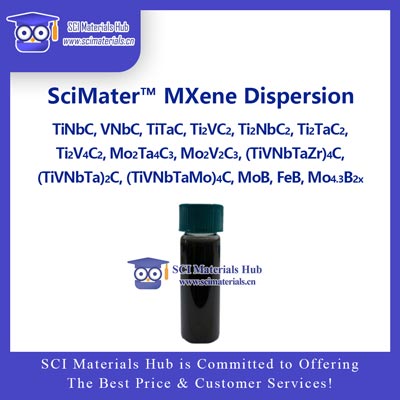
  • Product Code:TiNbC, VNbC, TiTaC, Ti2VC2, Ti2NbC2, Ti2TaC2, Ti2V4C2, Mo2Ta4C3, Mo2V2C3, (TiVNbTaZr)4C, (TiVNbTa)2C, (TiVNbTaMo)4C, MoB, FeB, Mo4.3B2x
  • Description:
  • Brand:SciMater™
  • Lead time:Ask for quote
  • Views:
  • Telephone:+86 153-5789-9751; +86 156-0553-2352
  • Keywords:SciMater™ Single-Layer MXene Dispersion (Multi-Metal Series), SCI Materials Hub
SciMater™ TWO-DIMENSIONAL MATERIALS

SciMaterTM Multi-Metal Single-Layer Dispersions

Multi-Metal Two-Dimensional Carbide and Boride Liquid Systems | 2 mg/mL and 5 mg/mL | 15 Catalog Formulas

Single-Layer Dispersions 15 Catalog Formulas 2 mg/mL 5 mg/mL 25–200 mL Options
The SciMater™ multi-metal single-layer dispersion portfolio includes bimetallic carbides, multi-component layered carbides, high-entropy multi-element carbides, and boride dispersion systems. All liquid products are presented under a unified single-layer-dispersion category to reduce powder weighing, pre-wetting, and redispersion steps for film formation, coating, electrode-slurry preparation, and composite processing.

Product Overview

Single-layer dispersions are liquid systems containing predominantly single-layer or relatively thin two-dimensional sheets. They reduce powder weighing, pre-wetting, and redispersion steps and are suitable for direct coating, film formation, electrode-slurry preparation, interface assembly, and composite fabrication.

This portfolio includes multi-metal carbide, high-entropy multi-element carbide, and boride liquid systems. Different catalog formulas may show different elemental compositions, surface chemistry, colloidal stability, oxidation behavior, and interfacial properties. Actual dispersion medium, pH, lateral size, layer-number distribution, surface terminations, viscosity, and batch stability should be confirmed using the relevant technical documentation.

Bimetallic

Bimetallic Carbide Dispersions

Includes TiNbC, VNbC, and TiTaC, each listed at 5 mg/mL.

Multi-Component

Multi-Component and High-Entropy Systems

Includes Ti2VC2, Mo2V2C3, (TiVNbTaZr)4C, and related systems at 5 mg/mL.

Borides

Boride Dispersion Systems

Includes MoB, FeB, and Mo4.3B2x catalog systems at 2 mg/mL.

Concentration and Volume Specifications

Product Concentration
2 mg/mL 5 mg/mL Multi-metal and high-entropy carbide systems are listed at 5 mg/mL; boride systems are listed at 2 mg/mL.
Liquid Volume Options
25 mL 50 mL 100 mL 200 mL All listed single-layer dispersions use these standard volume options.

Core Product Comparison

Material FamilyChemical Formula / ModelProduct FormConcentrationComposition CharacteristicsTypical Research Areas
Bimetallic
Carbides
TiNbCSingle-Layer Dispersion5 mg/mLTi–Nb bimetallic systemElectrochemistry, films, conductive composites, and interfaces
VNbCV–Nb bimetallic systemIon storage, catalysis, sensing, and composites
TiTaCTi–Ta bimetallic systemCatalysis, electrochemistry, films, and interfaces
Multi-Component
Layered Carbides
Ti2VC2Ti–V multi-metal layered systemEnergy storage, electrodes, films, and interface assembly
Ti2NbC2Ti–Nb multi-metal layered systemElectrochemistry, photothermal research, films, and composites
Ti2TaC2Ti–Ta multi-metal layered systemCatalysis, interfacial reactions, films, and composites
Ti2V4C2Ti–V multi-component layered systemStructure, electrochemistry, films, and composites
Mo2Ta4C3Mo–Ta multi-component systemCatalysis, electrochemistry, films, and interfaces
Mo2V2C3Mo–V multi-metal systemCatalysis, energy storage, conductive composites, and assembly
High-Entropy
Multi-Element Carbides
(TiVNbTaZr)4CTi–V–Nb–Ta–Zr five-element systemHigh-entropy interfaces, catalysis, films, and composites
(TiVNbTa)2CTi–V–Nb–Ta four-element systemElectrochemistry, films, sensing, and interfaces
(TiVNbTaMo)4CTi–V–Nb–Ta–Mo five-element systemMulti-element synergy, catalysis, films, and composites
Boride
Dispersion Systems
MoBSingle-Layer Dispersion2 mg/mLMolybdenum-boride systemCatalysis, films, interfaces, and composite research
FeBIron-boride systemMagnetic, catalytic, film, and interface research
Mo4.3B2xMolybdenum-boride catalog-composition systemStructure, catalysis, films, and fundamental materials research

Original labels such as “single-layer solution” and “single-layer dispersion” are presented under the unified term “single-layer dispersion” on this page.

Boride dispersions are not MXenes in the conventional definition of transition-metal carbides, nitrides, and carbonitrides. They are retained here because the source catalog groups them with the broader liquid two-dimensional-material portfolio. The formula “Mo4.3B2x” is also retained as supplied and should be verified against the product label and batch-specific phase, stoichiometry, and characterization data.

Quick Selection Recommendations

Research RequirementRecommended ModelRecommended Processing RouteSelection Rationale
Ti–Nb electrochemistry, conductive films, and interface researchTiNbCFilm coating, electrode preparation, or composite mixingSuitable for Ti–Nb bimetallic interface and conductive-network studies.
V–Nb ion storage, catalysis, sensing, and composite researchVNbCElectrode coating, sensing-layer preparation, or catalyst support processingRecommended for vanadium–niobium systems focused on storage and surface reactions.
Ti–Ta catalysis, electrochemistry, films, and interfacesTiTaCDrop casting, spray coating, film deposition, or composite preparationSuitable for Ti–Ta composition and interface-sensitive research.
Ti–V energy storage, electrode preparation, and interface assemblyTi2VC2Vacuum filtration, electrode coating, or layered composite assemblySupports both electrochemical and two-dimensional interface-processing studies.
Ti–Nb electrochemistry, photothermal films, and compositesTi2NbC2Film deposition, coating, electrode processing, or polymer mixingSuitable for film-based functional and composite research.
Ti–Ta catalysis, interfacial reactions, and thin-film researchTi2TaC2Catalytic coating, interface assembly, or composite-film preparationRecommended for Ta-containing multi-metal interface studies.
Ti–V multi-component structural, electrochemical, and film researchTi2V4C2Confirm formula and phase before film or electrode processingSuitable for composition-focused research after batch formula verification.
Mo–Ta catalysis, electrochemistry, films, and interfacesMo2Ta4C3Catalyst loading, film coating, or composite processingRecommended for Mo–Ta multi-component systems after batch verification.
Mo–V catalysis, energy storage, conductive composites, and assemblyMo2V2C3Electrode preparation, catalytic coating, or composite-film formationSupports Mo–V multi-metal interface and electrochemical studies.
Five-element high-entropy interfaces, catalysis, films, and composites(TiVNbTaZr)4CThin-film deposition, catalytic coating, or composite assemblyProvides a high-entropy five-element system for multi-element synergy research.
Four-element high-entropy electrochemistry, sensing, and interfaces(TiVNbTa)2CElectrode coating, sensing-layer preparation, or film processingSuitable for surface-sensitive high-entropy studies.
Five-element Ti–V–Nb–Ta–Mo catalysis and composite films(TiVNbTaMo)4CCatalytic coating, thin-film formation, or polymer-composite processingRecommended for multi-element synergy and high-interface-area research.
Molybdenum-boride catalysis, films, interfaces, and compositesMoBFilm coating, catalyst loading, or composite mixingChoose when a molybdenum-boride system rather than an MXene is required.
Iron-boride magnetic, catalytic, and film researchFeBMagnetic-film preparation, catalytic coating, or interface studiesSuitable for iron-boride systems with magnetic or catalytic objectives.
Molybdenum-boride composition, structure, catalysis, and fundamental studiesMo4.3B2xVerify stoichiometry and phase before film or catalyst processingUse only after confirming the catalog notation and batch-specific composition.
Final selection should also consider dispersion medium, pH, solids content, viscosity, lateral size, layer-number distribution, surface chemistry, oxidation state, substrate compatibility, coating method, drying conditions, and batch-specific stability.

Typical Applications

01Thin Films and Coatings

Vacuum filtration, drop casting, spray coating, spin coating, and blade coating for two-dimensional functional films.

02Electrochemical Electrodes

Electrode-slurry preparation, active-material composites, and two-dimensional conductive-network construction.

03Multi-Metal Catalysis

Active-component loading, interfacial reactions, and possible multi-metal synergistic effects.

04Polymer Composites

Combination with polymers, carbon materials, metal oxides, and other two-dimensional materials.

05Sensors and Devices

Humidity, gas, biochemical, strain, magnetic, and functional-interface device research.

06Fundamental Materials Research

Dispersion stability, concentration effects, elemental composition, surface chemistry, oxidation, and interfacial behavior.

Instructions for Use

  1. 01 Inspect Before Use Check color, sedimentation, agglomeration, leakage, and container integrity before use. Do not use material showing unexplained severe changes.
  2. 02 Mix Gently Mild sedimentation may be addressed by slow shaking, vortex mixing, stirring, or brief low-power ultrasonication. Avoid prolonged high-power treatment and significant temperature rise.
  3. 03 Adjust Concentration Dilute gradually with a compatible medium according to the experimental requirement, and record the medium, dilution ratio, final concentration, and processing time.
  4. 04 Prepare the Sample Use vacuum filtration, drop casting, spray coating, spin coating, blade coating, electrode-slurry preparation, catalyst loading, or composite mixing as required.
  5. 05 Reseal and Store Reseal immediately after use, protect from light, and minimize air exposure, elevated temperature, and repeated temperature changes.
Do not mix different chemical formulas or concentrations without prior compatibility and stability testing. For comparative experiments, standardize concentration, processing history, film thickness, drying conditions, and test parameters.

Frequently Asked Questions

01Are “single-layer solution” and “single-layer dispersion” classified separately?
No. This page presents all liquid single-layer products under the unified term “single-layer dispersion.” The actual dispersion medium, colloidal state, and composition should still be confirmed using batch-specific data.
02How should I choose between 2 mg/mL and 5 mg/mL?
The concentration should be selected according to target solids content, film thickness, composite ratio, coating method, and processing window. For comparative experiments, standardize the final concentration before evaluating performance.
03Is mild sedimentation normal?
Mild sedimentation may occur in two-dimensional sheet dispersions during storage. Gently shake, stir, vortex, or briefly sonicate the sample and confirm that it returns to a uniform state. Irreversible agglomeration, abnormal precipitation, or significant color change should be evaluated before use.
04Can the dispersions be used directly for film formation?
They may be used for vacuum filtration, drop casting, spray coating, spin coating, and blade coating. Film quality depends on substrate wetting, concentration, viscosity, coating rate, target thickness, drying conditions, and dispersion stability. A small-scale trial is recommended.
05How should single-layer dispersions be stored?
Store sealed and protected from light while minimizing air exposure. Avoid elevated temperature, strong light, and repeated freeze–thaw cycles. Before reuse, inspect color, sedimentation, and dispersion state. Follow batch-specific storage instructions where available.
SciMater™ Multi-Metal Single-Layer Dispersions | Page content is intended for product selection and scientific research reference. Confirm the catalog formula, dispersion medium, concentration, pH, solids content, lateral size, layer-number distribution, surface chemistry, storage conditions, and batch-specific stability before use.

🌍 International Orders & Shipping

📧 Email: contact@scimaterials.cn

📞 WhatsApp & Tel: +86 153-7569-8751

🔗 Place quick orders on our eBay / Amazon / AliExpress stores.

🌐 We ship worldwide via DHL, FedEx, UPS, SF-Express, or other requested carriers.

📦 Bulk quantities with discount available upon request.

💳 Payment methods accepted: Bank Wire Transfer, PayPal, Credit Card (via Taobao), Alipay, WeChat Pay.

Multi-Metal MXene Single-Layer Dispersion Specifications / Price List

Concentrations: 5 mg/mL and 2 mg/mL ' Volumes: 25 mL, 50 mL, 100 mL, and 200 mL

Chemical Formula / ModelProduct FormConcentration25 mL50 mL100 mL200 mL
TiNbCSingle-Layer Dispersion5 mg/mL$200$350$607$1,040
VNbC$200$350$607$1,040
TiTaC$200$350$607$1,040
Ti2VC2$250$397$650$1,080
Ti2NbC2$250$397$650$1,080
Ti2TaC2$250$397$650$1,080
Ti2V4C2$250$397$650$1,080
Mo2Ta4C3$250$397$650$1,080
Mo2V2C3$250$397$650$1,080
(TiVNbTaZr)4C$280$467$720$1,360
(TiVNbTa)2C$280$467$720$1,360
(TiVNbTaMo)4C$280$467$720$1,360
MoB2 mg/mL$280$477$720$1,360
FeB$280$477$720$1,360
Mo4.3B2x$280$477$720$1,360

Partial references citing our materials (from Google Scholar)

Carbon Dioxide Reduction

1. ACS Nano Strain Relaxation in Metal Alloy Catalysts Steers the Product Selectivity of Electrocatalytic CO2 Reduction

The bipolar membrane (Fumasep FBM) in this paper was purchased from SCI Materials Hub, which was used in rechargeable Zn-CO2 battery tests. The authors reported a strain relaxation strategy to determine lattice strains in bimetal MNi alloys (M = Pd, Ag, and Au) and realized an outstanding CO2-to-CO Faradaic efficiency of 96.6% with outstanding activity and durability toward a Zn-CO2 battery.


2. Front. Chem. Boosting Electrochemical Carbon Dioxide Reduction on Atomically Dispersed Nickel Catalyst

In this paper, Vulcan XC-72R was purchased from SCI Materials Hub. Vulcan XC 72R carbon is the most common catalyst support used in the anode and cathode electrodes of Polymer Electrolyte Membrane Fuel Cells (PEMFC), Direct Methanol Fuel Cells (DMFC), Alkaline Fuel Cells (AFC), Microbial Fuel Cells (MFC), Phosphoric Acid Fuel Cells (PAFC), and many more!


3. Adv. Mater. Partially Nitrided Ni Nanoclusters Achieve Energy-Efficient Electrocatalytic CO2 Reduction to CO at Ultralow Overpotential

An AEM membrane (Sustainion X37-50 Grade RT, purchased from SCI Materials Hub) was activated in 1 M KOH for 24 h, washed with ultra-purity water prior to use.


4. Adv. Funct. Mater. Nanoconfined Molecular Catalysts in Integrated Gas Diffusion Electrodes for High-Current-Density CO2 Electroreduction

In this paper (Supporting Information), an anion exchanged membrane (Fumasep FAB-PK-130 obtained from SCI Materials Hub (www.scimaterials.cn)) was used to separate the catholyte and anolyte chambers.

SCI Materials Hub: we also recommend our Fumasep FAB-PK-75 for the use in a flow cell.


5. Appl. Catal. B Efficient utilization of nickel single atoms for CO2 electroreduction by constructing 3D interconnected nitrogen-doped carbon tube network

In this paper, the Nafion 117 membrane was obtained from SCI Materials Hub.


6. Vacuum Modulable Cu(0)/Cu(I)/Cu(II) sites of Cu/C catalysts derived from MOF for highly selective CO2 electroreduction to hydrocarbons

In this paper, Proton exchange membrane (Nafion 117), Nafion D520, and Toray 060 carbon paper were purchased from SCI Materials Hub.


7. National Science Review Confinement of ionomer for electrocatalytic CO2 reduction reaction via efficient mass transfer pathways

An anion exchange membrane (PiperION-A15-HCO3) was obtained from SCI Materials Hub.


8. Catalysis Communications Facilitating CO2 electroreduction to C2H4 through facile regulating {100} & {111} grain boundary of Cu2O

Carbon paper (TGPH060), membrane solution (Nafion D520), and ionic membrane (Nafion N117) were obtained from Wuhu Eryi Material Technology Co., Ltd (a company under SCI Materials Hub).


Batteries

1. J. Mater. Chem. A Blocking polysulfides with a Janus Fe3C/N-CNF@RGO electrode via physiochemical confinement and catalytic conversion for high-performance lithium–sulfur batteries

Graphene oxide (GO) in this paper was obtained from SCI Materials Hub. The authors introduced a Janus Fe3C/N-CNF@RGO electrode consisting of 1D Fe3C decorated N-doped carbon nanofibers (Fe3C/N-CNFs) side and 2D reduced graphene oxide (RGO) side as the free-standing carrier of Li2S6 catholyte to improve the overall electrochemical performance of Li-S batteries.


2. Joule A high-voltage and stable zinc-air battery enabled by dual-hydrophobic-induced proton shuttle shielding

This paper used more than 10 kinds of materials from SCI Materials Hub and the authors gave detailed properity comparsion.

The commercial IEMs of Fumasep FAB-PK-130 and Nafion N117 were obtained from SCI Materials Hub.

Gas diffusion layers of GDL340 (CeTech) and SGL39BC (Sigracet) and Nafion dispersion (Nafion D520) were obtained from SCI Materials Hub.

Zn foil (100 mm thickness) and Zn powder were obtained from the SCI Materials Hub.

Commercial 20% Pt/C, 40% Pt/C and IrO2 catalysts were also obtained from SCI Materials Hub.


3. Journal of Energy Chemistry Vanadium oxide nanospheres encapsulated in N-doped carbon nanofibers with morphology and defect dual-engineering toward advanced aqueous zinc-ion batteries

In this paper, carbon cloth (W0S1011) was obtained from SCI Materials Hub. The flexible carbon cloth matrix guaranteed the stabilization of the electrode and improved the conductivity of the cathode.


4. Energy Storage Materials Defect-abundant commercializable 3D carbon papers for fabricating composite Li anode with high loading and long life

The 3D carbon paper (TGPH060 raw paper) were purchased from SCI Materials Hub.


5. Nanomaterials A Stable Rechargeable Aqueous Zn–Air Battery Enabled by Heterogeneous MoS2 Cathode Catalysts

Nafion D520 (5 wt%), and carbon paper (GDL340) were received from SCI-Materials-Hub.


6. SSRN An Axially Directed Cobalt-Phthalocyanine Covalent Organic Polymer as High-Efficient Bifunctional Catalyst for Zn-Air Battery

Carbon cloth (W0S1011) and other electrochemical consumables required for air cathode were provided by SCI Materials Hub.


Oxygen Reduction Reaction

1. J. Chem. Eng. Superior Efficiency Hydrogen Peroxide Production in Acidic Media through Epoxy Group Adjacent to Co-O/C Active Centers on Carbon Black

In this paper, Vulcan XC 72 carbon black, ion membrane (Nafion N115, 127 μL), Nafion solution (D520, 5 wt%), and carbon paper (AvCarb GDS 2230 and Spectracarb 2050A-1050) were purchased from SCI Materials Hub.


2. Journal of Colloid and Interface Science Gaining insight into the impact of electronic property and interface electrostatic field on ORR kinetics in alloy engineering via theoretical prognostication and experimental validation

The 20 wt% Pt3M (M = Cr, Co, Cu, Pd, Sn, and Ir) were purchased from SCI Materials Hub. This work places emphasis on the kinetics of the ORR concerning Pt3M (M = Cr, Co, Cu, Pd, Sn, and Ir) catalysts, and integrates theoretical prognostication and experimental validation to illuminate the fundamental principles of alloy engineering.


Water Electrolysis

1. International Journal of Hydrogen Energy Gold as an efficient hydrogen isotope separation catalyst in proton exchange membrane water electrolysis

The cathodic catalysts of Pt/C (20 wt%, 2–3 nm) and Au/C (20 wt%, 4–5 nm) were purchased from SCI Materials Hub.


2. Small Science Silver Compositing Boosts Water Electrolysis Activity and Durability of RuO2 in a Proton-Exchange-Membrane Water Electrolyzer

Two fiber felts (0.35 mm thickness, SCI Materials Hub) were used as the porous transport layers at both the cathode and the anode.


3. Advanced Functional Materials Hierarchical Crystalline/Amorphous Heterostructure MoNi/NiMoOx for Electrochemical Hydrogen Evolution with Industry-Level Activity and Stability

Anion-exchange membrane (FAA-3-PK-130) was obtained from SCI Materials Hub website.


Fuel Cells

1. Polymer Sub-two-micron ultrathin proton exchange membrane with reinforced mechanical strength

Gas diffusion electrode (60% Pt/C, Carbon paper) was purchased from SCI Materials Hub.


Characterization

1. Chemical Engineering Journal Electrochemical reconstitution of Prussian blue analogue for coupling furfural electro-oxidation with photo-assisted hydrogen evolution reaction

An Au nanoparticle film was deposited on the total reflecting plane of a single reflection ATR crystal (SCI Materials Hub, Wuhu, China) via sputter coater.

Related Products

We Provide A Broad Range of Materials, Instruments & Solutions in Advanced Science and Technologies About Us
Product consultation
Customer service1
Customer service2
After-sales and technical consultation
Customer service1
Customer service2
WeChat Customer Service

Back to top