

Welcome to the SCI Materials Hub !
Home > PEEK Chromatography Fittings > HPLC Fittings & Connectors > PEEK Tee Fittings and PEEK Cross Fittings

PEEK Tee Fittings and PEEK Cross Fittings

  • Product Code:
  • Description:PEEK Tee Fittings and PEEK Cross Fittings
  • Brand:SCI Materials Hub
  • Lead time:In Stock
  • Views:
  • Telephone:+86 153-5789-9751; +86 156-0553-2352
  • Keywords:PEEK Tee Fittings and PEEK Cross Fittings, SCI Materials Hub
PEEK 3-Way & 4-Way Fluid Fittings | Product Overview
SCI Materials HubPEEK Fluid Fittings

PEEK 3-Way / 4-Way Fluid Fittings

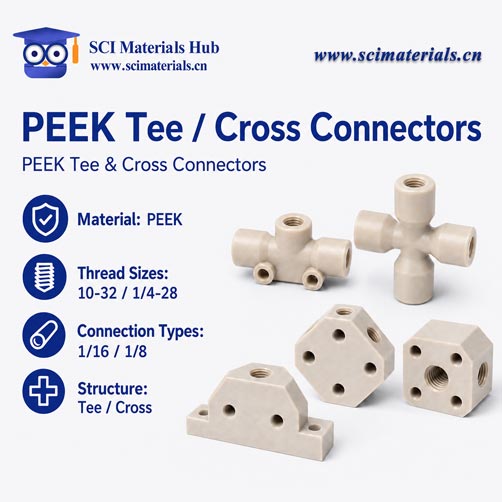
PEEK multi-port fluid fittings for research instruments, compact fluidic systems, sampling, splitting, and combining applications. The series covers 3-port and 4-port configurations, 1/16 and 1/8 tubing, and 10-32 / 1/4-28 interface families for straightforward matching by tubing size, bore, and flow-path geometry.

10 Standard Models3-Way / 4-Way1/16 / 1/8 Tubing0.5–1.5 mm BorePEEK Body

Core Configuration

Body MaterialPEEK
Flow Configuration3-Way / 4-Way
Tubing Size1/16 (1.58 mm) / 1/8 (3.2 mm)
Interface Series10-32 / 1/4-28
Product Overview

Product Overview

Multiple configurations · Easy selection · Built for research fluidics

This series of PEEK 3-way and 4-way fluid fittings is designed for splitting, combining, bypass, sampling, and multi-branch connections in laboratory fluidic systems. Available geometries include T-type, Y-type, square, round, cross, and inline-base configurations, allowing selection around instrument space, tubing direction, and flow-path layout.

Models are available for common 1/16 (1.58 mm) and 1/8 (3.2 mm) tubing systems with bores from 0.5 to 1.5 mm. The PEEK body is suitable for research fluidics where electrical insulation, low metal contact, and chemical compatibility are important. Actual media compatibility, operating temperature, and pressure capability should be confirmed for the complete assembly, including tubing, nuts/ferrules, solvent composition, and operating conditions.

10Standard Models
3 / 4 PortsPort Count
0.5–1.5 mmBore Range
1/161.58 mm Tubing
1/83.2 mm Tubing
PEEKBody Material
Core Features

Core Product Features

Match interface, installation geometry, and bore size efficiently
01

Multiple Flow Geometries

T-type, Y-type, cross, square, and round geometries support different splitting/combining directions and instrument layouts.

02

Two Common Tubing Sizes

Supports both 1/16 and 1/8 tubing systems for analytical instruments, compact reactors, and laboratory fluidic assemblies.

03

Multiple Bore Options

0.5, 0.8, 1.0, and 1.5 mm bores can be selected according to flow rate, pressure-drop, and dead-volume requirements.

04

Non-Metallic PEEK Body

Suitable for research fluidics requiring electrical insulation, low weight, and reduced metal contact; confirm media compatibility for the intended operating conditions.

05

Clear Model Identification

CHST01–CHST09 and CHST-10 cover distinct configurations for clear experimental records, spare-parts management, and repeat ordering.

06

Selection Support

Selection can be reviewed against port count, thread, tubing size, bore, and installation constraints to reduce mismatch risk.

Quick Selection

Quick Selection Filter

Filter by configuration, tubing size, or model keyword
Showing 10 models

CHST01 · T-Type 3-Way

3-Way1/8 (3.2 mm)Bore 1.0 mm

Straight three-port layout for standard fluidic connections; a larger-tubing 3-way fitting suitable for routine splitting and combining.

CHST02 · T-Type 3-Way

3-Way1/16 (1.58 mm)Bore 0.5 mm

Compact geometry for small instrument fluidics; a standard 1/16 3-way fitting for basic splitting and combining.

CHST03 · Offset 3-Way

3-Way1/16 (1.58 mm)Bore 0.5 mm

Offset geometry supports connections in confined spaces and horizontal tubing layouts.

CHST04 · Square 3-Way

3-Way1/8 (3.2 mm)Bore 1.5 mm

Square body with a larger bore, suitable for panel-style fluid routing and higher-flow branch layouts.

CHST05 · Cross 4-Way

4-Way1/16 (1.58 mm)Bore 0.5 mm

Four crossed ports support multi-branch connections, four-way distribution, and cross-flow routing.

CHST06 · Y-Type 3-Way

3-Way1/16 (1.58 mm)Bore 0.8 mm

Y-shaped geometry provides a smoother angled transition for diagonal inlet/outlet routing and fewer sharp turns.

CHST07 · Y-Type 3-Way

3-Way1/8 (3.2 mm)Bore 1.0 mm

Y-type branch for larger tubing, supporting angled three-way connections in 1/8 tubing systems.

CHST08 · Round 3-Way

3-Way1/16 (1.58 mm)Bore 0.5 mm

Round geometry suits circular routing, perimeter tubing layouts, and compact installations.

CHST09 · Square 4-Way

4-Way1/8 (3.2 mm)Bore 1.5 mm

1/8 four-way fitting for larger-flow branches, four-way distribution, and modular fluidic assemblies.

CHST-10 · Inline-Base 3-Way

3-Way1/8 (3.2 mm)Bore 0.8 mm

Inline-base geometry supports horizontal routing and compact installation inside instruments.

Model Comparison

Model Specification Comparison

Compare all standard models by geometry, interface, tubing, bore, and dimensions
ModelConfigurationPortsThread / SeatTubingBoreReference Dimensions
CHST01T-Type 3-Way31/4-28 / Flat-Bottom1/8 (3.2 mm)1.0 mmApprox. 52.5 × 18.7 mm
CHST02T-Type 3-Way310-32 / Cone-Bottom1/16 (1.58 mm)0.5 mmBody width approx. 25.4 mm
CHST03Offset 3-Way310-32UNF / Cone-Bottom1/16 (1.58 mm)0.5 mmApprox. 27.5 / 12.8 / 8.8 mm
CHST04Square 3-Way31/4-28 / Flat-Bottom1/8 (3.2 mm)1.5 mmApprox. 27.5 × 27.5 mm
CHST05Cross 4-Way410-32 / Cone-Bottom1/16 (1.58 mm)0.5 mmOverall width approx. 27.8 mm
CHST06Y-Type 3-Way310-32 / Cone-Bottom1/16 (1.58 mm)0.8 mmCenter width approx. 9.8 mm
CHST07Y-Type 3-Way31/4-28 / Flat-Bottom1/8 (3.2 mm)1.0 mmCenter width approx. 9.8 mm
CHST08Round 3-Way310-32UNF / Cone-Bottom1/16 (1.58 mm)0.5 mmØ24 × 6 mm, boss Ø16 mm
CHST09Square 4-Way41/4-28 / Flat-Bottom1/8 (3.2 mm)1.5 mmApprox. 27.5 × 27.5 mm
CHST-10Inline-Base 3-Way31/4-28UNF / Flat-Bottom1/8 (3.2 mm)0.8 mmApprox. 27.5 / 12.8 / 8.8 mm
Interface Guide

Interface & Specification Guide

Verify the complete interface specification before ordering

1/16 Tubing Series

For tubing with an outer diameter of approximately 1.58 mm, primarily paired with 10-32-type interfaces and cone-bottom seats. Standard models include CHST02, CHST03, CHST05, CHST06, and CHST08.

1/8 Tubing Series

For tubing with an outer diameter of approximately 3.2 mm, primarily paired with 1/4-28-type interfaces and flat-bottom seats. Standard models include CHST01, CHST04, CHST07, CHST09, and CHST-10.

Selection Checklist:
① Tubing OD → ② Thread specification → ③ Flat-bottom / cone-bottom seat → ④ Bore size → ⑤ 3-way / 4-way geometry and port direction. If matching existing nuts, ferrules, or tubing assemblies, provide photos or interface dimensions to help confirm compatibility.
Operating Note:
No single maximum pressure or temperature is specified for the entire series because usable limits depend on the fitting, tubing, seals, media, and assembly condition. For high-pressure, high-temperature, or special-solvent applications, confirm the complete fluidic system before use.
Applications

Applications

Splitting · Combining · Bypass · Sampling · Multi-Branch Connections

Laboratory Fluidic Systems

Connect pumps, valves, reaction cells, reservoirs, and detection modules through three-way or four-way fluid paths.

Analytical & Sampling Lines

Supports bypass lines, sample distribution, pre-/post-mixing routing, and sampling branches in low-flow systems.

Electrochemical System Fluidics

Suitable for peripheral fluid lines where non-metallic fittings or compact routing are preferred.

Micro-Reaction & Transfer

Use different bore sizes and fitting geometries to organize branches and directional changes in confined spaces.

Internal Instrument Connections

Square, round, Y-type, and inline-base geometries support tubing routes that follow instrument architecture.

Teaching & Research Platforms

Clear model identification and intuitive geometry support fluidics demonstrations, research prototypes, and standardized spare-parts management.

Use Guide

Installation & Use Guide

Correct interface matching is more important than excessive tightening
01 Verify the Interface

Confirm that tubing OD, thread specification, and flat-bottom / cone-bottom seat are compatible.

02 Inspect the Tube End

Ensure the tube end is cut square and free of obvious burrs that could affect sealing or flow.

03 Assemble Evenly

Tighten progressively using the compatible nut/ferrule system. Avoid forcing the assembly with excessive torque.

04 Low-Pressure Leak Check

Before the experiment, perform a low-pressure flow and leak check with a compatible medium. Proceed to the intended operating condition only after confirming a secure seal.

FAQ

FAQ

Quick checks before ordering
Can 1/16 and 1/8 models be used interchangeably?

Direct interchange is not recommended. The two tubing systems typically differ in outer diameter, thread, and seat geometry, so select according to the existing tubing and compatible fitting system.

Should I choose a T-type or Y-type 3-way fitting?

T-type fittings suit right-angle branch layouts, while Y-type fittings suit angled routing. If smoother directional transitions or limited installation space are priorities, compare the Y-type geometry first.

Why do 3-way models use different bore sizes?

Bore size influences flow rate, pressure drop, internal volume, and sensitivity to blockage. Select according to pump flow, media properties, and experimental objectives.

Can custom dimensions be requested?

Please provide the interface, tubing size, bore, port direction, and dimensional constraints. Feasibility is subject to a manufacturing review.

Purchase & Technical Support

Purchase & Technical Support

Standard models can be identified directly by CHST number. If your current fluidic interface is uncertain, provide tubing OD, thread, seat type, bore, port direction, and media information so compatibility can be reviewed efficiently.


Marketplace AvailabilityAmazon & eBay availabilitySearch by CHST model or contact us for the appropriate listing
Quotation Emailcontact@scimaterials.cnFor bulk, custom, and project purchases
Online SupportSCI-Materials-HubFor model selection and after-sales support
WhatsApp+86 153 5789 9751International inquiry available
Phone+86 130 0303 8751+86 156 0553 2352
Information for Custom RequestsPort count / tubing size / thread / seat typeBore / flow direction / dimensional constraints / media
Specifications and dimensions shown are intended for model selection. Final compatibility should be confirmed against tubing, threads, ferrules, media, pressure, temperature, and assembly conditions.
PEEK 3-Way & 4-Way Fluid Fittings ' Purchase Channels
PEEK Fluid FittingsCHST Series

PEEK 3-Way / 4-Way Fittings ' Purchasing & Selection

Ten standard models cover 1/16 and 1/8 tubing, 3-way and 4-way configurations, and 0.5–1.5 mm bores. Use the model and price table to narrow your selection, then purchase through major marketplaces or contact us for quotation and technical support.

USD Reference PricingStandard Models AvailableBulk & Custom SupportInteractive Model Filtering

Purchase Overview

10Standard Models
$13Starting Reference Price
1/16 / 1/8Two Common Tubing Sizes
3 / 4 Ports3-Way & 4-Way
Purchase Channels

Purchase Channels

Choose a marketplace or request a direct quotation for project purchasing
01

Amazon Marketplace

For standard-model purchasing, note the CHST model number first and search the marketplace listing that matches your required configuration.

Search Amazon
02

eBay Marketplace

Search by CHST model for international marketplace purchasing. If you need help confirming the correct configuration, contact us before placing an order.

Search eBay
03

Direct Sales & RFQ

Recommended for bulk orders, project procurement, lead-time confirmation, commercial documentation, and custom requirements.

Request a Quote
Model & Price

Model & Price Finder

Filter standard models by port type, tubing size, and USD reference price
Port Type
Tubing
Price Range USD

Filter Options:Combine port type, tubing size, and price filters. If only the table header remains, no standard model matches the selected combination.

ModelConfigurationPortsInterfaceTubingBorePrice USDAction
CHST01T-Type 3-Way3 Ports1/4-28 / Flat-Bottom1/8 (3.2 mm)1.0 mm$15Marketplace
CHST02T-Type 3-Way3 Ports10-32 / Cone-Bottom1/16 (1.58 mm)0.5 mm$13Marketplace
CHST03Offset 3-Way3 Ports10-32UNF / Cone-Bottom1/16 (1.58 mm)0.5 mm$13Marketplace
CHST04Square 3-Way3 Ports1/4-28 / Flat-Bottom1/8 (3.2 mm)1.5 mm$15Marketplace
CHST05Cross 4-Way4 Ports10-32 / Cone-Bottom1/16 (1.58 mm)0.5 mm$32Marketplace
CHST06Y-Type 3-Way3 Ports10-32 / Cone-Bottom1/16 (1.58 mm)0.8 mm$29Marketplace
CHST07Y-Type 3-Way3 Ports1/4-28 / Flat-Bottom1/8 (3.2 mm)1.0 mm$27Marketplace
CHST08Round 3-Way3 Ports10-32UNF / Cone-Bottom1/16 (1.58 mm)0.5 mm$21Marketplace
CHST09Square 4-Way4 Ports1/4-28 / Flat-Bottom1/8 (3.2 mm)1.5 mm$30Marketplace
CHST-10Inline-Base 3-Way3 Ports1/4-28UNF / Flat-Bottom1/8 (3.2 mm)0.8 mm$50Marketplace
Ordering Guide

Ordering Guide

Order by CHST model number to reduce interface mismatch
01 Confirm Tubing Size

First identify whether your fluidic system uses 1/16 (1.58 mm) or 1/8 (3.2 mm) tubing.

02 Confirm the Interface

Verify 10-32 / 1/4-28 threads and cone-bottom / flat-bottom seat geometry rather than relying on appearance alone.

03 Confirm the Flow Configuration

Choose a 3-way or 4-way fitting, then select T-type, Y-type, square, round, or other geometry according to the installation space.

04 Record the Model

Once the CHST model and quantity are confirmed, proceed through a marketplace or send an RFQ for project purchasing.

Custom Support

Bulk & Custom Support

Provide the complete fluidic interface specification for efficient review
Interface DetailsThread specification, flat-bottom / cone-bottom seat, and compatible nut/ferrule type.
Tubing DetailsTubing outer diameter, tubing material, and whether existing tubing components must be matched.
Flow-Path DetailsPort count, bore size, flow direction, and any dead-volume requirements.
Mechanical ConstraintsInstallation space, envelope dimensions, port angle, mounting-hole requirements, and order quantity.
FAQ

Purchasing FAQ

Selection, pricing, ordering, and international procurement
How should I use the listed USD prices?

The table shows integer USD reference prices for standard-model comparison. Final marketplace or quoted pricing may vary with quantity, shipping destination, taxes, availability, and commercial terms.

What is the fastest way to confirm the correct model?

Confirm tubing OD first, then the thread and seat type, and finally choose the 3-way / 4-way configuration and body geometry. The filter above can quickly narrow the standard-model range.

Can bulk orders receive a separate quotation?

Yes. Send the model, quantity, shipping destination, and required commercial documentation to the quotation email for bulk or project-specific pricing.

Can I request a non-standard configuration?

Yes. Provide the tubing size, thread, seat type, bore, port direction, dimensional constraints, and target quantity. Custom feasibility is confirmed after a manufacturing review.

Purchase & Technical Support

Purchase & Technical Support

Standard models can be purchased by CHST model number. For bulk quotations or non-standard configurations, provide tubing OD, thread, seat type, bore, port direction, and quantity so the request can be reviewed efficiently.

Marketplace PurchasingAmazon & eBaySearch by CHST model or request the appropriate listing link
Quotation Emailcontact@scimaterials.cnFor bulk, custom, and project purchasing
Online SupportSCI-Materials-HubFor selection support, application discussion, and after-sales assistance
WhatsApp+86 153 5789 9751International inquiry available
Phone+86 130 0303 8751+86 156 0553 2352
Custom Request ChecklistPorts / tubing / thread / seat / boreFlow direction / dimensional constraints / quantity / media
USD prices shown are reference prices for standard-model comparison. Final price, stock status, shipping cost, and lead time are subject to the selected marketplace listing or formal quotation.
Model copied

Partial references citing our materials (from Google Scholar)


Carbon Dioxide Reduction

1. ACS Nano Strain Relaxation in Metal Alloy Catalysts Steers the Product Selectivity of Electrocatalytic CO2 Reduction

The bipolar membrane (Fumasep FBM) in this paper was purchased from SCI Materials Hub, which was used in rechargeable Zn-CO2 battery tests. The authors reported a strain relaxation strategy to determine lattice strains in bimetal MNi alloys (M = Pd, Ag, and Au) and realized an outstanding CO2-to-CO Faradaic efficiency of 96.6% with outstanding activity and durability toward a Zn-CO2 battery.


2. Front. Chem. Boosting Electrochemical Carbon Dioxide Reduction on Atomically Dispersed Nickel Catalyst

In this paper, Vulcan XC-72R was purchased from SCI Materials Hub. Vulcan XC 72R carbon is the most common catalyst support used in the anode and cathode electrodes of Polymer Electrolyte Membrane Fuel Cells (PEMFC), Direct Methanol Fuel Cells (DMFC), Alkaline Fuel Cells (AFC), Microbial Fuel Cells (MFC), Phosphoric Acid Fuel Cells (PAFC), and many more!


3. Adv. Mater. Partially Nitrided Ni Nanoclusters Achieve Energy-Efficient Electrocatalytic CO2 Reduction to CO at Ultralow Overpotential

An AEM membrane (Sustainion X37-50 Grade RT, purchased from SCI Materials Hub) was activated in 1 M KOH for 24 h, washed with ultra-purity water prior to use.


4. Adv. Funct. Mater. Nanoconfined Molecular Catalysts in Integrated Gas Diffusion Electrodes for High-Current-Density CO2 Electroreduction

In this paper (Supporting Information), an anion exchanged membrane (Fumasep FAB-PK-130 obtained from SCI Materials Hub (www.scimaterials.cn)) was used to separate the catholyte and anolyte chambers.

SCI Materials Hub: we also recommend our Fumasep FAB-PK-75 for the use in a flow cell.


5. Appl. Catal. B Efficient utilization of nickel single atoms for CO2 electroreduction by constructing 3D interconnected nitrogen-doped carbon tube network

In this paper, the Nafion 117 membrane was obtained from SCI Materials Hub.


6. Vacuum Modulable Cu(0)/Cu(I)/Cu(II) sites of Cu/C catalysts derived from MOF for highly selective CO2 electroreduction to hydrocarbons

In this paper, Proton exchange membrane (Nafion 117), Nafion D520, and Toray 060 carbon paper were purchased from SCI Materials Hub.


7. National Science Review Confinement of ionomer for electrocatalytic CO2 reduction reaction via efficient mass transfer pathways

An anion exchange membrane (PiperION-A15-HCO3) was obtained from SCI Materials Hub.


8. Catalysis Communications Facilitating CO2 electroreduction to C2H4 through facile regulating {100} & {111} grain boundary of Cu2O

Carbon paper (TGPH060), membrane solution (Nafion D520), and ionic membrane (Nafion N117) were obtained from Wuhu Eryi Material Technology Co., Ltd (a company under SCI Materials Hub).


Batteries

1. J. Mater. Chem. A Blocking polysulfides with a Janus Fe3C/N-CNF@RGO electrode via physiochemical confinement and catalytic conversion for high-performance lithium–sulfur batteries

Graphene oxide (GO) in this paper was obtained from SCI Materials Hub. The authors introduced a Janus Fe3C/N-CNF@RGO electrode consisting of 1D Fe3C decorated N-doped carbon nanofibers (Fe3C/N-CNFs) side and 2D reduced graphene oxide (RGO) side as the free-standing carrier of Li2S6 catholyte to improve the overall electrochemical performance of Li-S batteries.


2. Joule A high-voltage and stable zinc-air battery enabled by dual-hydrophobic-induced proton shuttle shielding

This paper used more than 10 kinds of materials from SCI Materials Hub and the authors gave detailed properity comparsion.

The commercial IEMs of Fumasep FAB-PK-130 and Nafion N117 were obtained from SCI Materials Hub.

Gas diffusion layers of GDL340 (CeTech) and SGL39BC (Sigracet) and Nafion dispersion (Nafion D520) were obtained from SCI Materials Hub.

Zn foil (100 mm thickness) and Zn powder were obtained from the SCI Materials Hub.

Commercial 20% Pt/C, 40% Pt/C and IrO2 catalysts were also obtained from SCI Materials Hub.


3. Journal of Energy Chemistry Vanadium oxide nanospheres encapsulated in N-doped carbon nanofibers with morphology and defect dual-engineering toward advanced aqueous zinc-ion batteries

In this paper, carbon cloth (W0S1011) was obtained from SCI Materials Hub. The flexible carbon cloth matrix guaranteed the stabilization of the electrode and improved the conductivity of the cathode.


4. Energy Storage Materials Defect-abundant commercializable 3D carbon papers for fabricating composite Li anode with high loading and long life

The 3D carbon paper (TGPH060 raw paper) were purchased from SCI Materials Hub.


5. Nanomaterials A Stable Rechargeable Aqueous Zn–Air Battery Enabled by Heterogeneous MoS2 Cathode Catalysts

Nafion D520 (5 wt%), and carbon paper (GDL340) were received from SCI-Materials-Hub.


6. SSRN An Axially Directed Cobalt-Phthalocyanine Covalent Organic Polymer as High-Efficient Bifunctional Catalyst for Zn-Air Battery

Carbon cloth (W0S1011) and other electrochemical consumables required for air cathode were provided by SCI Materials Hub.


Oxygen Reduction Reaction

1. J. Chem. Eng. Superior Efficiency Hydrogen Peroxide Production in Acidic Media through Epoxy Group Adjacent to Co-O/C Active Centers on Carbon Black

In this paper, Vulcan XC 72 carbon black, ion membrane (Nafion N115, 127 μL), Nafion solution (D520, 5 wt%), and carbon paper (AvCarb GDS 2230 and Spectracarb 2050A-1050) were purchased from SCI Materials Hub.


2. Journal of Colloid and Interface Science Gaining insight into the impact of electronic property and interface electrostatic field on ORR kinetics in alloy engineering via theoretical prognostication and experimental validation

The 20 wt% Pt3M (M = Cr, Co, Cu, Pd, Sn, and Ir) were purchased from SCI Materials Hub. This work places emphasis on the kinetics of the ORR concerning Pt3M (M = Cr, Co, Cu, Pd, Sn, and Ir) catalysts, and integrates theoretical prognostication and experimental validation to illuminate the fundamental principles of alloy engineering.


Water Electrolysis

1. International Journal of Hydrogen Energy Gold as an efficient hydrogen isotope separation catalyst in proton exchange membrane water electrolysis

The cathodic catalysts of Pt/C (20 wt%, 2–3 nm) and Au/C (20 wt%, 4–5 nm) were purchased from SCI Materials Hub.


2. Small Science Silver Compositing Boosts Water Electrolysis Activity and Durability of RuO2 in a Proton-Exchange-Membrane Water Electrolyzer

Two fiber felts (0.35 mm thickness, SCI Materials Hub) were used as the porous transport layers at both the cathode and the anode.


3. Advanced Functional Materials Hierarchical Crystalline/Amorphous Heterostructure MoNi/NiMoOx for Electrochemical Hydrogen Evolution with Industry-Level Activity and Stability

Anion-exchange membrane (FAA-3-PK-130) was obtained from SCI Materials Hub website.


Fuel Cells

1. Polymer Sub-two-micron ultrathin proton exchange membrane with reinforced mechanical strength

Gas diffusion electrode (60% Pt/C, Carbon paper) was purchased from SCI Materials Hub.


Characterization

1. Chemical Engineering Journal Electrochemical reconstitution of Prussian blue analogue for coupling furfural electro-oxidation with photo-assisted hydrogen evolution reaction

An Au nanoparticle film was deposited on the total reflecting plane of a single reflection ATR crystal (SCI Materials Hub, Wuhu, China) via sputter coater.

Related Products

We Provide A Broad Range of Materials, Instruments & Solutions in Advanced Science and Technologies About Us
Product consultation
Customer service1
Customer service2
After-sales and technical consultation
Customer service1
Customer service2
WeChat Customer Service

Back to top