
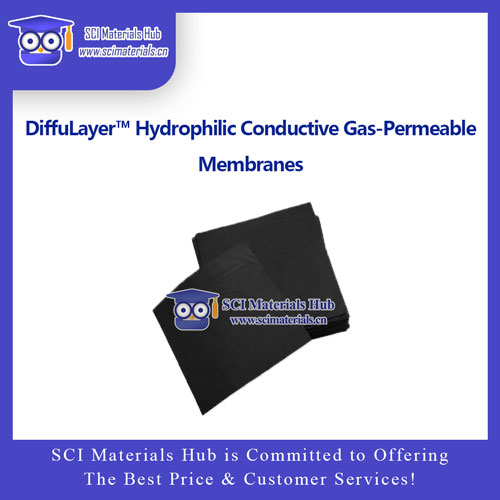
DiffuLayer™ Hydrophilic / Hydrophobic Conductive Waterproof Breathable Membrane Hydrophilic / Hydrophobic Conductive Waterproof Breathable Membrane
A functional membrane series for electrochemistry, air-electrode, gas–liquid interface, and porous conductive-material research. Hydrophilic and hydrophobic surface-wettability options are available. The conductive porous structure can be selected according to requirements for electrolyte wetting, gas transport, interfacial conditions, and electrode architecture.
HYDROPHILIC
HYDROPHOBIC
Product Overview
Built on the same conductive porous-membrane platform with different surface wettability options, enabling direct comparison and selection for gas–liquid interfaces and electrolyte-wetting requirements.
The DiffuLayer™ hydrophilic / hydrophobic conductive waterproof breathable membrane series is designed for research use as a porous conductive functional membrane. Different surface-wettability states provide options for liquid wetting, gas transport, and gas–liquid interface control in electrochemical systems.
The hydrophilic version is better suited to studies requiring liquid contact, electrolyte wetting, or interfacial wetting. The hydrophobic version is intended for cases where excessive liquid intrusion should be limited, gas-transport pathways maintained, or gas–liquid interface balance investigated.
The primary thickness is 0.30 ± 0.02 mm. Selected hydrophobic specifications are also available at 0.50 ± 0.05 mm. Multiple square and rectangular sheet sizes are offered.
How to Choose: Hydrophilic vs. Hydrophobic
The primary difference is surface-wetting behavior. Final selection should be evaluated together with the electrolyte, gas-supply method, and electrode structure.
Hydrophilic Conductive Breathable Membrane
Prioritizes Liquid WettingSuitable for studies focused on liquid contact, electrolyte wetting, electrode-surface wetting, and liquid-phase interfacial transport. It can be used to compare how different wettability states affect electrochemical reaction interfaces.
Hydrophobic Conductive Waterproof Breathable Membrane
Prioritizes Gas PathwaysSuitable for studies involving liquid blocking, retention of gas pathways, gas–liquid interface stability, and mass transport in porous electrodes. It can serve as a material option for experiments balancing gas diffusion and liquid wetting.
Key Features
Conductive Porous Structure
The porous membrane structure supports conductive contact while accommodating research involving gas and liquid transport.
Two Wettability Options
Hydrophilic and hydrophobic versions support comparative studies of different interfacial states.
Multiple Sheet Sizes
Multiple sizes are available, including formats from 100 × 100 mm to 200 × 200 mm.
Research Pack Options
Package quantities include 5, 10, 20, 50, 100, and 500 pcs, depending on the specification.
Core Specifications
Only confirmed product specifications are shown. Performance values such as resistivity, air permeability, and contact angle are not stated when reliable test results have not been provided.
Four-Step Quick Selection
Determine Wettability Requirement
Choose the hydrophilic version when strong liquid wetting is required. Choose the hydrophobic version when limiting liquid intrusion and maintaining gas pathways are more important.
Confirm Thickness
Most standard specifications use 0.30 ± 0.02 mm; selected specifications are also available at 0.50 ± 0.05 mm.
Confirm Size
Select the appropriate square or rectangular format according to electrode area, fixture design, and cutting allowance.
Confirm Quantity
Select the package quantity according to sample screening, parallel experiments, and subsequent batch research.
Specifications & Pricing
Hydrophilic and hydrophobic versions are combined in one specification matrix for direct comparison of size, thickness, package quantity, and selling price.
| Type | Size | Thickness | Package Quantity | Price |
|---|---|---|---|---|
| Hydrophilic | 100 × 100 mm | 0.30 ± 0.02 mm | 20 pcs | ¥150 |
| 50 pcs | ¥342.5 | |||
| 100 pcs | ¥694 | |||
| 500 pcs | ¥2710 | |||
| 150 × 150 mm | 0.30 ± 0.02 mm | 5 pcs | ¥210 | |
| 200 × 200 mm | 0.30 ± 0.02 mm | 10 pcs | ¥390 | |
| 20 pcs | ¥730 | |||
| Hydrophobic | 100 × 100 mm | 0.30 ± 0.02 mm | 20 pcs | ¥150 |
| 50 pcs | ¥342.5 | |||
| 100 pcs | ¥694 | |||
| 500 pcs | ¥2710 | |||
| 100 × 200 mm | 0.50 ± 0.05 mm | 5 pcs | ¥210 | |
| 150 × 150 mm | 0.30 ± 0.02 mm | 5 pcs | ¥210 | |
| 170 × 170 mm | 0.30 ± 0.02 mm | 20 pcs | ¥580 | |
| 195 × 200 mm | 0.30 ± 0.02 mm | 10 pcs | ¥352 | |
| 200 × 200 mm | 0.30 ± 0.02 mm | 10 pcs | ¥390 | |
| 20 pcs | ¥730 |
Typical Research & Applications
Gas Diffusion Electrodes
For investigating the relationship among gas supply, electrolyte wetting, and porous-electrode interfaces.
Metal–Air Batteries
For experimental screening of air-electrode structures, gas–liquid interfaces, and different wettability states.
Electrochemical Interface Research
For studying the effects of wettability, gas transport, and liquid-phase contact on reaction interfaces.
Porous Conductive Materials
Can be used as a research material for porous conductive supports, functional membranes, and composite electrode structures.
Handling & Technical Notes
Experimental Recommendation: For new electrolytes, gas electrodes, or special pressure conditions, begin with a small sample quantity. Verify wettability, gas transport, liquid penetration, conductive contact, and dimensional stability before selecting a final batch specification.
Cutting Recommendation: Use clean, sharp tools for cutting. Avoid creasing, surface contamination, and local over-compression of the porous structure. For experiments requiring controlled gas–liquid interfaces, keep assembly orientation and compression conditions consistent across sample groups.