
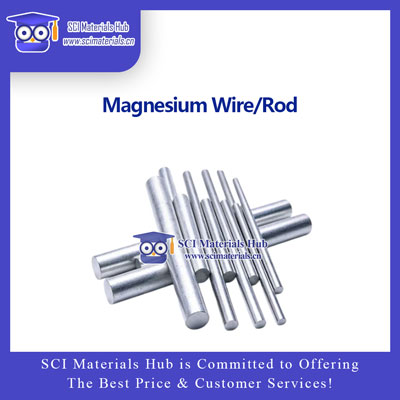
Magnesium Wire / Rod for Research
Designed for materials research, chemistry education, electrochemical experiments, and CNC specimen preparation, with custom fine diameters and standard Φ1–30 mm rods.
Fine and non-standard sizes quoted separately
Product Overview
Multiple sizes · Machinable · Customizable
Magnesium wire and rod are lightweight metallic research materials combining low density, good machinability, and active electrochemical behavior. Standard products are available in diameters from 1 to 30 mm with a length of 100 mm. Fine diameters from 0.4 to 0.9 mm and other custom diameters or lengths are also available. Typical uses include specimen preparation, corrosion studies, surface treatment, electrochemical testing, chemistry demonstrations, and prototyping of small components. Purity, grade, dimensional tolerance, and surface condition are not specified in the available product data and should be confirmed with the supplier before quantitative research or precision machining.
Key Features
Four core product advantages
Wide Diameter Range
Standard Φ1–30 mm rods cover both small specimens and bulk sample machining.
Convenient Fixed Length
The standard 100 mm length simplifies selection, budgeting, and specimen planning.
Custom Sizes Available
Diameters, lengths, quantities, tolerances, and drawing-based parts can be quoted.
Research and Machining Ready
Suitable for weighing, sectioning, grinding, polishing, clamping, and CNC prototyping.
Structure & Technical Specifications
General reference values; batch data should follow the inspection report
Specifications & Sales Prices
Sorted by diameter; low-price items include the specified CNY 10 shipping adjustment
| Diameter (mm) | Length | Diameter Tolerance (mm) | Quantity | Lead Time | Sales Price (CNY) |
|---|---|---|---|---|---|
| Φ1 | 100 mm | Confirm Before Order | 1 pc | 1–3 Days | 80 |
| Φ2 | 100 mm | Confirm Before Order | 1 pc | 1–3 Days | 70 |
| Φ3 | 100 mm | Confirm Before Order | 1 pc | 1–3 Days | 74 |
| Φ4 | 100 mm | Confirm Before Order | 1 pc | 1–3 Days | 82 |
| Φ5 | 100 mm | Confirm Before Order | 1 pc | 1–3 Days | 90 |
| Φ6 | 100 mm | Confirm Before Order | 1 pc | 1–3 Days | 94 |
| Φ8 | 100 mm | Confirm Before Order | 1 pc | 1–3 Days | 98 |
| Φ10 | 100 mm | Confirm Before Order | 1 pc | 1–3 Days | 102 |
| Φ12 | 100 mm | Confirm Before Order | 1 pc | 1–3 Days | 106 |
| Φ14 | 100 mm | Confirm Before Order | 1 pc | 1–3 Days | 108 |
| Φ15 | 100 mm | Confirm Before Order | 1 pc | 1–3 Days | 114 |
| Φ16 | 100 mm | Confirm Before Order | 1 pc | 1–3 Days | 118 |
| Φ18 | 100 mm | Confirm Before Order | 1 pc | 1–3 Days | 122 |
| Φ20 | 100 mm | Confirm Before Order | 1 pc | 1–3 Days | 126 |
| Φ22 | 100 mm | Confirm Before Order | 1 pc | 1–3 Days | 138 |
| Φ25 | 100 mm | Confirm Before Order | 1 pc | 1–3 Days | 150 |
| Φ30 | 100 mm | Confirm Before Order | 1 pc | 1–3 Days | 166 |
Typical Applications
Suitability depends on purity, grade, and experimental conditions
Materials Science
Magnesium-based materials, corrosion behavior, metallography, surface treatment, and mechanical specimen preparation.
Electrochemical Experiments
Magnesium electrodes, reactive materials, and corrosion electrochemistry with controlled area and pretreatment.
Chemistry Education
Demonstration of representative magnesium properties under professional supervision and controlled conditions.
CNC Prototyping
Turning, sectioning, drilling, and small specimen machining with appropriate chip and dust controls.
Lightweight Material Comparison
Density and machinability comparisons between magnesium, aluminum, titanium, and steel.
Custom Experimental Parts
Custom connectors, supports, consumable specimens, and special geometries for research equipment.
How to Use
Confirm → Inspect → Machine → Record
Confirm Requirements
Specify diameter, length, quantity, purity, grade, tolerance, surface condition, and report requirements.
Inspect and Clean
Check deformation and oxidation, then degrease, grind, clean, and dry according to the test protocol.
Cut and Clamp
Use magnesium-compatible tools and parameters, maintain ventilation, and prevent dust accumulation or ignition sources.
Record and Trace
Record batch, dimensions, mass, pretreatment, exposed area, and environmental conditions.
Safety & Storage
Read the supplier SDS and follow institutional safety procedures before use
Store sealed in a dry, cool location away from moisture, heat, sparks, open flames, strong acids, and strong oxidizers. Magnesium chips and dust generated during cutting or grinding present elevated fire and dust-explosion hazards. Use local exhaust ventilation, suitable personal protective equipment, and dedicated cleanup procedures. For a magnesium metal fire, use a Class D extinguishing agent suitable for metal fires or dry sand. Do not apply water, foam, or carbon dioxide directly to burning magnesium.
Product Video
Insert the actual video URL into the iframe data-video-src attribute
Frequently Asked Questions
8 essential questions
1. Is this product magnesium wire or magnesium rod?
Standard Φ1–30 mm × 100 mm products are best described as rods. The custom Φ0.4–0.9 mm range may be supplied as fine wire or rod depending on the required dimensions.
2. What is the product purity?
The available product data do not specify an exact purity or grade. Request batch purity, impurity data, or an inspection report before quantitative research.
3. Can other sizes be customized?
Yes. Provide the required diameter, length, quantity, tolerance, surface condition, and intended use for quotation.
4. Do the listed prices include shipping?
The prices follow the supplied adjustment rule: items originally priced at CNY 100 or below include an additional CNY 10 shipping charge after the stated multiplier is applied.
5. Can it be used as an electrochemical electrode?
It can be used in magnesium-related research, but purity, grade, surface condition, exposed area, and electrolyte compatibility must be confirmed.
6. Should the surface be polished before use?
It depends on the experiment. Surface, electrochemical, and corrosion studies usually require a controlled grinding, cleaning, and drying procedure.
7. How should magnesium rod be machined?
Use magnesium-compatible tools, fixtures, and process parameters. Prevent heat, sparks, and dust accumulation, and manage chips as combustible-metal waste.
8. How should the product be stored?
Store sealed, dry, and cool, away from moisture, acids, strong oxidizers, and ignition sources. Retain batch labels and material identification.