
PTFE Coating
Resistant to acids, alkalis and most organic solvents. The easy-to-clean surface is suitable for routine chemical experiments.


Laboratory Mixing Accessories
Types A, B and C
Featuring a chemically resistant PTFE coating and an encapsulated magnetic core, these stir bars provide stable, low-noise mixing without a mechanical drive shaft contacting the liquid. Multiple sizes support everyday laboratory work with small-volume samples, standard beakers and larger vessels.
Type A, B and C magnetic stir bars are rotors used with laboratory magnetic stirrers. The stirrer generates a rotating magnetic field that drives the bar at the bottom of the vessel, creating liquid flow to improve mass transfer, dissolution and mixing.
Resistant to acids, alkalis and most organic solvents. The easy-to-clean surface is suitable for routine chemical experiments.
Select suitable dimensions for small-volume samples, beakers, reagent bottles and other common laboratory vessels.
Smooth profiles help reduce snagging and magnetic decoupling, supporting continuous stirring under suitable operating conditions.
| Type | Design Features | Recommended Vessels | Typical Uses |
|---|---|---|---|
| Type A | General-purpose cylindrical profile with rounded transitions | Test tubes, sample vials and small beakers | Dissolution, dilution and routine low- to medium-speed stirring |
| Type B | Balanced contact length and magnetic coupling for stable mixing | Beakers, Erlenmeyer flasks and reaction bottles | Buffer preparation, culture media and synthetic reaction mixtures |
| Type C | Longer contact surface with a design intended to improve stability | Larger beakers and flat-bottom vessels | Larger liquid volumes and higher-viscosity mixtures |
| Parameter | Type A | Type B | Type C |
|---|---|---|---|
| Coating Material | PTFE (polytetrafluoroethylene) | PTFE (polytetrafluoroethylene) | PTFE (polytetrafluoroethylene) |
| Internal Structure | Encapsulated magnetic core | Encapsulated magnetic core | Encapsulated magnetic core |
| Available Dimensions | Approximately 3 × 5 mm to 20 × 60 mm | Approximately 3 × 5 mm to 20 × 60 mm | Approximately 3 × 5 mm to 20 × 60 mm |
| Operating Temperature | Suitable for routine heated laboratory stirring. The actual temperature limit depends on the PTFE coating, vessel and stirrer configuration. | ||
| Chemical Compatibility | Resistant to most acids, alkalis, salt solutions and common organic solvents. Verify compatibility before use with strongly oxidizing media or extreme high-temperature conditions. | ||
| Selection Criteria | Consider vessel base area, liquid volume, viscosity and the magnetic field strength of the stirrer. | ||
Dimensions, pack quantities and magnetic grades depend on the selected SKU. Refer to the corresponding product listing and physical label for exact specifications.
Accelerate the dissolution of powders, salts and buffer components while reducing manual shaking.
Maintain uniform mixing during temperature-controlled experiments, dropwise addition and reflux.
Support extraction, dilution, dispersion and sample homogenization before analysis.
First select the length based on vessel base area and liquid volume, then consider viscosity and target speed. Type A is a common starting point for small vessels, Type B suits routine beaker applications, and Type C may be considered for larger volumes or higher-viscosity mixtures.
Common causes include excessive starting speed, an unsuitable bar-to-vessel size match, an off-center vessel or excessive liquid viscosity. Reduce the speed, recenter the vessel and select a more suitable stir bar size.
Rinse with clean water or a cleaning agent compatible with the experimental medium. Wipe gently if necessary and dry thoroughly. Avoid prolonged soaking in incompatible, strongly oxidizing media.
Continued use is not recommended. A damaged coating may expose the magnetic core, contaminate the sample and reduce chemical resistance. Replace the stir bar promptly.
USD Price List · Product Sizes and Pack Options
Taobao Store: 科学材料站 (Science Materials Station)
Taobao: Open Taobao
Phone: +86 130-0303-8751 / +86 156-0553-2352
WeChat: SCI-Materials-Hub
Email for Quotations & Corporate Purchasing: contact@scimaterials.cn
| Product Specification / Pack Size | 5 pcs/pack | 10 pcs/pack | 25 pcs/pack | 50 pcs/pack | 100 pcs/pack |
|---|---|---|---|---|---|
| Type A · 3 × 5 mm | $12 | — | $22 | — | $55 |
| Type A · 3 × 6 mm | $6 | — | $13 | $24 | — |
| Type A · 4 × 8 mm | — | $16 | $22 | — | $55 |
| Type A · 5 × 7 mm | — | $17 | $23 | — | $61 |
| Type A · 5 × 10 mm | — | $17 | $23 | — | $61 |
| Type A · 6 × 8 mm | — | $17 | $23 | — | $61 |
| Type A · 6 × 10 mm | — | $17 | $23 | — | $61 |
| Type A · 7 × 15 mm | — | $15 | $20 | — | $50 |
| Type A · 7 × 18 mm | $8 | — | $19 | $36 | — |
| Type A · 8 × 20 mm | — | $18 | $25 | — | $66 |
| Type A · 9 × 20 mm | — | — | $34 | $56 | $104 |
| Type A · 9 × 25 mm | — | $20 | — | $44 | $77 |
| Type A · 10 × 25 mm | — | $27 | — | $76 | $134 |
| Type A · 10 × 30 mm | — | $36 | — | $89 | $152 |
| Type A · 11 × 20 mm | $11 | $19 | $34 | — | — |
| Type A · 11 × 30 mm | $11 | $19 | $34 | — | — |
| Type A · 12 × 25 mm | $12 | $22 | $42 | — | — |
| Type A · 12 × 30 mm | — | $25 | — | $91 | $168 |
| Type A · 12 × 35 mm | $21 | — | $56 | $93 | — |
| Type A · 13 × 35 mm | — | $47 | — | $126 | $214 |
| Type A · 13 × 40 mm | $15 | $23 | $45 | — | — |
| Type A · 15 × 35 mm | — | $23 | — | $81 | $149 |
| Type A · 15 × 40 mm | — | $48 | — | $128 | $218 |
| Type A · 16 × 45 mm | — | $54 | — | $147 | $251 |
| Type A · 16 × 50 mm | $22 | $41 | $90 | — | — |
| Type A · 16 × 60 mm | $31 | $54 | $135 | — | — |
| Type A · 17 × 50 mm | $39 | $54 | — | $176 | — |
| Type A · 17 × 60 mm | $23 | $39 | $85 | — | — |
| Type A · 18 × 60 mm | $47 | — | $133 | $204 | — |
| Type A · 18 × 62 mm | $45 | $81 | $205 | — | — |
| Type A · 18 × 70 mm | — | $77 | — | $241 | $430 |
| Type A · 20 × 40 mm | $22 | $40 | $86 | — | — |
| Type A · 20 × 45 mm | $23 | $42 | $91 | — | — |
| Type A · 20 × 50 mm | $25 | $42 | $101 | — | — |
| Type A · 20 × 60 mm | $35 | $60 | $147 | — | — |
| Type A · 20 × 70 mm | $55 | $100 | $256 | — | — |
| Type A · 23 × 70 mm | $50 | $89 | — | — | — |
| Type A · 23 × 80 mm | $68 | $117 | — | — | — |
| Type A · 23 × 96 mm | $97 | $169 | — | — | — |
| Type A · 25 × 70 mm | $66 | $101 | $229 | — | — |
| Type A · 25 × 100 mm | $174 | $244 | $625 | — | — |
| Type A · 27 × 100 mm | $103 | $180 | — | — | — |
All prices are in US dollars (USD) per pack. “—” indicates that no price is listed for this pack option. On small screens, scroll the table horizontally to view all pack sizes.
Partial references citing our materials (from Google Scholar)
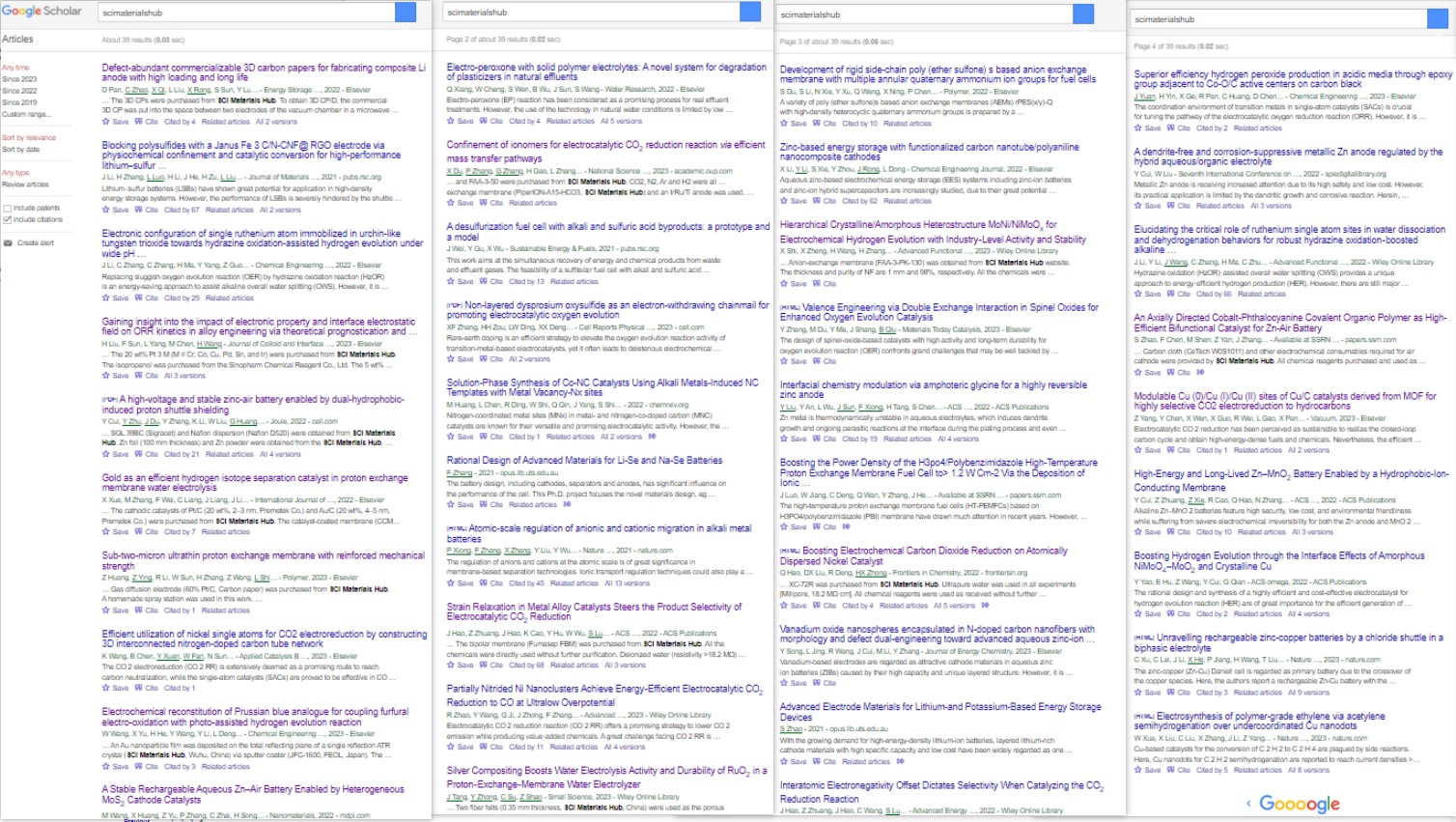
Carbon Dioxide Reduction
1. ACS Nano Strain Relaxation in Metal Alloy Catalysts Steers the Product Selectivity of Electrocatalytic CO2 Reduction
The bipolar membrane (Fumasep FBM) in this paper was purchased from SCI Materials Hub, which was used in rechargeable Zn-CO2 battery tests. The authors reported a strain relaxation strategy to determine lattice strains in bimetal MNi alloys (M = Pd, Ag, and Au) and realized an outstanding CO2-to-CO Faradaic efficiency of 96.6% with outstanding activity and durability toward a Zn-CO2 battery.
2. Front. Chem. Boosting Electrochemical Carbon Dioxide Reduction on Atomically Dispersed Nickel Catalyst
In this paper, Vulcan XC-72R was purchased from SCI Materials Hub. Vulcan XC 72R carbon is the most common catalyst support used in the anode and cathode electrodes of Polymer Electrolyte Membrane Fuel Cells (PEMFC), Direct Methanol Fuel Cells (DMFC), Alkaline Fuel Cells (AFC), Microbial Fuel Cells (MFC), Phosphoric Acid Fuel Cells (PAFC), and many more!
3. Adv. Mater. Partially Nitrided Ni Nanoclusters Achieve Energy-Efficient Electrocatalytic CO2 Reduction to CO at Ultralow Overpotential
An AEM membrane (Sustainion X37-50 Grade RT, purchased from SCI Materials Hub) was activated in 1 M KOH for 24 h, washed with ultra-purity water prior to use.
4. Adv. Funct. Mater. Nanoconfined Molecular Catalysts in Integrated Gas Diffusion Electrodes for High-Current-Density CO2 Electroreduction
In this paper (Supporting Information), an anion exchanged membrane (Fumasep FAB-PK-130 obtained from SCI Materials Hub (www.scimaterials.cn)) was used to separate the catholyte and anolyte chambers.
SCI Materials Hub: we also recommend our Fumasep FAB-PK-75 for the use in a flow cell.
5. Appl. Catal. B Efficient utilization of nickel single atoms for CO2 electroreduction by constructing 3D interconnected nitrogen-doped carbon tube network
In this paper, the Nafion 117 membrane was obtained from SCI Materials Hub.
In this paper, Proton exchange membrane (Nafion 117), Nafion D520, and Toray 060 carbon paper were purchased from SCI Materials Hub.
7. National Science Review Confinement of ionomer for electrocatalytic CO2 reduction reaction via efficient mass transfer pathways
An anion exchange membrane (PiperION-A15-HCO3) was obtained from SCI Materials Hub.
8. Catalysis Communications Facilitating CO2 electroreduction to C2H4 through facile regulating {100} & {111} grain boundary of Cu2O
Carbon paper (TGPH060), membrane solution (Nafion D520), and ionic membrane (Nafion N117) were obtained from Wuhu Eryi Material Technology Co., Ltd (a company under SCI Materials Hub).
Batteries
1. J. Mater. Chem. A Blocking polysulfides with a Janus Fe3C/N-CNF@RGO electrode via physiochemical confinement and catalytic conversion for high-performance lithium–sulfur batteries
Graphene oxide (GO) in this paper was obtained from SCI Materials Hub. The authors introduced a Janus Fe3C/N-CNF@RGO electrode consisting of 1D Fe3C decorated N-doped carbon nanofibers (Fe3C/N-CNFs) side and 2D reduced graphene oxide (RGO) side as the free-standing carrier of Li2S6 catholyte to improve the overall electrochemical performance of Li-S batteries.
This paper used more than 10 kinds of materials from SCI Materials Hub and the authors gave detailed properity comparsion.
The commercial IEMs of Fumasep FAB-PK-130 and Nafion N117 were obtained from SCI Materials Hub.
Gas diffusion layers of GDL340 (CeTech) and SGL39BC (Sigracet) and Nafion dispersion (Nafion D520) were obtained from SCI Materials Hub.
Zn foil (100 mm thickness) and Zn powder were obtained from the SCI Materials Hub.
Commercial 20% Pt/C, 40% Pt/C and IrO2 catalysts were also obtained from SCI Materials Hub.
3. Journal of Energy Chemistry Vanadium oxide nanospheres encapsulated in N-doped carbon nanofibers with morphology and defect dual-engineering toward advanced aqueous zinc-ion batteries
In this paper, carbon cloth (W0S1011) was obtained from SCI Materials Hub. The flexible carbon cloth matrix guaranteed the stabilization of the electrode and improved the conductivity of the cathode.
4. Energy Storage Materials Defect-abundant commercializable 3D carbon papers for fabricating composite Li anode with high loading and long life
The 3D carbon paper (TGPH060 raw paper) were purchased from SCI Materials Hub.
5. Nanomaterials A Stable Rechargeable Aqueous Zn–Air Battery Enabled by Heterogeneous MoS2 Cathode Catalysts
Nafion D520 (5 wt%), and carbon paper (GDL340) were received from SCI-Materials-Hub.
Carbon cloth (W0S1011) and other electrochemical consumables required for air cathode were provided by SCI Materials Hub.
Oxygen Reduction Reaction
1. J. Chem. Eng. Superior Efficiency Hydrogen Peroxide Production in Acidic Media through Epoxy Group Adjacent to Co-O/C Active Centers on Carbon Black
In this paper, Vulcan XC 72 carbon black, ion membrane (Nafion N115, 127 μL), Nafion solution (D520, 5 wt%), and carbon paper (AvCarb GDS 2230 and Spectracarb 2050A-1050) were purchased from SCI Materials Hub.
2. Journal of Colloid and Interface Science Gaining insight into the impact of electronic property and interface electrostatic field on ORR kinetics in alloy engineering via theoretical prognostication and experimental validation
The 20 wt% Pt3M (M = Cr, Co, Cu, Pd, Sn, and Ir) were purchased from SCI Materials Hub. This work places emphasis on the kinetics of the ORR concerning Pt3M (M = Cr, Co, Cu, Pd, Sn, and Ir) catalysts, and integrates theoretical prognostication and experimental validation to illuminate the fundamental principles of alloy engineering.
Water Electrolysis
1. International Journal of Hydrogen Energy Gold as an efficient hydrogen isotope separation catalyst in proton exchange membrane water electrolysis
The cathodic catalysts of Pt/C (20 wt%, 2–3 nm) and Au/C (20 wt%, 4–5 nm) were purchased from SCI Materials Hub.
2. Small Science Silver Compositing Boosts Water Electrolysis Activity and Durability of RuO2 in a Proton-Exchange-Membrane Water Electrolyzer
Two fiber felts (0.35 mm thickness, SCI Materials Hub) were used as the porous transport layers at both the cathode and the anode.
3. Advanced Functional Materials Hierarchical Crystalline/Amorphous Heterostructure MoNi/NiMoOx for Electrochemical Hydrogen Evolution with Industry-Level Activity and Stability
Anion-exchange membrane (FAA-3-PK-130) was obtained from SCI Materials Hub website.
Fuel Cells
1. Polymer Sub-two-micron ultrathin proton exchange membrane with reinforced mechanical strength
Gas diffusion electrode (60% Pt/C, Carbon paper) was purchased from SCI Materials Hub.
Characterization
1. Chemical Engineering Journal Electrochemical reconstitution of Prussian blue analogue for coupling furfural electro-oxidation with photo-assisted hydrogen evolution reaction
An Au nanoparticle film was deposited on the total reflecting plane of a single reflection ATR crystal (SCI Materials Hub, Wuhu, China) via sputter coater.

|
We Provide A Broad Range of Materials, Instruments & Solutions in Advanced Science and Technologies | About Us |