
Quartz Cuvettes for Quantum Efficiency Measurements
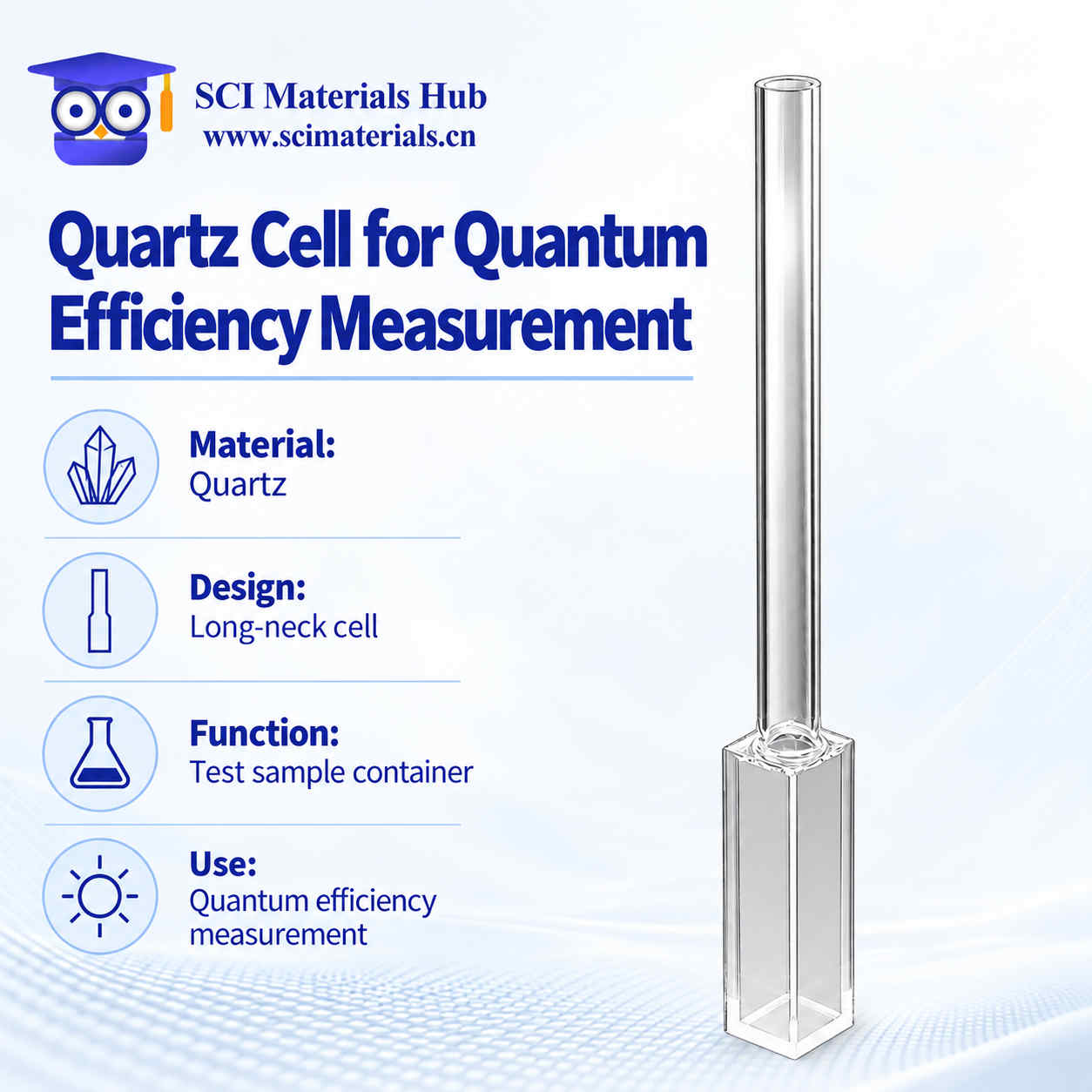
Long-neck quartz cuvettes for quantum efficiency, fluorescence, absorption and luminescence measurements. Options include two-window and four-window optical designs, rounded or flat shoulders, screw-top closures and small-mouth configurations. Select according to the excitation path, emission collection path and instrument sample compartment.
Product Overview
These quartz cuvettes hold liquid samples and provide stable optical channels for excitation and emission. Two-window designs suit transmission measurements along a single direction. Four-window designs support mutually perpendicular excitation and emission collection directions.
Most models have a 10 mm optical path, with a custom 1 mm short-path model also available. The long neck facilitates filling, closure, connections or accommodation within specific instrument chambers. Rounded shoulders, flat shoulders, screw-top closures and small-mouth configurations support different handling requirements.
Confirm beam height, sample compartment space, the required number of optical windows, optical path length, overall length, mouth dimensions, closure type and sample compatibility with quartz and sealing components.
Structure Types
Specification Range
| Type / Specification | Dimensions | Optical Design |
|---|---|---|
| Long-Neck, Rounded-Shoulder, Two-Window | 10 mm Optical Path | Two Windows |
| Long-Neck, Screw-Top UV, Two-Window | 10 mm Optical Path | Two Windows |
| Long-Neck, Custom QY1, Four-Window | 1 mm Optical Path | Four Windows |
| Long-Neck, Rounded-Shoulder, Four-Window | 10 mm Optical Path | Overall Length: 140 mm | Four Windows |
| Long-Neck, Flat-Shoulder, Four-Window | 10 mm Optical Path | Length: 140 mm | Four Windows |
| Long-Neck, Screw-Top Fluorescence, Four-Window | 10 mm Optical Path | Four Windows |
| Long-Neck, Small-Mouth 10–8, Four-Window Custom Order — Contact Customer Service | Confirm Dimensions by Model | Four Windows |
| Long-Neck, Small-Mouth 10–16, Four-Window | Confirm Dimensions by Model | Four Windows |
Product Features
Applications
How to Use
Inspect the Windows
Confirm the cuvette is clean and crack-free, with no visible contamination on optical surfaces.Fill Slowly
Introduce the sample along the inner wall and prevent bubbles from entering the effective optical path.Check Orientation
Align excitation and collection directions according to the two-window or four-window configuration.Measure & Clean
Measure after stable placement, then clean promptly with a compatible solvent.Selection Guide
| Measurement Requirement | Suggested Design | Key Checks |
|---|---|---|
| Single-direction transmission or absorption | Two-window | Optical path and beam height |
| Fluorescence or quantum efficiency | Four-window | Excitation and collection directions |
| Routine liquid measurements | 10 mm optical path | Sample concentration and absorbance |
| Concentrated or strongly absorbing samples | 1 mm optical path QY1 | Sample quantity and instrument compatibility |
| Closure required | Screw-top | Threaded interface and seal compatibility |
| Specified connection interface | Small-mouth 10–8 or 10–16 | Interface dimensions and custom requirements |
Cleaning & Maintenance
Frequently Asked Questions
What is the difference between two-window and four-window designs?
Two-window designs typically use opposing optical windows to form a single transmission path. Four-window designs have four optical faces and support mutually perpendicular excitation and emission collection paths.
Why are four-window quartz cuvettes commonly used for quantum efficiency measurements?
Many fluorescence and quantum efficiency measurements excite the sample from one direction and collect emission from another. Four-window designs facilitate different optical-path arrangements.
How do I choose between 1 mm and 10 mm optical paths?
10 mm is a common optical path length. Consider a 1 mm short path for concentrated, strongly absorbing or limited-volume samples, and validate the choice against the instrument's range and experimental method.
What do small-mouth 10–8 and 10–16 mean?
These are model designations for small-mouth configurations. Confirm the actual mouth, connection and mating dimensions against the instrument interface or experimental equipment before ordering.