Welcome to the SCI Materials Hub !
Home > Metal Fiber Paper > Titanium Fiber Paper > Youveim® E102 NiFeOx - Titanium Fiber Paper Electrode

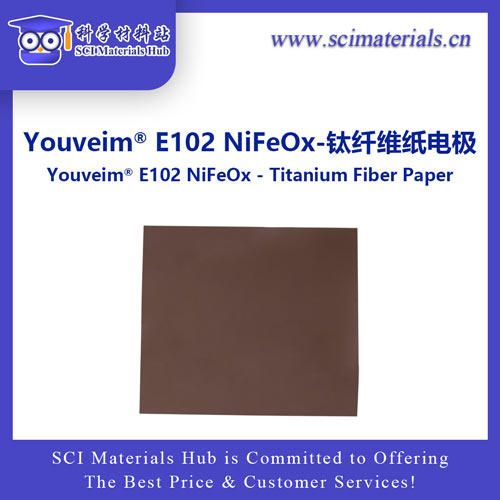
Youveim® E102 NiFeOx - Titanium Fiber Paper Electrode

  • Product Code:E102(SC), E102T(SC), E102PT(SC)
  • Description:Youveim® E102 NiFeOx - Titanium Fiber Paper Electrode
  • Brand:Youveim®
  • Lead time:Ask for quote
  • Views:
  • Telephone:+86 153-5789-9751; +86 156-0553-2352
  • Keywords:Youveim® E102 NiFeOx - Titanium Fiber Paper Electrode, SCI Matyerials Hub
Youveim® E102 Series | NiFeOx on Titanium Fiber Paper
YV Youveim® Engineered Electrodes
Product family: E102 Models: E102N / E102A / E102T Process: Controlled spray coating
Porous Electrode Platform

Youveim® E102 Series NiFeOx-Coated Titanium Fiber Paper Electrodes

The E102 Series combines Accelerate® NiFeOx electrocatalyst with a three-dimensional titanium fiber paper framework. Three binder systems—Nafion, anion-conducting resin, and PTFE—enable targeted control of catalyst-layer adhesion, ion-contact behavior, wettability, and gas–liquid transport for oxygen evolution and water-electrolysis research.

NiFeOx catalyst Porous titanium support Three binder architectures Research-grade electrode
Catalyst
Accelerate® NiFeOx
Non-precious-metal OER catalyst platform
Substrate
Titanium Fiber Paper
Three-dimensional porous conductive network
Core Models
E102N / E102A / E102T
Nafion, anion resin, or PTFE binder
Standard Process
Spray Coating
Controlled catalyst-layer deposition
Section 01

Product Overview

A modular porous-electrode family designed to study how catalyst chemistry, support architecture, and binder selection work together at the electrochemical interface.

Engineered Electrode

Binder-Controlled NiFeOx Electrode Platform

The Youveim® E102 Series is built around a common catalytic and structural foundation: NiFeOx deposited onto a porous titanium fiber paper substrate. The three models differ primarily in binder chemistry, allowing researchers to compare ion-conducting, adhesion, wetting, and gas-release behavior without changing the core catalyst or support platform.

The interconnected titanium fiber network provides an electronically conductive skeleton and mechanically stable catalyst carrier while preserving open pathways for electrolyte access and gas evacuation. The deposited NiFeOx layer creates a high-contact catalytic interface for oxygen-evolution studies in alkaline and related electrochemical environments.

By selecting Nafion, anion-conducting resin, or PTFE, the E102 platform can be adapted for different ion-contact strategies, electrolyte conditions, wetting targets, and electrode-transport studies. This makes the series suitable not only for activity screening, but also for systematic investigations of catalyst-layer design and porous-electrode engineering.

  • Shared NiFeOx catalyst and titanium fiber paper architecture across all three models
  • Model-specific binder chemistry for controlled interface comparison
  • Three-dimensional pathways for electron conduction, electrolyte penetration, and gas release
  • Suitable for laboratory-scale electrolysis, OER, durability, and electrode-structure studies
  • Available with configurable electrode dimensions, catalyst loading, and substrate specifications
Section 02

Electrode Architecture

The E102 architecture integrates catalyst, binder, and a porous titanium framework into one test-ready electrode structure.

Three-Layer Function
Functional Layer Stack
Conceptual illustration—not to scale. Final morphology depends on loading, binder content, substrate grade, and processing conditions.
e−

Electronic Conduction

The interconnected titanium fibers provide a continuous current-collection pathway through the electrode body.

OH

Ion-Contact Control

Binder selection changes how the catalyst layer interacts with the local ionic environment and electrolyte phase.

O₂

Gas Release

Open pore channels support oxygen-bubble transport and reduce blockage of active regions during gas evolution.

3D

Mechanical Support

The porous titanium structure provides a robust carrier for deposited catalyst while retaining permeability.

Section 03

Product Models

E102N, E102A, and E102T use the same catalyst and titanium support. Their key difference is the binder and the corresponding interface behavior.

Three Binder Systems
E102N
NiFeOx / Titanium Fiber Paper
Nafion Binder
Nafion

E102N uses Nafion as the catalyst-layer binder. This formulation is intended for studies where a robust polymer-bound catalyst layer and a Nafion-based ionic contact environment are desired.

Binder
Nafion
Interface
Polymer-bound ion-contact network
Wettability
Hydrophilic / electrolyte-accessible
Research focus
Adhesion, ion contact, interfacial resistance
Best suited for: Nafion-containing catalyst-layer studies, comparative electrode architecture work, and research requiring a strongly bound catalytic coating.
E102A
NiFeOx / Titanium Fiber Paper
Anion-Conducting Resin Binder
Anion Resin

E102A incorporates an anion-conducting resin binder to establish an interface better aligned with alkaline and anion-exchange-membrane research. It is the most directly targeted model for AEM water-electrolysis and alkaline OER interface studies.

Binder
Anion-conducting resin
Interface
Alkaline-oriented ion-contact phase
Wettability
Electrolyte-accessible, binder-dependent
Research focus
AEM electrolysis and alkaline OER
Best suited for: AEM electrolyzer anodes, alkaline oxygen-evolution evaluation, and binder–membrane compatibility studies.
E102T
NiFeOx / Titanium Fiber Paper
PTFE Binder
PTFE

E102T uses PTFE to introduce a more hydrophobic catalyst-layer interface. The design is intended for work focused on controlled wetting, reduced liquid accumulation, bubble detachment, and gas–liquid transport.

Binder
PTFE
Interface
Hydrophobic gas–liquid transport interface
Wettability
Reduced wetting versus ionomer systems
Research focus
Bubble release, flooding control, transport
Best suited for: Gas-evolving electrode studies, high-wetting environments, and experiments where liquid management is a primary variable.
Section 04

Parameter Comparison

Use the table below to compare binder chemistry, ionic environment, wetting tendency, interface behavior, and recommended research direction.

Quick Selection Table
ModelBinder SystemTarget Ionic EnvironmentRelative Wetting TendencyPrimary Interface CharacteristicRecommended Research Direction
E102N
Nafion
Nafion ionomerNafion-associated ion-contact studies; compatibility must be validated for the actual electrolyteGenerally hydrophilic and electrolyte-accessibleStrong polymer binding with continuous catalyst-particle and substrate contactCatalyst-layer adhesion, ion-contact pathways, interfacial resistance, electrode-structure comparison
E102A
Anion Resin
Anion-conducting resinAlkaline and anion-exchange-membrane research environmentsElectrolyte-accessible; depends on resin chemistry and operating conditionAlkaline-oriented ionic interface between catalyst and electrolyte/membrane phaseAEM water electrolysis, alkaline oxygen evolution, anode-interface optimization
E102T
PTFE
PTFEBinder is not selected primarily for ion conduction; electrolyte access occurs through porous pathwaysMore hydrophobic than the ionomer-bound versionsHydrophobic gas–liquid transport interface for wetting and bubble-management studiesGas-evolving electrodes, bubble detachment, flooding control, high-humidity or high-wetting tests
Selection note: Binder type indicates the intended interface architecture; it does not guarantee long-term compatibility with every membrane, electrolyte, temperature, potential, or pressure condition. Validate the full electrode–electrolyte–membrane system before extended operation.
Section 05

Applications & Research Directions

The E102 Series is primarily positioned for alkaline oxygen evolution, water-electrolysis development, and porous-electrode interface research.

Laboratory & Development
01

Alkaline Water Electrolysis

Evaluation of NiFeOx oxygen-evolution activity, electrode polarization, operating stability, and porous-anode behavior in alkaline electrolyte.

02

AEM Water Electrolysis

E102A supports studies of anion-conducting catalyst layers, membrane–electrode contact, local ionic pathways, and anode-interface design.

03

Oxygen Evolution Reaction

Screening of catalytic response, current-density behavior, potential-dependent performance, and durability under selected OER conditions.

04

Wetting & Bubble Management

E102T enables focused experiments on liquid penetration, flooding tendency, bubble detachment, and oxygen-removal pathways.

05

Binder Comparison Studies

Direct comparison of Nafion, anion-conducting resin, and PTFE while maintaining the same catalyst and porous titanium platform.

06

General Porous-Electrode Research

Investigation of catalyst loading, pore accessibility, interfacial resistance, compression, high-current operation, and accelerated durability.

Section 06

Core Materials & Structural Advantages

The E102 platform combines a non-precious-metal catalytic phase with a corrosion-resistant, three-dimensional titanium support.

Catalyst + Support
Accelerate® Catalyst Material

NiFeOx Nickel–Iron Oxide

NiFeOx is widely investigated as a non-precious-metal oxygen-evolution catalyst for alkaline electrochemical systems. Its composition and surface chemistry make it a practical platform for studying OER activity, catalyst utilization, and electrode integration.

  • Designed for alkaline oxygen-evolution research
  • Non-precious-metal catalyst system
  • Suitable for porous-electrode integration
  • Supports comparative binder and interface studies
Youveim® Electrode Substrate

Titanium Fiber Paper

Titanium fiber paper consists of interconnected titanium fibers that create a permeable three-dimensional network. It acts as a conductive support, mechanical framework, catalyst carrier, and transport medium for electrolyte and evolved gas.

  • Continuous three-dimensional conductive structure
  • Open pore network for electrolyte and gas transport
  • Mechanical stability for coated catalyst layers
  • Compatible with multiple binder architectures
Section 07

How to Select the Right Model

Start with the target ionic environment, then evaluate wetting requirements and the interface variable you want to isolate.

Three-Step Guide

Define the electrochemical environment

Identify the electrolyte, membrane chemistry, pH range, temperature, pressure, and expected operating potential.

Choose the desired interface behavior

Select ionomer-based contact for ionic-interface work, or PTFE when wetting and gas-release behavior are the main variables.

Confirm geometry and loading

Match active area, substrate thickness, catalyst loading, compression, and fixture dimensions to the intended test cell.

Choose E102NWhen Nafion-bound catalyst-layer adhesion and ion-contact structure are the primary research variables.
Choose E102AWhen alkaline/AEM ionic compatibility and anion-conducting catalyst-layer behavior are the priority.
Choose E102TWhen hydrophobicity, liquid management, oxygen release, and anti-flooding behavior are the priority.
Section 08

Configurable Product Parameters

Product configuration can be aligned with the intended fixture, active area, loading target, and electrochemical protocol.

Customizable

Electrode Dimensions

Square, rectangular, circular, or fixture-specific cutting can be discussed according to the test platform.

mg

Catalyst Loading

Loading level can be selected for screening, device integration, or high-current-density evaluation.

%

Binder System

Standard model selection is based on Nafion, anion-conducting resin, or PTFE binder architecture.

Substrate Structure

Titanium fiber paper thickness, porosity, and related substrate specifications may be matched to the fixture and compression target.

Coated Area

Full-area or defined active-area coating can be considered based on gasket geometry and current-collector design.

ID

Sample Identification

Model, batch, coating side, dimensions, and requested loading can be documented for experimental traceability.

For a quotation or technical match, provide the target model, electrode dimensions, coated area, catalyst loading, substrate preference, electrolyte/membrane system, operating temperature, and expected current-density range.
Section 09

Technical Application Note

Final performance depends on the complete electrochemical system—not only the catalyst and binder selected for the electrode.

Validation Required
!

System-level compatibility must be verified

NiFeOx is primarily intended for alkaline oxygen-evolution research. The E102N, E102A, and E102T model codes indicate binder and interface architecture; they do not imply universal compatibility or guaranteed durability in every membrane or electrolyte system. Evaluate catalyst-layer adhesion, ion transport, contact resistance, gas removal, corrosion behavior, and long-term stability under the actual electrolyte concentration, temperature, potential, pressure, compression, and operating duration.

Youveim® Engineered Electrode Platform

Integrating catalytic material, porous titanium support, and binder-controlled interface design for water-electrolysis and advanced electrochemical research.

  • Shared NiFeOx catalyst platform
  • Three binder/interface options
  • Configurable dimensions and loading
  • Research and development applications
Youveim® E102 Series — NiFeOx-coated titanium fiber paper electrodes.
Youveim® E102 Series ' Global Purchase Channels
Global Ordering · Research Electrode Platform

Youveim® E102 Series
Global Purchase Channels

Purchase NiFeOx-coated titanium fiber paper electrodes through established international marketplaces. Compare purchasing channels, binder systems, technical parameters, catalyst loadings, electrode dimensions, and integer USD prices in one page.

Where to buy

International Purchase Channels

Select the marketplace that best matches your region, institutional workflow, payment method, and shipping preference. Product availability may differ according to model, catalyst loading, electrode size, destination, and marketplace inventory.

e
Marketplace

eBay

Suitable for international buyers seeking direct marketplace checkout, order records, and cross-border delivery options.

Visit eBay
a
Marketplace

Amazon

Designed for buyers who prefer familiar purchasing workflows, institutional accounts, and region-dependent fulfillment.

Visit Amazon
A
Marketplace

AliExpress

A practical option for cross-border purchasing, product discovery, seller messaging, and international shipping selection.

Visit AliExpress
Video Channel

YouTube

Review product demonstrations, electrode-structure explanations, application guidance, and links to current marketplace listings.

Visit YouTube
Channel selection

Purchase Channel Comparison

ChannelPrimary FunctionOrdering MethodTypical AvailabilityBuyer CommunicationRecommended Buyer
eBayDirect marketplace purchaseStandard listing and checkoutSelected standard sizes and catalyst loadingsMarketplace messagingResearchers and international laboratories
AmazonConvenient marketplace procurementRegional account checkoutRegion-dependent standard configurationsMarketplace order supportBuyers using institutional marketplace accounts
AliExpressCross-border product orderingListing purchase with seller messagingStandard and selected configurable productsDirect seller messagingInternational buyers comparing shipping options
YouTubeProduct education and listing discoveryFollow links in video descriptionsDemonstrations and application referencesComments and linked contact channelsResearchers evaluating products before ordering
Technical overview

Core Product Parameters

Standard Substrate
Youveim® research-grade titanium fiber paper
Upgrade Substrate
Gold-coated titanium fiber paper
Anode Catalyst
Accelerate® NiFeOx, 25–35 nm
Standard Fabrication
Spray-coated catalyst layer
Product selection

Model Parameter Comparison

ModelBinder SystemInterface CharacterKey AdvantageSuggested Research Direction
E102NNafion® binderIon-conductive catalyst-layer interfaceStable catalyst-layer adhesion and continuous ionic contactElectrode-interface studies and general electrochemical research
E102AAnion-conducting ionomerAlkaline and AEM-oriented ionic interfaceImproved compatibility with alkaline oxygen-evolution environmentsAEM water electrolysis and alkaline OER research
E102TPTFE binderHydrophobic gas–liquid transport interfaceImproved gas release and reduced electrode flooding tendencyGas-evolving electrodes and wettability-control research
E102GConfigurableGold-coated titanium fiber paper interfaceEnhanced surface conductivity, oxidation resistance, and electrical-contact stabilityInterface-sensitive, corrosion-focused, and custom electrochemical studies
Standard configurations

Integer USD Price Comparison

The table covers standard E102N, E102A, and E102T configurations. Marketplace prices, shipping charges, taxes, duties, regional fees, and promotional adjustments may differ by destination and channel.

ModelNiFeOx
Loading
1 × 1
cm
2 × 2
cm
3 × 3
cm
4 × 4
cm
5 × 5
cm
10 × 10
cm
20 × 20
cm
E102NNafion® binder1.0 mg/cm²$4$14$28$47$67$233$700
2.0 mg/cm²$5$18$35$58$83$267$800
3.0 mg/cm²$7$25$50$75$100$300$900
4.0 mg/cm²$8$30$60$92$125$400$1,200
E102AAnion-conducting ionomer1.0 mg/cm²$5$15$31$51$73$257$770
2.0 mg/cm²$6$19$39$64$92$293$880
3.0 mg/cm²$7$28$55$83$110$330$990
4.0 mg/cm²$9$33$66$101$138$440$1,320
E102TPTFE binder1.0 mg/cm²$4$14$28$47$67$233$700
2.0 mg/cm²$5$18$35$58$83$267$800
3.0 mg/cm²$7$25$50$75$100$300$900
4.0 mg/cm²$8$30$60$92$125$400$1,200
E102G GOLD-COATED UPGRADE

Custom Quotation Required

E102G uses gold-coated titanium fiber paper and is quoted according to electrode size, catalyst loading, binder selection, substrate specification, production quantity, and destination.

Lead time: Please confirm before ordering.

Standard sizes: 1 × 1 cm, 2 × 2 cm, 3 × 3 cm, 4 × 4 cm, 5 × 5 cm, 10 × 10 cm, and 20 × 20 cm.

Standard catalyst loading: 1.0–4.0 mg/cm².

Custom products: Other sizes, catalyst loadings, binder systems, and electrode configurations are available by quotation.

Volume purchasing: Contact the sales team for project quantities and orders above 3 m².

Procurement workflow

How to Place an Order

01

Select the Model

Choose E102N, E102A, E102T, or request an E102G gold-coated configuration.

02

Confirm Parameters

Select electrode dimensions, NiFeOx loading, binder system, quantity, and destination.

03

Choose a Channel

Use eBay, Amazon, or AliExpress for listed products, or follow verified product links from YouTube.

04

Review Delivery

Confirm availability, shipping method, import requirements, and final order details before payment.

Need a Custom E102 Configuration?

Send the model, size, catalyst loading, binder preference, quantity, and destination for a formal quotation.

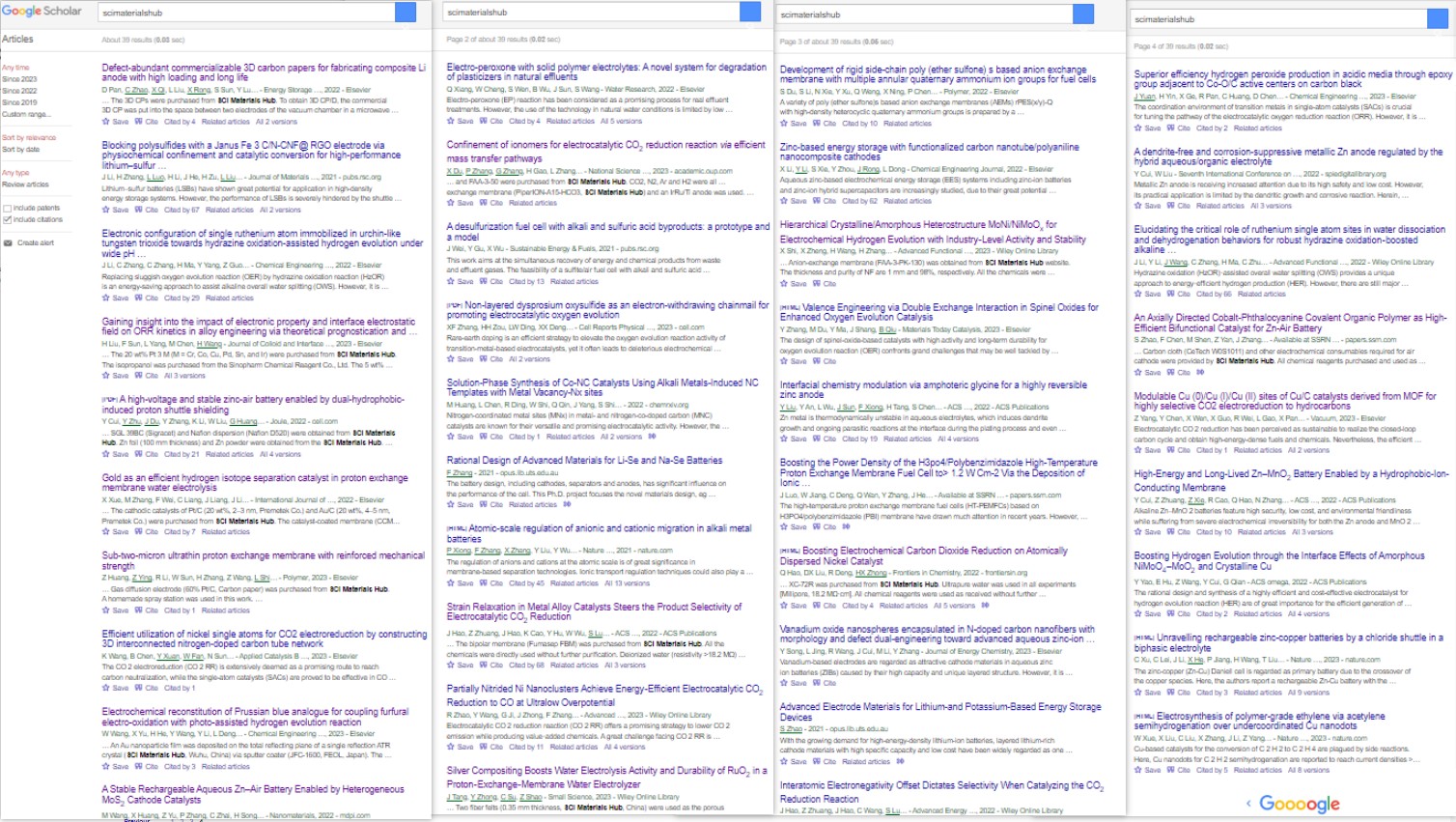
Partial references citing our materials (from Google Scholar)

Carbon Dioxide Reduction

1. ACS Nano Strain Relaxation in Metal Alloy Catalysts Steers the Product Selectivity of Electrocatalytic CO2 Reduction

The bipolar membrane (Fumasep FBM) in this paper was purchased from SCI Materials Hub, which was used in rechargeable Zn-CO2 battery tests. The authors reported a strain relaxation strategy to determine lattice strains in bimetal MNi alloys (M = Pd, Ag, and Au) and realized an outstanding CO2-to-CO Faradaic efficiency of 96.6% with outstanding activity and durability toward a Zn-CO2 battery.


2. Front. Chem. Boosting Electrochemical Carbon Dioxide Reduction on Atomically Dispersed Nickel Catalyst

In this paper, Vulcan XC-72R was purchased from SCI Materials Hub. Vulcan XC 72R carbon is the most common catalyst support used in the anode and cathode electrodes of Polymer Electrolyte Membrane Fuel Cells (PEMFC), Direct Methanol Fuel Cells (DMFC), Alkaline Fuel Cells (AFC), Microbial Fuel Cells (MFC), Phosphoric Acid Fuel Cells (PAFC), and many more!


3. Adv. Mater. Partially Nitrided Ni Nanoclusters Achieve Energy-Efficient Electrocatalytic CO2 Reduction to CO at Ultralow Overpotential

An AEM membrane (Sustainion X37-50 Grade RT, purchased from SCI Materials Hub) was activated in 1 M KOH for 24 h, washed with ultra-purity water prior to use.


4. Adv. Funct. Mater. Nanoconfined Molecular Catalysts in Integrated Gas Diffusion Electrodes for High-Current-Density CO2 Electroreduction

In this paper (Supporting Information), an anion exchanged membrane (Fumasep FAB-PK-130 obtained from SCI Materials Hub (www.scimaterials.cn)) was used to separate the catholyte and anolyte chambers.

SCI Materials Hub: we also recommend our Fumasep FAB-PK-75 for the use in a flow cell.


5. Appl. Catal. B Efficient utilization of nickel single atoms for CO2 electroreduction by constructing 3D interconnected nitrogen-doped carbon tube network

In this paper, the Nafion 117 membrane was obtained from SCI Materials Hub.


6. Vacuum Modulable Cu(0)/Cu(I)/Cu(II) sites of Cu/C catalysts derived from MOF for highly selective CO2 electroreduction to hydrocarbons

In this paper, Proton exchange membrane (Nafion 117), Nafion D520, and Toray 060 carbon paper were purchased from SCI Materials Hub.


7. National Science Review Confinement of ionomer for electrocatalytic CO2 reduction reaction via efficient mass transfer pathways

An anion exchange membrane (PiperION-A15-HCO3) was obtained from SCI Materials Hub.


8. Catalysis Communications Facilitating CO2 electroreduction to C2H4 through facile regulating {100} & {111} grain boundary of Cu2O

Carbon paper (TGPH060), membrane solution (Nafion D520), and ionic membrane (Nafion N117) were obtained from Wuhu Eryi Material Technology Co., Ltd (a company under SCI Materials Hub).


Batteries

1. J. Mater. Chem. A Blocking polysulfides with a Janus Fe3C/N-CNF@RGO electrode via physiochemical confinement and catalytic conversion for high-performance lithium–sulfur batteries

Graphene oxide (GO) in this paper was obtained from SCI Materials Hub. The authors introduced a Janus Fe3C/N-CNF@RGO electrode consisting of 1D Fe3C decorated N-doped carbon nanofibers (Fe3C/N-CNFs) side and 2D reduced graphene oxide (RGO) side as the free-standing carrier of Li2S6 catholyte to improve the overall electrochemical performance of Li-S batteries.


2. Joule A high-voltage and stable zinc-air battery enabled by dual-hydrophobic-induced proton shuttle shielding

This paper used more than 10 kinds of materials from SCI Materials Hub and the authors gave detailed properity comparsion.

The commercial IEMs of Fumasep FAB-PK-130 and Nafion N117 were obtained from SCI Materials Hub.

Gas diffusion layers of GDL340 (CeTech) and SGL39BC (Sigracet) and Nafion dispersion (Nafion D520) were obtained from SCI Materials Hub.

Zn foil (100 mm thickness) and Zn powder were obtained from the SCI Materials Hub.

Commercial 20% Pt/C, 40% Pt/C and IrO2 catalysts were also obtained from SCI Materials Hub.


3. Journal of Energy Chemistry Vanadium oxide nanospheres encapsulated in N-doped carbon nanofibers with morphology and defect dual-engineering toward advanced aqueous zinc-ion batteries

In this paper, carbon cloth (W0S1011) was obtained from SCI Materials Hub. The flexible carbon cloth matrix guaranteed the stabilization of the electrode and improved the conductivity of the cathode.


4. Energy Storage Materials Defect-abundant commercializable 3D carbon papers for fabricating composite Li anode with high loading and long life

The 3D carbon paper (TGPH060 raw paper) were purchased from SCI Materials Hub.


5. Nanomaterials A Stable Rechargeable Aqueous Zn–Air Battery Enabled by Heterogeneous MoS2 Cathode Catalysts

Nafion D520 (5 wt%), and carbon paper (GDL340) were received from SCI-Materials-Hub.


6. SSRN An Axially Directed Cobalt-Phthalocyanine Covalent Organic Polymer as High-Efficient Bifunctional Catalyst for Zn-Air Battery

Carbon cloth (W0S1011) and other electrochemical consumables required for air cathode were provided by SCI Materials Hub.


Oxygen Reduction Reaction

1. J. Chem. Eng. Superior Efficiency Hydrogen Peroxide Production in Acidic Media through Epoxy Group Adjacent to Co-O/C Active Centers on Carbon Black

In this paper, Vulcan XC 72 carbon black, ion membrane (Nafion N115, 127 μL), Nafion solution (D520, 5 wt%), and carbon paper (AvCarb GDS 2230 and Spectracarb 2050A-1050) were purchased from SCI Materials Hub.


2. Journal of Colloid and Interface Science Gaining insight into the impact of electronic property and interface electrostatic field on ORR kinetics in alloy engineering via theoretical prognostication and experimental validation

The 20 wt% Pt3M (M = Cr, Co, Cu, Pd, Sn, and Ir) were purchased from SCI Materials Hub. This work places emphasis on the kinetics of the ORR concerning Pt3M (M = Cr, Co, Cu, Pd, Sn, and Ir) catalysts, and integrates theoretical prognostication and experimental validation to illuminate the fundamental principles of alloy engineering.


Water Electrolysis

1. International Journal of Hydrogen Energy Gold as an efficient hydrogen isotope separation catalyst in proton exchange membrane water electrolysis

The cathodic catalysts of Pt/C (20 wt%, 2–3 nm) and Au/C (20 wt%, 4–5 nm) were purchased from SCI Materials Hub.


2. Small Science Silver Compositing Boosts Water Electrolysis Activity and Durability of RuO2 in a Proton-Exchange-Membrane Water Electrolyzer

Two fiber felts (0.35 mm thickness, SCI Materials Hub) were used as the porous transport layers at both the cathode and the anode.


3. Advanced Functional Materials Hierarchical Crystalline/Amorphous Heterostructure MoNi/NiMoOx for Electrochemical Hydrogen Evolution with Industry-Level Activity and Stability

Anion-exchange membrane (FAA-3-PK-130) was obtained from SCI Materials Hub website.


Fuel Cells

1. Polymer Sub-two-micron ultrathin proton exchange membrane with reinforced mechanical strength

Gas diffusion electrode (60% Pt/C, Carbon paper) was purchased from SCI Materials Hub.


Characterization

1. Chemical Engineering Journal Electrochemical reconstitution of Prussian blue analogue for coupling furfural electro-oxidation with photo-assisted hydrogen evolution reaction

An Au nanoparticle film was deposited on the total reflecting plane of a single reflection ATR crystal (SCI Materials Hub, Wuhu, China) via sputter coater.


Related Products

We Provide A Broad Range of Materials, Instruments & Solutions in Advanced Science and Technologies About Us
Product consultation
Customer service1
Customer service2
After-sales and technical consultation
Customer service1
Customer service2
WeChat Customer Service

Back to top