

Product Introduction
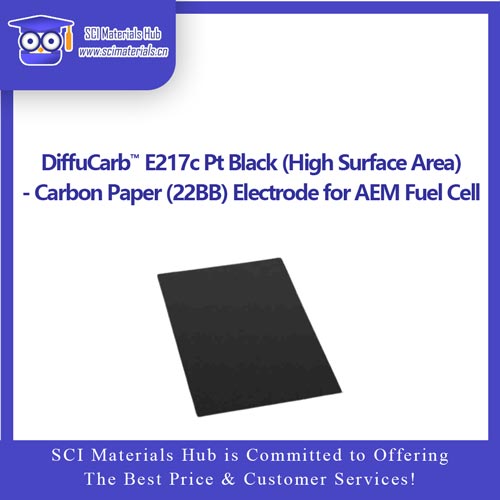
DiffuCarb® E216c and E217c are platinum-based carbon paper electrodes developed for AEMFC / AFC systems. They use SGL 22BB hydrophobic carbon paper as the gas diffusion substrate and include an MPL microporous layer, helping balance gas transport, water removal, and electrode structural stability during fuel cell operation.
E216c uses a platinum/high-surface-area carbon supported catalyst system, emphasizing platinum particle dispersion, platinum utilization, and long-term stability. E217c uses a high-surface-area Pt Black catalyst system, emphasizing initial activity and short-term performance testing. Both electrodes can include optimized post-coat treatment to enhance membrane-electrode interface adhesion and water management.
DiffuCarb® E216c
Pt/high-surface-area carbon carbon paper electrode. Platinum nanoparticles are supported on high-surface-area carbon materials, providing good dispersion and catalytic efficiency. Suitable for AEMFC / AFC testing focused on stability and cost control.
DiffuCarb® E217c
High-surface-area Pt Black carbon paper electrode. Uses a high-surface-area platinum black system with strong initial activity, suitable for short-term performance testing, cathode optimization, and high-activity validation.
Core Features
High-Performance Substrate
SGL 22BB carbon paper contains a hydrophobic PTFE microporous layer, supporting smooth gas diffusion and water removal while providing stable catalyst-layer support.
Premium Platinum-Based Catalysts
E216c uses platinum nanoparticles supported on high-surface-area carbon, while E217c uses a high-surface-area Pt Black catalyst to meet different research requirements.
Post-Coat Ionomer Treatment
Optional anion exchange ionomers such as Fumion®, PiperION®, and NEXIONIC® can be used to enhance catalyst-layer and membrane interface bonding.
Improved Water Management
The combination of MPL, hydrophobic PTFE layer, and post-coated ionomer helps optimize gas transport, water removal, and electrode structural stability.
Dual-Electrode Compatibility
Can be designed for cathode or anode use according to requirements, supporting HOR, ORR, and related electrochemical reaction studies.
Flexible Processing Support
Spray coating, hot pressing, cutting, loading customization, active-area matching, and special electrode structure preparation are available.
Model Comparison Table
| Item | DiffuCarb® E216c Pt/High-Surface-Area Carbon Paper Electrode | DiffuCarb® E217c High-Surface-Area Pt Black Carbon Paper Electrode |
|---|---|---|
| Substrate | SGL 22BB carbon paper with MPL, PTFE treated, hydrophobic | Same as left |
| Catalyst Type | Platinum supported on high-surface-area carbon, including carbon black, CNT, graphene, or other support materials | Pt Black, high-surface-area nanoscale platinum particles |
| Surface Area Advantage | High-surface-area carbon effectively disperses Pt particles, improving catalytic efficiency and platinum utilization | Pt Black itself has ultra-high surface area and provides abundant active sites |
| Electrode Suitability | Suitable for both anode and cathode, for HOR / ORR | More suitable for cathode use, also applicable to anode use |
| Water Management | MPL + hydrophobic PTFE + ionomer post-coat layer | Same as left, balanced structure |
| Electrocatalytic Performance | Better stability, longer life, lower Pt aggregation risk | Strong initial activity, slightly lower long-term stability |
| Cost-Effectiveness | Higher platinum utilization and better cost control | High initial activity, suitable for testing and validation |
| Recommended Loading | 0.02–1.0 mg/cm², customizable | 1–4 mg/cm², customizable |
| Post Coat | Includes Fumion® / PiperION® / NEXIONIC® or other ionomer post-coat treatment | Same as left, used to enhance interface stability |
Post-Coat Treatment Description
E216c and E217c can both include optimized post-coat treatment using anion exchange ionomers such as Fumion®, PiperION®, and NEXIONIC® to further improve the contact condition between the catalyst layer and membrane interface.
Application Directions
AEMFC Cathode / Anode Electrodes
Suitable for cathode ORR or anode HOR electrode research in anion exchange membrane fuel cells.
AFC Cathode / Anode Electrodes
Can be used for hydrogen-oxygen reaction studies and electrode performance validation in alkaline fuel cell systems.
Hydrogen-Oxygen Fuel Cells
Suitable for hydrogen-oxygen fuel cell single-cell testing, MEA preparation, and small-stack validation.
Hydrogen Sensors
Can be used for hydrogen sensing, electrochemical detection, and related gas-reaction platform studies.
Oxygen Reduction Research
Suitable for systematic comparison of ORR catalysts, electrode structures, ionomer systems, and gas diffusion layers.
Laboratory Validation Platforms
Suitable for AEMFC / AFC performance testing and material validation in universities, research institutes, and industrial R&D teams.
Shipping and Service
| Service Item | Description | Note |
|---|---|---|
| Stock Sizes | Common sizes such as 5×5 cm, 10×10 cm, and 20×20 cm are supported | Standard sizes can be confirmed quickly |
| Custom Sizes | Cutting sizes can be customized according to fixtures, single cells, MEAs, or stack structures | Confirmed by drawing or active area |
| Processing Methods | Spray coating, hot pressing, post-coat treatment, and dual-electrode structures are supported | Selected according to experiment goals |
| Supporting Services | MEA matching, electrode-structure design, and testing-scheme suggestions are available | Confirmed according to application conditions |
Supported Customization Options
Product Summary
DiffuCarb® E216c / E217c platinum-based carbon paper electrodes are built on SGL 22BB hydrophobic carbon paper and MPL microporous layers. They are suitable for AEMFC, AFC, hydrogen-oxygen fuel cells, hydrogen sensors, and oxygen reduction research. E216c focuses on platinum utilization, stability, and overall cost-effectiveness, while E217c focuses on high initial activity and performance validation enabled by high-surface-area Pt Black.
Both electrodes can be paired with post-coat ionomer treatment to improve membrane-electrode adhesion, water management, and interface stability. Standard sizes include 5×5 cm, 10×10 cm, and 20×20 cm. Loading density, shape, electrode structure, and ionomer system can also be customized.